MEMORIES OF AN UNKNOWN SOLDIER
Recollections of army service during the 2nd world war
By Neil Hogben
FRONTISPIECE
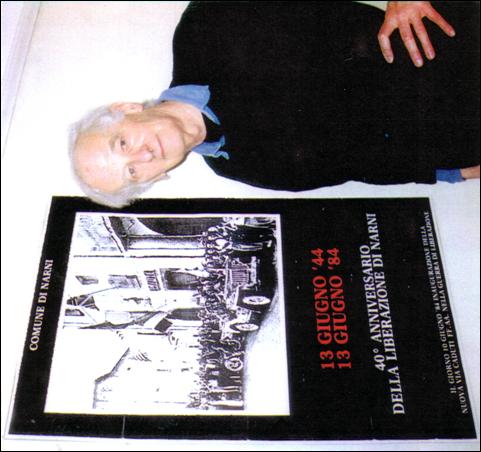
Me photographed in January 1998 with poster commemorating the liberation of Narni
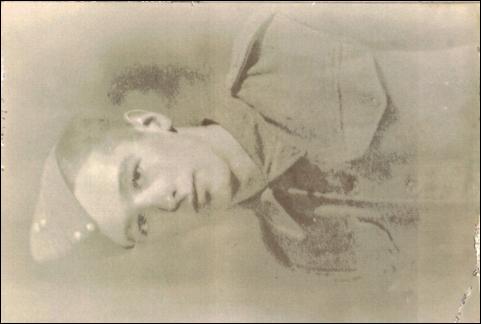
Me photographed in Naples in March 1944
CONTENTS
3. ROBERTVILLE: THE MAILED FIST ADVENTURE BEGINS
8. THE LONG FIGHT BEGINS AT PERUGIA
9. RESISTANCE STIFFENS AT AREZZO
10. A BRIEF RESPITE BESIDE THE RIVER ARNO
11. THE LONG FIGHT TOWARDS FLORENCE
12. ANOTHER BRIEF RESPITE BESIDE THE RIVER ARNO
13. BACK TO CAMPAIGNING NORTH EAST OF FLORENCE
15. RETURNING TO UNIT NORTH OF FLORENCE
16. BACK TO THE FRONT BY THE SANTERNO RIVER
17. WHIP TRACK: NEAR FONTANELICE
18. MOVING TO THE ADRIATIC COAST AT PESARO
20. THE LAST PUSH: NORTH FROM CESENA
21. THE WAR ENDS: NORTH FROM BONDENO THROUGH PADOVA
22. ENTRY INTO AUSTRIA: KLAGENFURT
25. THE MAILED FIST ADVENTURE ENDS NEAR PADOVA
26. HELPING SEND TROOPS HOME: O2E DETACHMENT NAPLES
27. SENDING TROOPS HOME: O2E DETACHMENT MILAN
28. SENDING TROOPS HOME: O2E DETACHMENT VILLACH
TAILPIECE: Farewell to Uniform
POSTSCRIPT: Tank Action at Bondeno
LIST OF ILLUSTRATIONS
|
Fig No |
Caption |
End of Chapter |
|
[1] |
2 |
|
|
[2] |
3 |
|
|
[3] |
3 |
|
|
[4] |
Anti-tank and Tank |
3 |
|
[5] |
3 |
|
|
[6] |
3 |
|
|
[7] |
3 |
|
|
[8] |
4 |
|
|
[9] |
5 |
|
|
[10] |
Some Comrades in Arms a) Sergeant Bert Spanswick in front of No1 gun (Bedford) |
7 |
|
[11] |
7 |
|
|
[12] |
Photographs Taken at the 10th Convalescent Depot in Rome a) Fred Chappell (on left) and myself with a trooper from a tank regiment (name not now known) |
14 |
|
[13] |
15 |
|
|
[14] |
16 |
|
|
[15] |
Whip Track |
17 |
|
[16] |
Wireless Messages as Recorded by Me in Gun |
20 |
|
[17] |
Guns on Tank Transporters (Sketch from Memory 20 years after) |
21 |
|
[18] |
Cover of 8th Army Order of Service with Divisional and Corps Emblems |
21 |
|
[19] |
Photographs of Horses at Bleiburg |
24 |
|
[20] |
27 |
|
|
[21] |
Sketches from O2E Gazette (by me) |
28 |
|
[22] |
Sample Clothing and Equipment Record |
Tailpiece |
|
[23] |
Postscript |
PREFACE
The title of these memoirs refers to my wartime self as an “unknown soldier". This expresses my strong sense that those long ago days were so totally different from the rest of my life that they were experienced by someone else. Although the account was written some 20 years after the war, it is based on notes made at the time. I should add moreover that the drama of the events had such an impact that my memory of them and of my thoughts and emotions remains surprisingly clear even to this day.
It may be helpful to mention here that prior to my time overseas described in the following pages, I served for about a year in England during which I was trained as an artillery signaller. I was in fact called up to the army 4 months after leaving school, aged 19, in July 1942 and enlisted at Milton Barracks Gravesend on the 3rd of December of that year, where I underwent 6 weeks of basic infantry training. I was then posted to the 37th Signal training Regiment, Royal Artillery at Burniston Barracks in Scarborough for 6 months and thence after 6 weeks in an artillery regiment at Alford in Lincolnshire, to the Royal Artillery Grand Depot in Woolwich where the story begins.
N.H. 1997
PREFACE TO THE SECOND EDITION
The level of interest in the original edition of this book prompted the printing of this second edition in which the opportunity has been taken to include the following new material:
Figure 15a
Some photographs from Fontanelice
(Courtesy of Signora Maria Monti)
POSTSCRIPT
An account of a tank action at Bondeno reproduced from the regimental history of the Lothians and Border Horse.
(Courtesy of Mr Kevin Fitzsimons)
N.H. 2004
1. VOYAGE INTO THE UNKNOWN
It all happened 20 years ago. To look back to those times is a strange and wistful feeling. Once it was a great adventure which stirred the imagination as it beckoned from a mysterious future. Then as I moved through those eventful years into a long unknown it was so intensely real. And now that reality can only be seen from a distance ; nothing can ever bring it closer. But that very distance casts for me a powerful spell. Some moments are remembered with such sharpness that it hurts to see how clear they are but how far away. Such a moment occurred on the 11th of November 1943. I was a young artillery man in a crowded mess hall at Woolwich barracks. It was the eve of our departure for an unknown port of embarkation. A mixture of brooding and noisy singing betrayed the nervous excitement of those present. Strange fancies of high seas and battles in far off lands mingled with thoughts of parting beneath the mock normality of a rousing song ('Roll me over in the Clover') which I can still hear ringing across the years from yesterday. A few stirred by the power of the moment stood on the tables and led the singing. It was this that imprinted the scene on my memory.
It was dark when we picked up our kit to march as draft serial REOFY to the station. Nobody sang as we swung through the almost deserted streets. We gave way to our thoughts. At each end of the column a lantern was carried. Those swinging lanterns I can also still see. The journey into active service abroad had begun. As I look back I know what lay ahead. Then I could not know. We didn’t even know the port of embarkation let alone the destination overseas. A few days ago we had drawn tropical kit from the stores but without sun helmets. The previous draft had been given sun helmets and rumour said they were bound for India.
Somehow I could not quite take in the idea that I could actually be about to voyage into such distant lands almost certainly to be launched into the grim realities of front line service in a foreign field. This idea was so completely outside all my experience that I could only think of it with a vague tingling of excitement. But I remember that I was keenly aware that a sudden and inexorable change was about to take place in my life. That overnight the past twenty years would be left behind. Until a year ago school days and home life were the sum total of my existence. This life and all its familiar haunts was about to vanish for a time which stretched unpredictably ahead into the distance.
We boarded a special train which threaded its way by a devious route round to the main line to Glasgow. I remember little of the journey north except the last bit. It must have been near midnight as the train rolled along the banks of the Clyde and at this point my memory becomes quite clear again. I can still see the faces peering from the back windows of houses and waving, wishing luck to the boys on their way to the war. I thought of all the films I had seen with train loads of troops on their way to the front and felt vaguely heroic. As we approached Greenock we could see a convoy of ships standing far out in the Clyde and I felt an extraordinary excitement at the prospect of boarding a troopship. For months with endless delays I had known that I was due for embarkation but had never quite digested that it would actually happen. I had visions of long and boring formalities and even remembered stories of troops turned back at the last minute. But it all happened very quickly. The train pulled into a small station adjoining a quay. We lined up on the platform, picked up our kit and marched onto a waiting tender which was soon steaming out to one of the troopships. From the deck of the tender the Cameronian towering above us as she rode at anchor was an imposing sight. I was filled in that moment with a powerful sense of the drama that was beginning.
On board, wandering through a maze of passageways, clambering down steep ladders into a crowded stuffy hold I still remember clearly how suddenly I felt lonely and trapped, perhaps a little frightened as the reality of the situation replaced the glamour and heroism.
The oppressiveness and sense of claustrophobia as I found myself like a sardine among 300 others in the same hold was aggravated by the fact that the ventilation was not yet working. Confusion reigned. I could not think of sleeping though it was 3 o’clock in the morning. I wondered when we would get our next meal and when our life would begin to find some sort of pattern. Were we to be left to work out our own existence in this sweaty chaos?
The precise sequence of our shipboard life is no longer so sharply imprinted on my memory. I content myself with recording some of the impressions and events which have survived.
It must have been at quite an early stage, maybe even during the first memorable night that the loudspeaker system announced our destination which was Philippeville, a port in French North Africa. This caused a buzz of speculation about what might be in store for us. At this time the fighting in North Africa had ended and the Italian campaign was well under way. Fierce battles were raging round the monastery of Monte Cassino which the Germans had established as a crucial stronghold. So it seemed that we must be bound for some North African reinforcement camp in which to be prepared for despatch to units at the front in Italy.
I believe it was on the same occasion that we were issued with letter forms and told we could write home ( subject to censorship) to say that we were going abroad but not to mention our destination. I can remember how the writing of this letter caused a new and stark awareness of what I was leaving behind without any idea of returning. At this time the adventure had no foreseeable ending and it did not even occur to me to think about the chances of coming back. The prospect of the voyage to North Africa and what might await us there fired my imagination sufficiently however to dispel much of the nostalgia and homesickness.
But this mood of expectancy was considerably frustrated when we discovered that we were to remain in the Clyde for several days before beginning our voyage. We lay at anchor in fact for four days feeling like prisoners in our crowded and uncomfortable quarters. Throughout this tedious period of waiting the ventilating fans were still not working and the atmosphere was almost unbearable.
During the whole of our period on board, our daily routine consisted of 3 meals and 2 boat drills. The drills involved mustering all troops at boat stations on deck, once in the morning and once in the afternoon. Each muster was a parade in which a roll was called and an inspection made of life jackets, emergency rations and other regulation equipment. The opportunity was also taken to make sundry announcements and give briefing on emergency drills. It was compulsory to wear great coats on these drills since, as we were informed, death due to exposure was a greater danger than drowning. Because of the large number of men involved in these drills they usually occupied most of the morning and afternoon and during this time every inch of deck space was packed with troops standing patiently sometimes singing, mostly just waiting.
The remainder of the day was spent down in our stuffy hold or waiting in interminable queues for rations or washing facilities. At meal times we sat at our tables so tightly crowded that we could not put our arms at our sides but had to hold them awkwardly in front of us.
In the evenings preparations for bed began early as there was not much else to do and it was important to stake a claim to a sleeping space in good time. At this point the crowding became most acute. The entire hold space was criss crossed with interlocking hammocks slung from specially provided bars. Every inch of floor and table space was also covered with sleeping bodies.
Most evenings however I was grateful to discover that it was possible to steal up on deck for a short time and to find myself surprisingly usually almost alone on these occasions. These brief escapes into the clear night air were greatly cherished and are among my most vivid memories of the voyage. While we were in the Clyde it was strangely tantalizing to look across to that homeland aware that soon I was to leave it. On one occasion I remember that I watched a signal lamp winking in the distance and being a trained signaller was able to read a message about a mine laying exercise to be conducted that night.
Then at last one morning we awoke to find ourselves well out to sea with no land in sight. We were informed that we were heading for a rendezvous with the rest of the convoy (presumably from Liverpool) somewhere northwest of Ireland. On all sides, other ships could be seen steaming at about 12 knots with a destroyer escort weaving in and out at much greater speed.
During the first day the sea was rough enough to cause widespread seasickness and in the crowded conditions the results were pretty repulsive. I was rather proud to be one of the few unaffected but earned only the doubtful reward of having to help clean up the mess. Emptying buckets through the sluices nearly overcame my resistance!
After the rendezvous we plodded out to the Atlantic on some devious course no doubt designed to evade enemy submarines. We could not know just what route we did take but I suppose we must have sailed quite far west towards Canada as it took about 10 days before we reached Gibraltar which we appeared to approach from the south west.
Those ten days were all much like each other. Boat drills twice a day, eating and sleeping in cramped quarters, queuing endlessly for rations, washing etc, other ships on all sides, destroyers weaving in and out. Each evening I made a brief escape to lean over the rail watching the foam swirl past and thinking of the future. Was it in the Mediterranean only or in the Atlantic too that I saw with fascination a glowing green phosphorescence twinkling in the waters of the bow wave?
From the time of reaching Gibraltar my memory is more vivid. As we approached it the loudspeakers announced our position and informed us that there would be no further practice drills; any further alarms would be the real thing.
We slipped through the straits at night and I remember watching a beacon flash the letters GR in Morse from the direction of the rock whose outline was dimly visible. In the direction of Africa the flickering lights of a town were visible. There appeared to be no ‘black out’ and the movement of traffic could be seen. From the sea it rather resembled the dancing of fireflies, a sight with which I was to become familiar in Italy.
As I watched it occurred to me to wonder what sinister eyes were watching the passage of our convoy which surely must have been visible from both shores. That night I specially remember watching some phosphorescence and some fish weaving along close to our bow.
Next day we were in the Mediterranean which was green and rather rough, the roughest part of the voyage in fact; not at all the way I had pictured the Mediterranean. The coast of Africa remained visible in the distance so our destination must have been getting near.
I think it was early that afternoon that the alarm system sounded ‘Action Stations’ and we knew that some real attack or danger was imminent. There was perhaps a little more than the usual bustle as the much practised drill was enacted. In our hold we had merely to sit with great coats and full equipment including life jackets at our mess tables. Some units had to go up on deck and man anti-aircraft guns and we could hear them clambering up the narrow stairways.
It wasn’t long before the sound of gunfire could be heard and occasionally some heavier explosions, bombs or depth charges maybe. At first there was an uneasy tension. It was frustrating not to be able to see what was happening and faintly disturbing to realise that we were all shut in below the waterline.
There was much noisy talk and presently an enterprising bombardier persuaded someone to play a trumpet and led some singing. I suppose it must have lasted an hour or two during which suspense and a trapped feeling lurked behind the singing, interrupted from time to time by a more than usually heavy explosion. There was one which made the whole ship shudder.
When it was all over, a short account of the action was given over the loudspeaker. We had been attacked by 8 or 9 German aircraft (Focke-Wulfs) using a new type of radio controlled bomb and one ship of the convoy had been sunk. One of the aircraft had been shot down by a gunner on our ship. Later we spoke to some of our men who had manned the guns and seen the whole action and were told that other aircraft were also shot down by fighters.
Late that evening we reached our destination, Philippeville and stood at anchor outside the harbour through the night. Very conscious that the enemy must now know our position we felt rather anxious especially when we observed that Philippeville was without any blackout.
But all was quiet and next morning I was early on deck to be greeted by the pleasing freshness of the sea air so welcome after the stuffy hold and eager for my first clear view of a North African town. It was indeed a fine spectacle with a colourful vista of white buildings, red rooves and the gold speckled green of orange groves.
The Cameronian lay just outside the harbour bar wallowing peacefully at anchor, the throb of the engines stilled at last. The rest of the convoy had left us except for a majestic 2 funnelled ship called the Duchess of Bedford which as I looked was just steaming slowly through the harbour entrance, her rails thronged with soldiery ready to disembark.
Shipboard routine continued as usual that morning until we weighed anchor and began also to head round towards the harbour entrance. Conscious that this was an historic moment I joined the crowd of craning necks and climbed up one of the davits to a point of vantage. It was a most exhilarating experience to be among the throng of eager faces that looked down from the decks of the Cameronian as she steamed proudly into Philippeville harbour.
At this moment the loudspeaker system began to announce the order of debarkation which consisted of a long sequence of serial letter codes each referring to a particular draft of men. Somewhere in the middle came the letters of my draft, REOFY which was to stay on board till the following day. (I still clearly remember those code letters which remained stencilled in large white letters on my kit bag for many years afterwards.
It was not long before we were made fast alongside a quay which lay rather far below the deck on which I stood. I watched with fascination as the disembarkation began. First to go ashore was a draft of Royal Armoured Corps. Heavily laden with full equipment and kit bags on shoulders they looked precarious threading their way down the long steep and narrow gangway hanging down the ship’s side. Some wisely allowed their kit bags to be thrown down onto the quay leaving their hands free to steady themselves.
The operation was smoothly organised and the stream of men in full faultless battle order, like so many toy soldiers, seemed never ending. Each draft as it was completed formed up and marched along the quay into the town. As I watched squad after squad march contentedly away, perfect and complete fighting units, as yet untried, I wondered where they would all end, how many would return to England and when. And for myself what adventure lay ahead? I was filled with curiosity and anticipation. It is so strange to remember that at that time all the memories which now follow had not yet happened.
2. CHATEAUDUN
While the Cameronian disgorged these toy soldiers, the Duchess of Bedford was being loaded. She was a fine looking ship with funnels and superstructure towering over the dingy warehouse under the stern. She was preparing to ferry troops over to Italy.
On Philippeville station next day I talked to some of these troops. Most of them had just come from an artillery depot far up in the mountains called Chateaudun. Some were making their way back from hospital; others had landed in Philippeville about two weeks before from England and were now on their way to join units in Italy. I began to think perhaps it would not be long before I too was on my way and had visions of returning in another fortnights time to embark on a troopship Naples bound.
From my conversations I gathered that Chateaudun was a pretty desolate place and my impatience to be finished with these tedious preliminaries and join a fighting unit was renewed. If I could have foreseen the 10 dreary weeks I was to stay in Chateaudun I would have despaired.
The first day on Philippeville station was a foretaste of the frustrations in store. Our train consisting entirely of cattle trucks was already waiting in the station due to leave in about an hour but the engine was being repaired and indefinite delay was forecast.
The morning passed. Time dragged in spite of entertainment provided by the native fruit hawkers in their exotic robes so strange to my eyes. The corner of the station nearest the town was full of life; noisy haggling for tangerines and the skins littering the ground; occasional angry scenes when offers were rebuffed. Small but aggressive native boys pressed shoeshines on reluctant troops and shouted obscene English phrases. Perhaps they did not know what they meant.
Afternoon came but still no engine. We collected scraps of wood and did some cooking; a drop of tea and some tinned stew. I wondered if life in French North Africa was always so vague and primitive. Everyone seemed quite resigned to the complete uncertainty and makeshift nature of the transport arrangements.
The train finally pulled out of Philippeville as twilight fell. As the cattle truck into which I had been herded lumbered roughly into the African night my mind lapsed into weird speculations, still trying to digest the fact that after all the long waiting I was now finally serving on foreign soil. It quickly became dark and I could not distinguish the passing scenery but that only strengthened the vivid impression of mystery still cloaking my image of the ‘dark continent’. At first I sat with my legs dangling out of an open door drinking in the magic of the night air, and this was one of those sharply remembered moments, almost as clear as yesterday but so long ago. Later we arranged ourselves for sleep as best we could among the piles of baggage.
In the small hours of the morning I woke to find the train had stopped and it was now bitterly cold. Boots and elbows enclosed me on all sides. Harsh reality replaced the dreamlike qualities of the day before. Then with a jerk the train began to rattle and rumble its way up into the Atlas mountains and I dozed fitfully.
When we finally reached Chateaudun at about 6 o’clock in the morning, my legs were numb and weak as I staggered out of the truck. The scene which met our gaze was like some weird projection of the fantastic imaginings of the night before. We saw an other worldly expanse of scrub and cactus clad rock and dust which could have been a moonscape, especially striking in the eerie light of breaking day. The whole atmosphere was dreamlike again but very vivid. As we waited for transport to fetch us we inspected our surroundings and from this time I still carry a fleeting memory of an American soldier sitting on top of a fuel train smoking a cigarette! As I watched he leant into the open hatch of a tanker with his cigarette dangling from his mouth to fill his lighter.
At about 9 o’clock, transport arrived and we trundled across the barren surreal landscape for about 8 miles until we saw a tented camp sprawled across a dusty plateau engulfed in the dusty peaks of the Atlas mountains. This was our destination, the ‘Royal Artillery Transit Depot (RATD) known as Chateaudun, though Chateaudun was in fact the name of the nearest town about 12 miles from the camp. By the time we arrived, the sun had ‘clicked’ over the horizon with disconcerting suddenness and it was now uncomfortably warm.
At the camp, the routine of checking in was the same as in any army station at home or in the remotest outpost. Number, rank, name, religion, civil occupation to be recited, kit checks to be endured and finally heavy kit bags lugged to our quarters which were in this case 160 pounder tents..
In those first days, Chateaudun was for me seen only as a stepping stone towards the reality of war. It fitted quite well my picture of a reinforcement camp and I was deeply impressed by numerous signs and symbols marking the imprint of the 8th army already a name filled with the glamour of its great victory at the battle of El Alamein. The army emblem was a yellow cross on a white shield with a black background and this was to be seen on shoulder badges, trucks and signboards on all sides and also on the shields of a number of 25 pounder guns standing as mute reminders of desert battles whose names were inscribed on them. I was tremendously stirred by all this and wondered whether I should presently be drafted into this historic army.
My curiosity about this was heightened as I mingled with many 8th army soldiers awaiting to return to their units at the front in Italy. No doubt there was much bravado in their talk about life in action but gradually I began to piece together a picture of how it might be. In spite of their lurid stories, most were anxious to return to Italy, to escape the desperate, impersonal boredom of the transit camp and rejoin the comradeship of their units. They admitted however that it was restful to be free from the constant sense of danger, not always alert for the sound of approaching shells.
For the first week we lived a carefree life. Inevitably in such a camp with so many miscellaneous troops passing through, discipline was slack. Parades were almost optional and meal times vague. My chief memory of this time is queuing in the crowded canteens for meals and for tea and cakes or of lounging in the sun. We went to bed early as lights were not strictly allowed in the tents. We learnt many small ways of achieving a degree of primitive comfort. We made candles illegally from cotton waste in mosquito ointment, butter or even boot grease. Petrol lights made from cigarette tins were also common. These were plentiful since we each received a free tin of 50 cigarettes every week.
We also had to learn how to derive the maximum warmth from the three blankets with which we were issued as it always got bitterly cold at nights. I developed my own special way of interleaving the blankets into a well sealed bag, reinforced by a great coat on top and a pair of trousers underneath.
At the end of that first week, I was informed rather to my disgust that I was to be retained in the camp for a course of training as a ‘driver/operator’, a more advanced rank than my present ranking as a ‘driver/signaller’.
At the same time, many of my companions from England were called out for drafting to an unknown destination probably in Italy. I listened wistfully to the catalogue of names then so familiar; men I had come to know through sharing many hardships in the past few weeks moving on again out of my memory; birds of passage, only a few of whom I can now recall with fleeting glimpses. Next morning I watched them climb into the trucks which came to take them away. Their time of waiting was ended. Perhaps tomorrow they would board a troopship at Philippeville. But for me another 8 or 9 weeks of waiting.
Gradually I resigned myself to this dreary prospect and even came to find a certain strange fascination in this new kind of experience. I discovered with some satisfaction that most of the candidates for the training course were drawn from serving units and I mingled with men from all branches of artillery many of whom had operated under battle conditions. The course was interesting and included intensive instruction in the servicing and driving of quite a wide variety of vehicles as well as familiarisation with two new types of wireless set. One of the latter, known as the 19 set (See figure [1]) was in fact later to be operated by me in many battles still undreamed of.
Among the vehicles we learned to drive was the bren carrier, which ran on tracks and was very treacherous to handle. Unknown to me then, this training also was to be put into practice during the battles ahead.
We drove through the most exacting conditions of mud and rough rutted tracks and across deep gullies or wadis. We went out in groups of 3 or 4 in each vehicle taking turns to drive. While waiting for my turn I was often regaled by tales of life in action and my picture of this life gradually became more real. Mostly I rode together with 2 eighth army signallers both drawn from the same unit then serving in Italy. I still remember them quite clearly; the older one, Jock Taylor a Scot of about 40 with a rich dry humour, the younger one, Taffy Williams, a Welshman of about 23. Both had served together from the outbreak of the war and had seen service through France before Dunkirk and North Africa and had many tales to tell. I cannot recall many details but they told about every day life with a fighting unit; how everyone learned to do many jobs, cooking, wireless operating, driving, firing the guns, observing, listening, waiting. These two had spent much time manning wireless sets in observation posts. These are positions usually on high ground, well forward, exposed and isolated, spotting enemy movements and controlling the fire of guns. They had also done much driving across difficult and dangerous country up steep and winding mountain tracks. Their stories were mostly of domestic life in their unit. I learned about the personalities of their officers and the impact of front line conditions on human relations, all told with the wry humour of Jock and the gentle bravado of Taffy. The only detail which has somehow remained in my memories Taffy telling of the first dead German he saw as he came into an observation post and how it made him feel sick. I wonder what those two are doing now.
Slowly the bleakness of Chateaudun became something which I now recall with sharp nostalgia. It was so remote, so other worldly, so charged with the drama of great armies. There was a quality of rarity about my experiences in those weeks which can still stir something deep inside me.
I remember in this way the evening when I was assigned to a duty known as Chateaudun town picket. This picket of half a dozen men was driven to Chateaudun about 12 miles from the camp across the barren dusty landscape and instructed to patrol and police the streets.
It is difficult to explain why I have recalled this as a special memory because there was no great adventure. Perhaps it was partly because I had been in the isolation of the camp long enough that this glimpse of civilization excited me. But more than that it excited me because this town of Chateaudun was so obscure, so different and so far from anything I had ever seen. We walked slowly around the streets in pairs. In the centre of the town was a market bustling with natives in their robes still so strange to my eyes. The outskirts were quiet with large luxurious houses belonging no doubt to the French colonial population. We finished the evening in a bistro and sat listening to some Frenchmen in air force uniforms singing French drinking songs. One of these has stuck in my mind to this day although I never heard it before or since. This song somehow symbolises for me that evening. It was a rare event in a far off place.
On another occasion I was detailed for duty guarding the detention compound, a sinister barbed wire enclosure with some tough and desperate looking cases wandering around inside. Between shifts we talked to some of the permanent guards and heard gruesome tales of the hard discipline which the prisoners had to endure. Shifts of duty were the usual ‘ 2 hours on and 4 hours off’ throughout 24 hours. At night it was bitterly cold, during the day when off duty I dozed fitfully in the hot sun.
Then there were some days when to my amazement it snowed and I recall how pitiful it was to see the few native peasants who wandered near the camp walking around with bare feet in the snow. In general however there was no great sympathy between troops and natives. each regarded the other with deep suspicion and not without reason for there was much ruthlessness and dishonest bargaining and no little stealing on both sides. The natives were all known to us derogatively as ‘wogs’.
Mostly I remember it as hot dry and dusty. On a typical day just after breakfast we would walk slowly the long trek from our tent at one end of the camp to the parade ground of the training centre at the other end about a mile distant. I have a rather special memory about the regimental sergeant major who conducted the morning parade prior to the days training. He was a small cocky Scot (from Argyle and Sutherland Highlanders I believe) and he strutted around with such aggressive swagger. But the supreme thing about him was his voice. In all my army years I never heard an ‘eyes front’ remotely like the one he sent ringing on a powerful descending note from one end of the camp to the other. At the end of the day, came the long trek back to our supper and an evening probably in the canteen or lounging in our tents.
From my tent companions who changed from time to time as drafts came and went I remember only one. He was a bombardier of abut 35 formerly a physical training instructor. What I remember about him chiefly was that he found my attitude to life in the camp to be a huge joke. I think what appealed to him was my flare for laziness and a certain ingenuity in scrounging and devising small comforts. I was always last out of bed in the mornings and frequently missed morning roll call. I remember how he roared with laughter when I arrived back from the cookhouse one evening with a large supply of boxwood tucked under my shirt for lighting the fire in the tent. It was quite a surprise for me to acquire this reputation, so different from the shy schoolboy of only a year ago, and I was rather pleased by it.
Then after about ten weeks of this strange life, the training was completed and we were on stand by for posting to units. A few days later, after supper I heard the now familiar chant of the orderly reading a list of names and numbers for draft. This time my name was there “.... 886 Gunner Hogben.... “. Next day after the routine medical inspection and kit check, we assembled ready to move beside the 3 ton trucks which had come from our future unit to collect us. The unit was in fact the 72nd Anti Tank regiment of the 6th Armoured Division. At last here was something to which I could belong and I felt a strange pride as I studied the white mailed fists on black grounds which were the divisional emblem (See figure [2]) and were neatly painted on each truck. Soon I would sew this badge on the shoulder of my tunic.
There was almost a sense of homecoming as I climbed over the tailboard of the truck. No longer was I to be a stray bird of passage but a fully fledged member of a fighting unit now resting and regrouping near Philippeville, after serving through the gruelling North African campaign.
I think we all breathed a deep sigh of relief as
we finally rolled out of that camp for the last time and watched the long lines
of tents stretched across the dusty plateau fade away down the dusty road.
Farewell to that rare experience in that far off place! And what now?
3. ROBERTVILLE: THE
MAILED FIST ADVENTURE BEGINS
That ride to my regiment in Robertville will never be forgotten. The discomfort of a crowded 3 tonner was lost in awe at the magnificence of the scenery coupled with the strange fancies which the occasion inspired. Though I had been in North Africa for 3 months I had seen very little of the country other than the dreary barren plain and surrounding rocky peaks of Chateaudun. But as the sun burned low, we emerged from this dusty desert into that very remarkable French town of Constantine. The weird beauty of it did not shine in its full glory till we began to roll down the winding mountain roads leading out of town. At this stage I saw through the back of the truck a panorama of inconceivable grandeur. Constantine has been built at a great height and stretches across a rocky gorge reminiscent of the grand canyon ( or so I imagined though I have never seen it). It seems to perch precariously but proudly on this rocky prominence and the bridge which spans the gap looks fragile by comparison with the giddy depths below. Quite recently I came across a sketch from Lord Tedder’s memoirs of this bridge (See figure [3]) ; it evidently impressed him too.
The beauty of the scene was greatly enhanced by the lighting effects produced by the sun which was by now sinking behind the hill on which the town stood. A mist of light of a delicate pale purplish hue seemed to flood the valley which fell away to the right. Meanwhile the town in our rear stood out in an impressive silhouette crowned by a statue which seemed to declare the wonder of the scene.
But still we rushed on down the hill into the gathering night gradually descending from the mountains towards the coastal plain where Robertville, our destination lay.
It was still quite dark when finally we rolled past a white belted sentry at the Regimental headquarters of the 72nd Anti-Tank regiment. I felt sleepy after the long ride but it was not late and after being shown to our tents in 111 Battery, we went down to the canteen for a meal. I contemplated my new home with mixed feelings. There was a pleasant homely feeling among the company assembled in the small Nissen hut, but I felt so much a stranger in their midst. In previous camps it had been easy to settle in with all the others who were also strangers. But here I realised was a small body of men who had no doubt come a long way through many hard experiences together. How long would it be before I could feel a part of them? What fortunes would I share with them?
In the tent that night, a lad from Newcastle, with whom we were to sleep until allotted to troops, treated us to yarns from the battery’s exploits in the North African campaign. He told how his mate had saved a truck and its occupants by achieving some difficult feat of repair under heavy shell fire. He also told that B troop( known as ‘Baker troop’) to which I was later assigned had knocked out the first Mark VI (‘Tiger’) tank of the war in a battle in which they had accounted altogether for 7 German tanks.
Next day I was appointed as wireless operator of No 3 gun in Baker troop. I was introduced to the ‘No 1’ (gun commander) Sergeant Stevens a splendid person for whom I rapidly acquired a great liking and admiration. He was capable, friendly and cool as a cucumber in all situations. I had a look at the gun a self propelled 3 inch naval gun, effectively a tank (See figure [4]) with the code name ‘ Berwick’ painted on the front. This was an American vehicle of a class known as ‘M10’ which was not very common and I had never seen one before. In my training I had been accustomed to towed ‘field guns’ and this tank like monster not unlike a German Mark VI ‘Tiger’ with its long sinister looking gun barrel, was most impressive to me.
I climbed into the wireless operator’s seat beside the driver at the front, now to become a sort of ‘home’ to me. A heavy steel hatch with a periscope was provided as a door or lid. A seat which could lower or raise me through the hatch was also provided and beside this a No 19 wireless, the type I had first met in Chateaudun. Considerable agility was needed to clamber up to the hatch and no mean strength and knack to open the lid. It was some time before I learned the trick of opening it from the inside.
Later that day I carried my kit into ‘Baker’ troop lines and found a place in a bell tent occupied by a bombardier and a gunner. For the first few days there was not much conversation. In the evenings the bombardier was always on duty as barman in the canteen and he slept late in the mornings. The gunner seemed a naturally quiet type who would lie on his bunk dozing or meditating. They were not unfriendly but I felt very conscious that they belonged and were part of this well seasoned troop but I was still a stranger, a ‘new boy’. In those first days I went through the daily routines which for them must by now have been such a familiar, permanent and well ordered existence; they seemed so completely at home in this life.
The routine was controlled by a system of whistles marking the times of parades; 4 blasts half an hour before, 3 blasts a quarter of an hour before and 2 for ‘on parade’. First parade of the day was a roll call before breakfast. This was a very informal affair attended by many bleary eyed, unshaven and still in the underwear in which it was customary to sleep (pyjamas were quite unheard of). After breakfast there was a more formal parade when the day’s programme, if any would be announced. Mostly this would be a morning spent on routine tasks such as servicing equipment, interrupted by the usual canteen break and followed at midday by a light meal known as ‘Tiffin’. After Tiffin came siesta time and then another parade and further routine duties till time for supper the main meal of the day. Finally there would be an evening spent in the canteen or dozing in one’s bunk.
A large part of the time was spent in the ‘battery lines’, rows of tents for sleeping, a Nissen hut for the canteen, a parade ground and a vehicle park where all the guns were arrayed. These were the basic ingredients of so many army camps anywhere in the world. In this case the elements were primitive, the parade ground a square of dry dusty barren earth, the whole landscape all around dry and dusty. But it all looked rather permanent and civilised.
Occasionally we ventured in the evenings down the dusty track to the Regimental Church Army canteen also in a Nissen hut but larger than the battery one. Occasionally too there were ‘liberty trucks’ running to Philippeville. A few days after my arrival I was fortunate to be allowed to go there and watch the final of the divisional football championship between the Ayrshire Yeomanry and the 17/21st lancers. This event made a big impression on me.
On the journey there in the back of a 3 ton truck I had a chance to see a bit more of the surrounding countryside. My memory of this is not very clear and is mainly of dry dusty roads lined with palm trees, orange groves and here and there small groups of rather primitive native huts.
The great impact of the occasion was the football match and the scene in the football ground. About two thirds of the entire 6th Armoured Division ( a division is about 15000 men) must have been there, all in immaculate battle dress proudly wearing their regimental badges and Divisional ‘mailed fists’. The proudest of all were the Ayrshire Yeomanry, a regiment of field artillery whose team were the winners. Their rivals, the 17/21st Lancers were a tank regiment formerly a cavalry regiment which had earned the nickname ‘Death or Glory’ boys and whose official badge was a skull and crossbones.
And the spectators included other famous regiments such as the ‘Lothian and Border Horse’ wearing black berets with golden wheat sheaves on pale blue background, another tank ex cavalry regiment. Distinctive also were the tall guardsmen from the 3rd battalion of the Grenadier Guards, from the Welsh Guards and the Coldstream Guards altogether forming the first Guards Brigade and boasting great fighting records. That sea of eager faces and immaculate ‘mailed fist’ uniforms made a great and unforgettable spectacle and made me proud to wear the ‘mailed fist’. These were to be my comrades in arms and those famous names were soon to be such familiar ‘household words’ sharing in many dramatic experiences. As I watched them I felt again how seasoned they were, a brotherhood of arms to which I was not yet really initiated, did not yet belong. I wondered too as I had done watching the ‘toy soldiers’ marching away from the Cameronian, what was in store for them and how many might never return home. I returned to Robertville with a strong awareness that the 6th Armoured Division was a rather special division and this awareness grew stronger in the next few years. Indeed, I still believe this.
Two or three days after this when I had been in the regiment still less than a week an even more powerful experience which gave me a foretaste of the Division in action and a chance to win a status of belonging. It happened because ‘Baker troop’ was selected to represent the battery in a divisional exercise or ‘scheme’ planned to last a week and to simulate battle conditions as closely as possible.
I collected a few personal belongings and a roll of blankets and made my way to the ‘Berwick’ (No 3 gun) where I joined the other 4 crew members. I slung my blankets into the improvised rack at the back and began nervously checking the radio equipment to ensure that everything worked and that the batteries were charged. I cannot now remember the precise sequence of events that week, but the atmosphere of it and many individual events I recall now as if it were yesterday. The overall memory is of continuous cold rain and of rumbling relentlessly night and day along wet muddy tracks, eating and sleeping in wet and cold conditions but learning fast to know and respect my crew mates and their simple good humoured but capable mastery of all the difficulties we met.
Of the ‘battle plan’ and our part in it I learned very little. Much of the time was spent pounding along in our ‘roaring monsters’ in column of route, following the gun in front. Occasionally the order came to deploy and we would swing off the track into positions where we would attempt to camouflage the guns. I imagined that our role was to answer the calls of other regiments to give them anti-tank protection. In fact however, wherever we halted or deployed, we mostly took the chance to snatch meals or brew tea. The positions in which we made these pauses were known as ‘lagers’ or ‘harbours’ and during the week we made a rather wet and bleak progression from lager to lager.
Whilst on the move I sat with my head through the hatch beside the driver, rain pelting into my face and headphones over my ears maintaining wireless contact with the troop commander’s ‘Honey’ tank and intercom contact with the other members of the crew. To maintain radio contact it was necessary from time to time to carry out an elaborate tuning procedure or ‘netting drill’ consisting of a sequence of jargon code transmissions during which each operator on the network had to make very exact adjustments of his controls, lock the required frequencies and report signal strength. The frequency locking was ingeniously designed so that it was possible to jump or ‘flick’ from one locked frequency to another and thus to operate on two different frequencies such as troop and battery simultaneously. When not otherwise in use, the second channel was generally locked on BBC which could be clearly received and was much appreciated by other crew members who could hear it on the intercom.
Three of the crew, the No 1, the bombardier and the loader were seasoned campaigners (but together for the first time) and expert at improvising rudimentary comforts in face of the most inclement conditions. The loader, an ex farmer with a delightful sly humour specialised in cooking and brewing tea and was quickly nicknamed the ‘Quartermaster’ by the bombardier, ‘Blondie’, a swashbuckling lad with a flare for coining nicknames and a shock of coarse blonde hair. The role of Blondie was as gun layer. he had a distinctive scar on his nose which he jokingly pretended was a battle scar. Actually it happened when he fell on a grating outside the canteen one drunken Christmas eve. The driver was like myself unseasoned. In fact to my surprise I discovered that though he had joined the regiment before me, he had left England after me. He was quite young but a splendid driver with professional experience as a long-distance lorry driver in civilian life. He had a splendidly mock-boastful way of telling stories from his past which I found quite entertaining. I also marvelled at his handling of the massive ungainly ‘tank’ in such adverse conditions. As the week progressed the tracks we followed became more and more deeply rutted with slimy treacherous mud. This could be a serious hindrance to the movement of long columns of heavy tanks and made heavy demands on the skill and concentration of the drivers.
During the week opportunity was taken to try the effectiveness of fitting devices known as ‘grousers’ in countering the mud problem. ‘Grousers’ were sets of steel spreader bars to be fitted to the existing track links to widen the contact area and give better support and grip. In the last few days, frequent orders to fit, remove and refit the grousers caused much grumbling especially as they were not only troublesome to fit but also did not prove very effective in operation. The result was a slower rougher ride and we preferred to rely on the driver’s skill in negotiating the mud.
Looking back now, I believe that week was rather realistic foretaste of life in action, lacking only the presence of a real enemy and the constant sense of danger from being under fire. It was life on the move from lager to lager, improvising rudimentary amenities under difficult conditions, never quite knowing what was going to happen next or what our part in the whole complex operation might be. Sometimes we got into firing positions lying in wait, ‘hull down’ (i.e. hull concealed), gun trained on the bend of a road ready to surprise an unwary enemy tank. Much of the time though we did nothing in particular other than cooking, improvising shelter and camouflage and fitting grousers. At nights we were often on the move to take up positions before dawn, the danger time for attack. When not moving at night, we took turns at sentry duty. Each gun mounted its own sentry every night and cut a pack of well worn cards for choice of shift. First or last shift was favoured and I preferred the first. Each sentry woke his own relief and passed him the watch.
As the week wore on I began to gain assurance and the crew gradually worked out some kind of routines and a sense of being a team. At each lager we began to know how best to improvise a shelter using a 12x12 foot canvas sheet which we erected as a sort of ‘lean to’ against the side of the tank (See figure [5]) ; we anchored and supported this with a selection of crowbars, shovels and pick handles which we soon learned to keep together in an easily accessible place.
Then the ‘quartermaster’ would get busy improvising a fire with petrol poured onto earth shovelled into a perforated tin can. Tea was brewed and meals cooked using standard packaged rations. Each gun crew (5 men) got a 14 man ration pack to last 2 and a half days. These contained mostly tinned foods such as steak and kidney puddings, corned beef, meat and vegetable stews (known as ‘m and v’ for short) also biscuits, chocolate, cigarettes and matches and (how civilised) toilet paper.
Often as we began to settle into a lager there would be a sudden change of plan and orders to move again. Often too as we rolled relentlessly along in column of route there were unexplained pauses awaiting further orders. Perhaps they might be due to a ‘minefield’, a ‘blown up bridge’ or ‘unexpected enemy resistance’ or leading vehicles were stuck in the mud. A tea can was often hastily heated and bundled from pause to pause until it finally boiled and tea was made.
There was incidentally some wireless operating for me to do but not much. Most of the time I just kept the headphones on waiting for instructions to halt, move, check tuning or find the BBC.
At last after seven days, orders came to return to the battery lines at Robertville. Still cold and wet and weary from much loss of sleep we were all pleased at the prospect of returning to a slightly more comfortable existence. For the homeward journey, I agreed to let Blondie, the bombardier sit in front in my wireless operator's seat beside the driver.
In a burst of high spirits the drivers cut across country, racing each other towards Robertville. I took up Blondie’s usual position in the open topped gun turret and felt greatly exhilarated as we pounded and buffeted our way across the rough still wet and muddy terrain, like a ship in a rough sea. Wind and rain drove into my face but I found it only rather refreshing. Our driver soon pulled into the lead and we all cheered.
Then suddenly came a more than usually large ‘puddle’ which turned out in fact to conceal a deep gully. Berwick plunged in, breasting the mud in a mighty wave of brown slime and submerging at an alarming rate. Bob, the driver and Blondie were coated from head to foot in mud as it poured in through the hatches, some of it even going over the top of the turret. understandably both Bob and Blondie quickly decided to abandon their seats and began to climb up onto the turret. Once Bob’s foot came off the accelerator pedal, the engine stalled, the exhaust being by now wholly underwater. Berwick was soon bogged down in about 6 feet of muddy water.
It all happened very quickly. Our exuberance vanished and we found ourselves surveying a dismal silent murky scene. The roar of the engines was stilled and everywhere there was thick mud; we were marooned in a sea of mud, wet and cold mud; and it was still raining. Poor Blondie, sitting in my wireless operator’s seat was wettest and muddiest of all. Even his hair was slimy with mud.
The other guns, seeing our plight, stopped and the crews gathered round. What was to be done? The troop commander Lieutenant Wilson known by the nickname ‘Tug’, conferred with some of the sergeants and it was decided to try and tow us out. Strong steel cables carried for this very purpose were shackled to special towing eyes on the front of Berwick. The ends of the cable were then shackled to 2 of the other guns and with much revving of engines they each strained and roared side by side like two powerful cart horses, but all their struggles were in vain. Berwick lay wallowing scarcely moving in her bath of mud while the cables tautened and tensed in an alarming way. And still it rained.
After an hour or so it began to get dark and eventually it was decided to postpone further attempts until the next day. Orders were given however that the gun should remain manned all night and this thankless task fell to ‘Steve’ (Harry Stevens) the No 1 and Bob the driver. I felt heartily sorry for them but they put a brave face on their plight. Blondie, the Quartermaster and I were each assigned to one of the other guns for the journey back to battery lines.
At last at about 9pm, cold, wet, tired and hungry we rumbled thankfully into the gun park. I climbed down with my pack and blanket roll and a real feeling of home coming. After dumping our kit in our tents we reassembled in the canteen where a hot meal was waiting. As we entered there was a roar of welcome from the usual crowd from the other 2 troops of the battery sitting over their evening drinks. News of our experiences had evidently travelled ahead of us and there was much shouting and good humoured teasing for the crew of Berwick.
In that moment I suddenly felt that I at last belonged to this company. The sensation was a bit reminiscent of the occasion when I played my first match in my school football team: Perhaps I thought too of that football match in Philippeville when the 6th Armoured Division was arrayed before me and I felt like a new boy.
Next day we went out to resume salvage attempts on Berwick. A new approach to the task was now proposed. The 2 towing guns should be in tandem and not side by side as on the previous night. This idea proved successful and slowly but surely Berwick was pulled out of the mud and back to battery lines.
For the next few days the crew of Berwick spent all their working hours cleaning out the mess. At first it seemed a hopeless task as the mud was everywhere. But we set about it methodically each doing an allotted part. For me it was a splendid way of familiarising myself with all the complicated details of the layout and I found myself probing into an endless succession of lockers, compartments, recesses, nooks and crannies which I had not yet seen. The floor plates of the turret were taken up revealing an array of storage spaces as well as an array of batteries which had to be changed. The operation of changing batteries proved to be a strenuous affair since they were very heavy and had to be manoeuvred by an ingenious improvised lifting tackle through narrow and tortuous gaps around the breech of the gun. An important part of my assignment was the cleaning and checking of all wireless equipment. This included in addition to the transmitting and receiving set, the wiring of the intercom system and all the associated earphones and microphones, as well as a box of spare valves, fuses, carbon brushes, bulbs and the like.
Working away with rags and oily brushes cleaning out the inside of the gun turret, I amused myself wondering what further adventures I was destined to share with this gun and its crew. The war in Italy seemed remote from this quiet North African hillside yet I realised that the recent reinforcement and intensified training programme of the Division, coupled with the approach of spring suggested that all this weight of armour might soon be thrown into some new offensive. But everything looked so settled and permanent. The idea that in a few weeks all these tanks might cross the water to an Italian port was hard to visualise.
Sitting by the wireless set checking the dials and meter readings I tried to picture the old Berwick rolling across some battle torn landscape in Italy. How would it be? Like the past week I supposed but with real shelling and minefields, real enemy tanks, machine guns and snipers. How would I react to these?
Gradually every piece of equipment and every smallest corner of the whole gun was cleaned and checked and we looked with pride on our handiwork. And then we returned to normal battery routine.
I think there were another 5 or 6 weeks of that settled routine. Tumbling out of bed each morning for a roll call, the whistles blowing for parades, mornings spent servicing equipment, occasionally drill or physical training; Tiffin the light meal at midday, a siesta period and routine duties then our main meal, an evening in the canteen and early to bed.
All this within the battery lines. These were 3 rows of 160 pounder tents on a dusty hillside marked off by drainage ditches, the canteen a Nissen hut, the parade ground a square of dust, the gun park 3 rows of guns lines up in the dust. These things quickly became the familiar background of my life, my home. Gradually I got to know more about my companions especially my tent mates. From the gunner, Fred Bass I learned that he was just 2 days older than me and that he used to be a ‘clicker’ in a shoe factory. He also had 2 girl friends back home, one of whom, the attractive one had gone off with an American. The other was dull but loyal.
I soon found Fred to be a most friendly and agreeable companion and gained a great respect for his simple placid imperturbable outlook on life. He seemed to be much in demand for the tedious and unpleasant ‘fatigue’ duties to be performed in any camp. His name was often on the tongues of the sergeants and bombardiers looking for volunteers for this and that. Uncomplaining except for a few good humoured curses he would do the job, but not with more exertion than was absolutely necessary. Like me he appreciated his bed and often lay on it dozing, saying nothing. In the mornings he and I were usually last on parade and usually looked rather dishevelled.
The bombardier, Reggie Lockwood, the only other occupant of our tent was about 35. As a civilian he had run a plastering business and used to commute every weekend on a motorbike from London to York. I saw less of him than of Fred because of his preoccupation with canteen duties. Most evenings he came to bed very late and rather merry. In the mornings he was excused parades to attend to canteen affairs. One morning I remember, he asked me to add up the canteen accounts for the previous evening and as a result I was very late on parade. Someone must have answered the roll for me however as I was not missed. I learned from Reggie that Fred had been one of the gunners who had fired on the first German ‘tiger tank’ ever to be knocked out. It seemed that this placid dozy fellow was a cool and accurate gun layer not to be ruffled by shells and tanks any more than by the shouts of sergeants and bombardiers. Reggie was sometimes temperamental but generally he was good humoured and occasionally regaled us with tales from his past or invented stories such as the exploits of the ‘crutch division’, an imaginary army of one legged paratroopers who were all quite mad!
Part of the process of settling in was that I had to make myself an improvised bed; it was a matter of prestige to have one. Here was scope for ingenuity, scrounging and assembling the necessary materials, canvas from some old tent and a few stout pieces of wood from ammunition boxes or large packing cases. After a first attempt which collapsed ignominiously I eventually succeeded and was rather proud of my handiwork.
Every week or two came a turn of duty on the regimental guard and soon I learned that in spite of the informality of some of the routine, the standard of turnout for guard mounting parade was very high. As in most army units, the smartest man on parade, the so called ‘stick man’ is excused from actual guard duty and competition for this concession was rather keen, at least in some quarters. Being by nature untidy I never considered myself to be in the running and strove only to avoid being actually reprimanded or punished for some lapse, and this attitude was heartily shared by Fred. Indeed the ‘stick’ usually went regularly and monotonously to certain predictable smart ones.
When the mounting parade was over the proceedings became informal again and it was not unusual for the sergeant commanding the guard to do a shift of duty himself. Also it was understood that the last shift, in addition to making a round of early calls for cooks and the like, lit the cookhouse fires and made the tea and porridge for breakfast.
During these weeks of routine following the adventure of the Divisional manoeuvre, I recall only one rather unusual event which was the occasion when a live pig was slaughtered by a sergeant who had formerly been a butcher. It was a gruesome spectacle. The pig was hoisted by a pulley onto a tree so that he hung head down from one of his hind legs and the knife was plunged into his throat. I still remember rather vividly the shrill squeals and convulsive movements of the death throes which continued for some time after he appeared otherwise dead.
Then one day after about six weeks in Robertville, there was a ‘muster parade’ (a full muster including cooks, batmen etc) and an announcement was made that the Division would shortly be moving. Our destination was not mentioned but Italian dictionaries were recommended. It was now the beginning of March 1944 and it seemed clear that the Division was to join in a Spring Offensive which was surely being planned to try and break the grim German resistance. Anchored by the deadly stronghold at Monte Cassino, the German ‘Gustav line’ had withstood heavy and determined attacks throughout the winter. Carpet bombing by American ‘Fortresses’, continuous shelling and repeated onslaughts by British, American, Indian and New Zealand troops all failed to breach this apparently impregnable position.
The announcement caused some excitement but was not unexpected as we all knew the situation in Italy. For most of the battery the prospect was of return to an already familiar kind of existence. For them, Robertville had been a restful interlude, a pause to regroup, and now, back to action.
For me however it was the eve of a great adventure; at last my burning curiosity about life at the front was surely going to be soon satisfied. But, looking around at the orderly lines of tents, the canteen and the solid array of guns and other armour making up 111 Battery of the 72nd Anti-tank regiment, the imminent move was difficult to imagine. And then I tried to picture it for the tremendous weight of armour and equipment of the whole 6th Armoured Division (a battery has about 150 men and a Division about 15,000). My mind boggled at the thought of all this being transported across the sea to Italy. Just to see how this mammoth operation was actually to be executed would surely be an intensely interesting experience.
The immediate effect on routine was a heavy programme of work preparing vehicles for the move and getting them into battle order. First of all the whole battery of 12 ‘tanks’ had to be track changed, a task which I soon discovered was very hard labour (See figure [6]). Each replacement track was delivered in 8 sections of 10 links and each such section taxed the strength of 6 men to lift it.
The changing operation was begun by laying and assembling the new pair of tracks on the ground. Apart from the strenuous physical effort required to drag each section off the delivery truck into its position, a great deal of brute force was needed to join them together. Obstinate and rusty nuts and bolts all had to be persuaded by heavy blows from 14 pound sledge hammers. when this was done a second gun equipped with cables was used to tow off the old tracks and at the same time tow on the new ones (already joined at one end to the old ones.) This complete operation for each gun was a very hard day’s work for two gun crews and that was not quite all. When the new tracks were on, the gun had to be ‘run in’ for 30 miles and then have a link removed from each track and both retaining nuts on each of the 79 remaining links on each track checked and tightened where necessary. Some of the nuts actually dropped off during the running in process.
After track changing a number of battle modifications had to be made. Some of these were carried out personally by gun crews to suit individual requirements. For example, a number of ingenious ways of increasing storage space for bedding, rations and personal equipment were improvised; ammunition boxes were bolted along the sides and a large bedding rack welded onto the back. In front of my wireless operators seat I built a little folding table for ease of writing and organising my log of wireless messages and decode material.
One particular modification which was compulsory was the fitting of baffle plates over the exhausts. This was partly as a protection for a vulnerable spot but mainly to prevent the downward directed exhaust from throwing up tell-tale clouds of dust. This modification was carried out for each gun at the regimental ‘Light Aid Detachment’ (LAD) who had to work all night by the light of arc lamps to complete their task.
The whole divisional area was thus a hive of industry, and within a week of hard methodical work a tremendous transformation was achieved. All the guns were track changed, cleaned and painted ready for active service. Most of the huts, canteens, stores etc... had been pulled down and loaded on trucks. So, towards the end of the week, that permanent look had begun to fade and presently only a few essential tents remained.
Finally, an announcement was made that the move would take place next morning. All tents were struck except for two marquees in which we were to spend the last night. Plans for the move were outlined. The port of embarkation was to be Bone and the majority of the battery was to travel there in a convoy of 3 ton trucks leaving very early the next morning, reveille being at 4.0 a.m. An advance party with most of the transport was to be the first to embark. The guns and drivers were to travel separately and cross later on a tank landing craft. Our port of debarkation in Italy was to be Naples.
I took a last look round at what had been the battery lines, now just a dusty North African hillside with a bare network of drainage ditches and discolourations where the rows of tents had been and 2 marquees.
I still have a rather clear memory of that last night in the marquee. The whole battery was all herded together with kit all packed and an air of suppressed excitement. Our improvised beds had all been loaded into the guns and so we had to lay on the ground. A game of ‘tombola’ (now known as ‘Bingo’) was organised and afterwards we talked far into the night; but eventually we slept.
As to the journey to Bone, my memory is less clear. I suppose the convoy left so early that it was still dark and my senses were still drowsy. Glimpses of the embarkation at Bone are however still printed on my mind. Our troopship was the Ascania and I remember looking down from her rail onto a quayside lined with warehouses. I still have a roughly scribbled sketch (See figure [7]) of the scene with the name of a French trading company painted along the roof of a warehouse.
But my memory is by no means as vivid as that of the unforgettable scene at Philippeville 3 months earlier, when I had watched troops embarking for Italy. In those 3 months I had been slowly transformed from a starry eyed spectator into an initiated if not yet seasoned participant.
4. PIEDIMONTE D’ALIFE
Arrival in Italy was another of the very intense moments which I can still relive as if it were yesterday. My picture begins with a vivid impression of standing on the foc'sle of the Ascania as she steamed across Naples Bay. It was a bright clear day with blue sky and rich blue sea only slightly ruffled by the stiff breeze that tingled in my face. On the port bow the island of Capri rose sheer out of the blue water, the rocky profile outlined with that sharp clarity characteristic of the Mediterranean never seen in England. Ahead lay the harbour of Naples and to starboard the peak of Vesuvius. What a splendid scene this was and I was quite entranced by it. In spite of the bright sun I had to brace myself against the cold whipping of the wind; but I stood there transfixed, oblivious of others around me looking in wonder. So this was Capri, Naples, Vesuvius of which I had often read and seen pictures. I suppose it must have taken about half an hour to steam across the bay into the harbour and I stood there gazing at Italy feeling more like a passenger on an expensive cruise than a soldier on his way into battle.
From the sea, Naples itself was a picturesque sight with its multitude of pastel coloured stucco buildings drenched in bright sunlight, arrayed along the waterfront and climbing and terracing up to the heights further inland. As we moved slowly into the harbour I could see that the waterfront stretched across quite a fashionable looking part of the city. Then as we edged closer still I noticed that there were 2 or 3 other ships in the harbour and they were all berthed against the sides of sunken ships. Then presently the Ascania came alongside a ‘quay’ which I quickly recognised as the hull of a hospital ship for it was all painted white with a large red cross blazoned on it. It was a strange sensation to walk down the gangplank onto the side of a ship.
A convoy of 3 ton trucks from the advance party waited near the quay to take us to a temporary camp which had been established a few miles to the north of Naples. From the back of the canopied truck we were not able to see much of the city as we rolled through it.
My chief memory of the camp is of the pitiful groups of hungry eyed Italian women and children who hung around begging for scraps of food. Some had fruit to sell, others searched among our garbage for any morsels to fill the pathetic little tins which they carried. It was clear that the Italian people were suffering great hardship and deprivation and we learnt that the Naples area had been particularly badly hit by poverty and disease including a severe typhoid epidemic caused by contamination of the water supplies.
We felt a great sympathy for these unhappy people and especially the children. We gladly bought the fruit and nuts which they had to sell and I remember particularly our delight in finding they had apples; we were so heartily sick of the tangerines and dates with which we were sated in Africa.
None of us spoke more than a word or two of Italian and communication was difficult. It was refreshing however to notice a genuine feeling of friendliness so different from the hostility and suspicion between us and the native population in North Africa. I recalled in contrast the aggressive and treacherous tangerine sellers on Philippeville station on the day I had landed there; I also remember being followed by a small boy threatening me with a penknife because I didn’t want my shoes polished by him. Here in Italy everything seemed friendlier, greener and fresher.
Another memory of that camp was that we arrived there on my 21st birthday so I remember that the date was the 23rd of March 1944. This new year of my life began also a new stage of my progress towards the front line.
The same evening the guns arrived in Naples harbour and a party was sent to meet them and escort them back to camp. This event was evidently noticed by the Germans since at the very moment of arrival the docks were heavily bombed. Fortunately no one was hurt but it was a bad moment for the drivers.
I am not sure how long we stayed in that camp but it was not more than a day or two. From there we moved to a small and rather picturesque mountain village called Piedimonte d’Alife about 40 miles farther north where a more permanent camp was established. The guns were again transported separately and we travelled in the backs of 3 ton trucks. I recall that our journey took us across the Volturno river which, while I was still in England had been a scene of bitter fighting. I remembered the newspaper stories of events which had then seemed so remote; and now here I was crossing that ‘far off battlefield’ so I regarded it with some awe, a stretch of Italian countryside scarred by war.
On all sides the tell tale marks left by armies on the move could be seen, the crisscrossing of tracks scored by the milling of tanks and supply convoys, fields heavily beaten and muddy with the tramping of encamped soldiers, buildings damaged by shelling. The bridge across the river had been blown up by the retreating Germans and we crossed on a military bridge known as a ‘Bailey Bridge’ erected by royal engineers using standard frameworks. Altogether it was a rather stark and desolate scene. Our journey also took us through the largish town of Caserta in which a number of headquarter units appeared to be stationed and army signs were to be seen on all sides.
Piedimonte d’Alife was some 20 or 30 miles behind the front line still running through Cassino, but near enough for us to hear quite clearly the sound of gunfire. So at last, more than 4 months after leaving England I was within earshot of the fighting.
But now the tents (See figure [8]) were erected in orderly rows and very quickly the old battery routine of Robertville, with its whistles and parades was reestablished.
Yet it wasn’t quite the same. For a few weeks everything did seem quite permanent again but the front line was no longer remote and we knew that any day our turn might come to join battle.
So our daily routine was injected with intensive new training programmes with a clear awareness of the urgency to be prepared for the impending action. An important change of role now made known was that our guns were to be adapted for use as field artillery in addition to the present anti-tank commitment. This called for a number of modifications to the guns as well as special training in new skills. Field guns have to be able to lay fire on remote targets by direction from a forward observation post. The necessary sighting facilities were added to the guns by the ingenious device of fitting a mirror under the teeth used for rotating the turret ring to set the direction, and a clinometer to be placed manually on the breech for setting the range.
Among the new skills to be learned was the technique of laying off the range and direction (the direction was known as the ‘switch’) on specially marked blank map grids. As a wireless operator with basic ‘field artillery’ training, I was selected to be instructed in this task, normally performed by a specialist known as a ‘G.P.O. Ack’ (Gun position officers Assistant). Essentially the requirement was to determine the range and switch from map references supplied for the gun position and the target. A special board (known as the ‘Artillery Board’) equipped with a pin to mark the gun position and a pivoted steel ruler swinging round a calibrated steel arc, was supplied for this purpose. It did not take me long to learn the procedure and I was soon able to take part in practice ‘shoots’.
In spite of this new sense of purpose and urgency in our daily programme and the sound of gunfire in the distance, there was also an extraordinary atmosphere of peacefulness about our life at Piedimonte. In leisure hours we walked into the village, mixed with the people in a rather friendly way and also explored the delightful mountain scenery all around. The environment was much more civilised and pleasant than in North Africa. In peace time Piedimonte must have been a tourist resort and we found a disused funicular railway probably once having served as a ski-lift.
Our camp was quite near the north side of the village and on the other side a narrow track wound along a deep valley beside a clear mountain stream and then climbed tortuously up into the mountains. I still have a vivid mental picture of that track beside the stream and I also see in the picture, Italian women kneeling by the water doing their washing in specially provided troughs. Then one day we ventured far up that narrow track and found a quaint little village hidden away at a great height. It was as if we had suddenly crossed into the middle ages and the reality of war was another world. The village was entered through a medieval style gateway and I remember watching some Italian women approach it up the steep track walking gracefully with heavy loads on their erect heads.
But each night we heard the gunfire and the sky to the north was lit with the flashes of the guns and the glow of flares. And from time to time we heard reports that some regiments of the Division had already gone into action. Among the first to go were the Ayrshire Yeomanry, winners of the Divisional football championship in Philippeville, a regiment of field artillery. Also soon in action was the brigade of guards, Welsh Guards, Coldstreams and Grenadiers who were reported to be in positions near Cassino. But our peaceful routine still continued; whistles, parades, training, guard mounting, servicing equipment; evenings in the village, walking in the mountains.
Then came a new development; the battery transport was assigned to help in fetching ammunition from a rear depot to a Divisional supply point nearer the front. Each day a truck, a driver and a driver’s mate went from the battery and we took turns in acting as driver’s mate and helping with the loading at the depot. I was given a turn at this, riding with Bob, the driver of Berwick, in a 3-ton truck back about 40 miles to the depot at Nola near Naples. It was a full day’s work but I welcomed the trip as a break from routine. It was a long and dusty ride back to Nola but travelling beside the driver was more comfortable than roughing it in the back to which I was more accustomed.
The ammunition depot covered an enormous area with pile upon pile of boxes containing shells of all shapes and sizes. It was hard work loading our assignment as each box needed our combined strength to lift and I remember that it was a very hot day.
We drove back tired but content and with a feeling of freedom; we could roll along at our own pace, admiring the countryside and we were completely our own masters for that day.
Then there was the day when my turn came for a trip in a ‘liberty truck’ to Naples, together with Fred Bass my tent mate from Robertville and about a dozen others. This time we were crowded into the back of the truck and the ride was not so pleasant. In Naples we spent a rather weary day wandering about the streets looking at the shops, depressed by the miserable poverty on all sides. We saw children touting for their 'sisters’ ; ‘my sister got English music, eggs and bacon...' they would chant. We also saw more agreeable sights such as the San Carlo opera house and beside it the royal palace with the harbour and bay close by. I still have a faded photograph of myself taken by a back street photographer on that day.
But the most dramatic memory was looking south across the city from the top of a hill and noticing that Vesuvius was actually erupting and sending a jet of bright red flame like some giant firework into the sky. As we drove back to Piedimonte late that evening we could see that flame still glowing far away getting smaller and smaller as we rolled northwards.
5. BAPTISM OF FIRE AT CASSINO
Then on Easter Sunday it came quite unexpectedly, a sudden call for ‘Baker’ troop to go into action at Cassino. Presumably because of the experience we gained in that week at Robertville, Baker troop was to be the first of the 3 troops in the battery to be sent into action.
I still remember very clearly that Sunday afternoon. It was pouring with rain and most of us were dozing on our bunks. Then gradually a voice penetrated our consciousness and it was chanting ‘Baker troop prepare to move’. Dopey faces peered out of tent flaps and wondered what sort of joke this was. But it wasn’t a joke it was hard and persistent reality. ‘Prepare to move... within an hour...a hot meal may be collected from the cookhouse in half an hour... prepare to move.... Baker troop prepare to move.‘ the voice persisted.
At first we were a bit dazed but we soon realised we must rouse ourselves to some urgent action to be ready in an hour. There was so much to do we scarcely had time to wonder what our mission might be, but it was known that our destination was in the neighbourhood of Cassino.
Some of the troop were in the village and had to be hastily ferreted out and brought back. Meanwhile we all set to work packing a few essential belongings and carrying our kit up to the gun park. Last minute checks were carried out on the gun and its equipment. The heavy rain made this a rather dreary task though we were too preoccupied to notice this very much. When all was ready we went to the cookhouse to collect a hastily cooked meal and within the prescribed hour we were in fact all set to move off. One by one the engines roared to life and we rolled out onto the road heading northwards. Because of the driving rain I had my hatch closed and sat on the ‘floor’ in the turret with the rest of the crew. I remembered that first week in Robertville and how then too it had been so wet.
As we rattled and rumbled steadily further north I was roused by curiosity to stand up and poke my head out of the turret and into the teeth of the rain. Presently I began to notice signs that we were getting nearer to the fighting area. Troop concentrations and wagon lines became more numerous and the landscape more desolate and scarred by the milling of tanks. As darkness gathered gun flashes and flares could be seen much more vividly and the noise of gunfire could sometimes be heard even above the roar of our tracks.
When we finally turned off into a harbour area and dismounted, the rain had abated and it was a clear starlit night. Tea was made with a splash of rum as a token that this was a rather special occasion, the eve of battle. As we sipped our mugs of tea the troop commander ‘Tug’ Wilson briefed us on the plan of action.
It seemed that we were to be the teeth of an anti-tank trap for which the ‘bait’ was a Sherman tank in a position high up on Mount Cairo to the north of Cassino monastery. This tank had in fact already been knocked out but had been placed in a position where it was hoped a German tank would be lured into attacking it. This position known by the sinister sounding name of ‘Phantom Ridge’ was within about half a mile of the German lines and could only be reached along an exposed route passing very close to the town of Cassino still held by German troops.
Our function was to lie in wait for the ‘tiger’ and ‘deal with’ it if it appeared. We were to move up to this position under cover of darkness the following night and an officer from a forward regiment was to come and act as our guide on this tortuous and vulnerable journey. it sounded as if a rather dangerous adventure lay ahead.
We cut cards for sentry duty and I got first shift. Not knowing how near we now were to the front I felt a little nervous as I prowled around in the starlit clearing among the ghostly shapes of the guns and a few trees. To the north I could see the gaunt silhouettes of the mountains. One of these was Monte Cassino and on it grimly determined German troops, ordinary human beings but our enemies. Behind it was Monte Cairo our destination for tomorrow night. The thought filled me with awe.
And all the time there was the spasmodic roar of guns, the flashes of the flares, more vivid than before and a new sound, the chattering of machine guns echoing in the mountains. The fighting line was certainly not far away.
Then after about an hour I heard the noise of an engine and saw dimly through the trees a jeep approaching. Nervously, rifle at the ready, I stepped into its path and challenged the driver who turned out to be the officer assigned to act as our guide. I directed him to the troop commander and resumed my vigil.
During the next day we remained in this same harbour and had the chance to take stock of our surroundings in bright sunlight. To the north Monte Cassino could now be clearly seen and we could discern the famous monastery looking down from its commanding height across the valleys on either side; it was a formidable and sinister stronghold brooding over its enemies. Long months of intensive shelling and bombing had failed to dislodge the grim and watchful Germans from this impregnable bastion of the defensive position known as the ‘Gustav line.’
Looking towards these mountains in broad daylight listening to the roar and chatter of artillery and machine guns the prospect of penetrating to some advanced position north of the monastery seemed even more forbidding. I do not remember just how we passed that day but I recall very vividly the tense moments as twilight fell and we stood round our guns lined up behind our guide in his jeep ready to move off. Now finally I was poised on the brink of battle, about to experience my ‘baptism of fire’.
It was indeed a pretty dangerous journey. As we threaded our way along narrow winding dusty tracks, the light faded and the sound of gunfire grew steadily louder. Some of the noise was drowned by the roar of our engines and the rattle of our tracks but I could see the flashes of guns and the glow of flares becoming more intense. Presently I noticed that we were skirting along the side of a mountain rising sharply above us on our right. And below on our left was an inferno of stabbing flashes crossed by the sinister bright yellow threads of tracer bullets from machine guns floating through the gathering darkness. This was in fact the town of Cassino, the focal point for the savage fighting which had been raging for so many months.
We had been warned that at one point our route passed within half a mile of the town and that at this point our only cover would be darkness. My memory of this critical stage of the journey is still vivid but confused. I could see the flashes of shells bursting quite near but the shattering noise of the explosions was submerged in the powerful roar of our engines as they laboured to climb the steep winding track. Ahead was a swirling cloud of dust from the gun in front; on our right the darkness of a mountainside; on our left the fireworks of Cassino. In all this noise, darkness, dust and confusion I felt excited rather than afraid, conscious of entering a battle which had already become a legend. The seasoned ones in the crew, Steve, Blondie and the ‘Quartermaster’ who understood more clearly the danger of our position were probably more afraid though they did not show it.
There were some nasty moments when tracer bullets from machine guns laid on ‘fixed lines’ ripped across our path; no one was hit however and we got past the exposed stretch without injury or damage. But now there was a new danger as the track became narrower, steeper and more tortuous, posing serious risks for the drivers. Relentlessly we roared on following the cloud of dust from the gun in front. Sometimes we seemed to be walled in by rock faces on both sides and then suddenly there would just be empty darkness falling away on one side.
I do not remember how long that journey lasted but finally after a particularly rough, narrow, steep and winding stretch Nos 3 and 4 guns halted ( I was in No 3, ‘Berwick’ ), pulled off the track and dismounted, while the jeep and Nos 1 and 2 guns carried on. It was now very dark and we could only dimly see that we were on a rock strewn mountainside. With the roar of the engines stilled we could hear again the incessant hammering of guns echoing sharply round the bare rock faces and up the narrow valleys. We were told that Nos 1 and 2 guns had gone on to a position about half a mile further up to lie in wait as the teeth of the trap for the ‘Tiger’. We were meanwhile to dig in and wait our turn to relieve the crews of the forward guns.
We were all very tired especially Bob for whom that drive must have been a nightmare. After the usual cutting of cards for sentry duty we hastily erected our 12’ X 12’ canvas sheet and snatched some fitful sleep. Next morning when we looked around in daylight we were awestruck to see the track up which we had climbed in the darkness of the previous night. The last bit was no more than a narrow ledge with a sheer drop on one side into a deep ravine. The position we now surveyed was a rock strewn arena sheltered on three sides by the rugged contours of a mountainside but exposed on the other side where the road ran past. Beyond the track was a deep ravine and beyond that more mountains.
Our immediate task was to do some ‘digging in’ and contrive some protection from shelling. The whistling of shells sailing over and crashing uncomfortably close soon convinced us of the urgency of this. But we quickly discovered that a rocky mountainside is not the ideal spot for digging. After much strenuous effort we succeeded in hewing out a shallow trough. We then built a wall of rocks around it to make it deep enough and erected a tent in it. This task occupied most of the first day with a number of interruptions to take cover when bursts of shelling, known as stonking landed very close. Already in that first day I began to develop a rather alert ear listening for the warning whistles of approaching shells. These had to be picked out from the general hubbub of the artillery, mortars and machine guns blazing away around us. Gradually I learned to distinguish the various characteristic sounds; there were the echoing cracks of 25 pounder field guns and the heavier thunder of 55mm medium guns firing against the Germans from behind the mountains, also the persistent ‘pumping’ noise of mortars being fired from a position in the valley on the other side of the road. Then there was the sinister whistle of German shells many of which sailed ominously over our heads and crashed into the mountains behind us not to mention the vicious swish and crash of shells landing near by which sent us diving for cover. I noticed that the old hands were the fastest onto their bellies on such occasions and my own alertness improved after a few close ones.
Late in the afternoon of the second day, there was a really savage burst landing right in amongst our positions without any warning swish; when they are so close there often is no warning. I was outside the rock walled shelter of the tent at the time and I suddenly found myself flattened onto my belly in a small crater made by a previous ‘stonk’. I still recall clearly my astonishment at the speed of this quite involuntary reflex reaction; I also remember the acutely naked and defenceless feeling which drove me to wish desperately that I could burrow into the rock for more protection from the savage explosions and the vicious hail of shrapnel. I was really badly shaken and even more so when Blondie came scrambling white faced into the tent with a shell splinter in his cheek. His wound was not serious but he was in a severe state of shock and with a trembling voice he told us why. He had been talking to some lads from a neighbouring detachment of infantry when the shells landed right in their midst. A young fusilier standing right beside him was struck down severely wounded by shrapnel in his throat; he had been waiting for a jeep to take him back for his turn of leave in a rest camp. Shortly afterwards Blondie learned at the dressing station that he died from his wound. From that time on I became much more alert and cautious about straying away from cover. Continually my ears were cocked and my eyes on the watch for the nearest shelter.
On the next day came a different kind of shock. About midday most of us were sitting in the tent when suddenly with a cry Steve leapt up and to our horror we saw the driver of No 4 gun outside with his clothing in flames; he had spilled some petrol while replenishing an ‘earth tin’ fire on which he had been cooking. With his usual presence of mind, Steve grabbed a blanket and rushed out followed by Blondie. Frantically they threw themselves at the driver (whose name was Bennet) knocked him down and rolled him in the blanket to smother the flames. They had acted swiftly but already Bennet was badly burned and the skin hung from his hands and arms; it was a ghastly sight. His condition was very serious and arrangements were quickly made for him to be evacuated to a casualty station. We never saw him again and I was especially shocked since like me, he was one of the ‘new boys’.
We stayed 4 days in this position and during this time did not venture far from the protection of our tent. Rations were brought up to us by mule under cover of darkness. We did do some primitive cooking but this was limited by strict orders not to allow smoke to betray our position to the enemy. By the third day we began to notice certain particular times when heavy shell fire was to be expected. Presumably the Germans had established some sort of routine schedule for their various targets and this helped us to be prepared.
On the fourth day our turn came to go up and relieve the crews on the two forward guns. The guns themselves were not to be moved so we had to get up there on foot. Having heard all the shelling and mortaring of the past days we were a little nervous about this idea. A devious route making use of available cover had been worked out. We were warned however that there was a short section of track exposed to German machine guns on ‘fixed lines’ (i.e. permanently trained on selected target areas). This route involved first scrambling down into the valley where a mortar platoon was sited and then climbing up a steeply rising gully leading to the exposed section of track. Fortunately though the climb was rather strenuous we managed to negotiate the track unnoticed and reached the forward guns without incident.We paused at the first of the two guns to recover our breath and were given some hot tea and some ideas of what to expect in the next few days. We were now on ‘Phantom Ridge’ about half a mile from the German lines. The forward gun to which I with the crew of Berwick was assigned was on the crest of the ridge covered only by a short clump of bushes from the enemy’s view. Shelling and machine gun fire was even more intense than what we had already experienced and the guns themselves offered the only protection from bullets and shrapnel. We were therefore advised to spend most of our time inside the guns, getting out only for essential requirements. We were not to do any cooking and arrangements had been made for us to collect cans of food already cooked from a platoon of Royal Inniskilling fusiliers (‘Skins’ for short) entrenched among the nearby bushes. Strict orders were in force that no wireless sets should be switched on because of the risk of detection by the enemy. Altogether a rather dangerous and Spartan existence seemed to be in store; And all the while we must be alert for the possible approach of the ‘tiger tank’, ready to spring the trap.
During a lull in the shelling we cautiously made our way up to the forward gun and found a tense and weary crew very pleased to be relieved from their grim and lonely vigil.
The next few days have left a very deep mark on my memory as one of the outstanding experiences of my whole life. There was a strange mingling of a nightmare of being trapped in continuous danger and a curious almost mystical feeling of participating in a very unusual and powerful event, an intense moment of history, a test of courage and endurance.
We quickly learned the wisdom of remaining inside the gun although it was a very cramped and uncomfortable space in which to spend such a long time. Our main distraction was a pack of cards and endless games of nap were played. We took turns slipping out to fetch cans of food from the ‘Skins’’ lines during suitable lulls in the shelling. This involved a dash of about 20 yards, keeping under cover of the bushes to a line of trenches where the tin helmeted ‘Skins’’ crouched beside large containers of food. I still remember the uncanny atmosphere of fear and expectancy as they filled our cans, with their ears and eyes sharply alert for the smallest sound, ready to flatten themselves.
When evening came we cut cards for shifts of sentry duty but it was agreed that the sentry would merely stand up in the turret and keep watch with only his head, tin helmeted, exposed. Even this proved to be quite an exciting experience as in the darkness the sinister bright threads of tracer bullets could be so clearly seen often uncomfortably close. The four not on duty tried to settle into restful positions and doze but this was scarcely possible; there was so little space and so many sharp edges and things jutting out in too many places. Much of the space occupied in the turret was occupied by the massive breech of the three inch gun, bristling with levers, lugs and bolts. Bob and I sat in our seats in front leaning our heads to one side. The two others managed to curl up on the floor of the turret wedged against the shells in the ammunition sponsons.
Occasionally during the night we heard the subdued rustle and murmur of patrols of ‘Skins’ going out to reconnoitre the German positions. This made me feel glad to have a layer of steel around me. Early in the morning we heard the stamping of hooves as a train of mules arrived with supplies of food, water and ammunition. When they left carrying empty water cans there was a loud clattering noise.
I believe it was on the second day that after eating some doubtful tinned fish, Steve and I were violently sick. Fortunately there was a lull in the shelling long enough for us to clamber out in time. The relief of stretching out on the ground was so great that we decided we would spend the next night laying underneath the gun. So in quiet moments during the day we filled some empty ammunition cases with earth and laid them around the bogies as a protective wall with a gap at one end for getting in and out. Wriggling in and out was in fact rather difficult and the thought of lying under about 30 tons of steel resting on relatively soft ground was an uneasy one. But after the previous two sleepless nights and weak from sickness, I finally got some restful sleep.
By the third day we were rather accustomed to the continuous noise of shelling and gunfire. Being on the crest of a ridge many of the shells swished over our heads and plunged with sickening crashes into the valley below. Our morale remained remarkably high with the aid of the cards and the good humour of Blondie, Bob and Arthur (the ‘Quartermaster’). Blondie was more than usually full of chatter since his recent shock. Bob told stories of his experiences as a long distance lorry driver interspersed with sly remarks from Arthur. Steve was not talkative but his cool confidence was reassuring.
On the afternoon of the third day our nerve was severely tested with some moments of cold fear as we suddenly became aware that a heavy German gun was ranging on us or at least on a position very close. When a gun is ranging it first ‘brackets’ its target and then under direction from an observation post, the ‘bracket’ is gradually closed. I was sitting in front and the others were playing cards in the turret. The first few rounds swished over into the valley and their explosions were not particularly noticed among the general din of battle to which we were accustomed. Then they crept nearer and anxious glances were exchanged.
At first we tried to appear unconcerned and to carry on with what we were doing. I was doodling on my wireless operators message pad and began to make an elaborate sketch to distract my attention, I still have this particular sketch, of a farm hand pitching hay from a cart onto a haystack (See figure [9]) , which will always vividly recall the tense moments when it was drawn.
What a helpless trapped feeling sitting there as each thunderous crash crept relentlessly closer till we could no longer hear the approaching swish. ‘This is getting naughty’ says Blondie with nervous humour during one of the tenser pauses and we force wry smiles. And then with a final cataclysmic roar the last one fell right beside the gun and we could hear the metallic clatter of shrapnel rattling onto the outer steelwork; thank God for that layer of steel. We waited tensely, acutely aware of the open top of our turret fearful that the next one might drop inside. But there was no next one. Perhaps the Germans were satisfied that they had already hit us. Gradually the tension relaxed and the card game continued.
On the afternoon of the fourth day we learned that a troop from another battery was being sent up to relieve us and we would be moving out when they arrived some time late in the evening. This was great news for the strain of confinement in this cramped and dangerous position was telling on our nerves and spirits.
The guns themselves were all to remain in position as it was considered too risky to move them. The relief troop came up in jeeps which were to be used by us for our return journey. They arrived at the expected time and we welcomed them as warmly as we could without causing too much disturbance. But we did not dally longer than was necessary to explain the situation to them and give such advice as we thought might be helpful. Then, wishing them luck, we piled our kit onto the jeep, climbed on and began the journey back. There was one jeep for each of the two forward crews. ‘Tug’, the troop commander sat in the other one which then led the way down a steep winding track to a rendez vous point. Here it was intended that we should meet the jeeps carrying the crews from the two rear guns with a guide to lead us back past Cassino to the rear harbour area.
The rendezvous was at a junction of 2 tracks which had earned itself the ominous nickname of ‘The Plasterer’s Arms’. We got there first and sat waiting rather nervously for the others. The minutes dragged anxiously as there was no protection from the ever present threat of shelling. After about an hour there was still no sign of the other jeeps. Finally Tug decided not to risk waiting any longer and determined to try and find our own way back with the help of a map.
That journey has remained in my imagination even more clearly and poignantly than the memorable journey up ten days previously.
The jeep was piled high with our kit. Bob was driving and Arthur Todd and I perched precariously on heaps of bedding rolls in the back. For some reason which I do not recall, Fred from No 4 gun, (my Robertville tent mate) was also in the same jeep which seemed to overflow with men and kit and this time there was no protective wall of steel around us and no roaring of engines and clouds of dust. So, in spite of the dust, we could see, hear and smell everything around us rather vividly.
What a strange scene it was, gun flashes and flares lighting up the ghostly shapes of the battle torn landscape, almost beautifully eerie in the night air, silhouettes of broken tree stumps, burnt out trucks and the rubble of shell shattered farm houses. Then there were the blackened dusty carcasses of mules filling the air with the pungent smell of death. And from time to time we passed patrols of infantry plodding silently on their way to relieve forward positions.
We proceeded cautiously stopping frequently to check our position as it was not easy for Tug in the darkness to be sure of his way through the maze of rough tracks, probably not clearly marked on his map. We could not afford to stray far from the prescribed route for a watchful enemy was uncomfortably close on all sides.
It must have been about midnight when we left the ‘Plasterer’s Arms’ and altogether it took us about 5 hours to thread our way back. Those 5 hours were filled with an intense dreamlike atmosphere which was somehow deeply moving. I suppose it was again that powerful effect of the rare event which always fascinated me; it was something which was so completely unlike anything I had ever experienced.
I remained awake all night but my mind hung in a strange trance between the weird reality all around and reflections on the events of the past days and nights. I wondered for instance about the crews who had relieved us and the guns we had left behind. I did not know then what I learned afterwards however that a member of the crew that took over the forward gun which we had manned had a foot blown off. They must have had a rough time and they in turn were relieved by crews from the Polish Division which later made history by capturing the Cassino monastery, attacking presumably with our guns, from that same position on Phantom Ridge.
So, as I already suspected as we drove away in the jeep on that strange night we were never to see those guns again. The ‘Berwick’ which we had brought from that dusty North African hillside in Robertville and which had already become a sort of home was gone. In its place we were to be given a similar gun from the Polish division, with the wireless labelled in Polish! But I did not then know this. What I chiefly recall among the many vivid thoughts which stirred in me was a sense of relief and satisfaction that at last my Baptism of fire was accomplished. At last I knew by my own direct experience what life in the fighting line was like. In the past days I had earned the right to say that I had fought in the great battle of Cassino.
I remember thinking of some lines from Shakespeare’s ‘Henry V’ spoken at Agincourt which had impressed me as a schoolboy.
The actual words are:
“He that outlives this day and comes safe home, will stand a tip toe when this day is named.... and gentlemen in England now abed shall think themselves accursed they were not here and hold their manhoods cheap while any speaks that fought with us on St Crispin’s day”.
Melodramatic perhaps and I did not remember the actual words, but their spirit expresses my feelings on that night at Cassino.
Although I did not sleep during the long drive it was like waking from some nightmare when we finally emerged from the embattled mountains and rolled through sleeping hillside villages with the breaking of dawn.
It was still early morning when we reached a rest point where a detachment from regimental headquarters had prepared a welcome breakfast. We ate with keen appetites enjoying the freedom from fear and the sense of return to civilisation.
After breakfast we climbed into 3 ton trucks waiting to take us back to the battery lines in Piedimonte about 30 miles further south. I do not remember that last bit of the journey. I recall however that as soon as we arrived we all went down to a mobile bath unit in the village of Piedimonte and enjoyed the luxury of a hot shower. I can still relive rather clearly that shower which washed away most of the strain and weariness of the past fortnight and filled me with such a sense of physical well being. That moment somehow marked the end of the first dramatic episode of my life in action. It was an episode which began on that bleak Easter Sunday 14 days ago and was now ended. They were 14 of the most intense days and nights that I have ever experienced.
I still remember that as I stood in the shower
some of the words of Henry V went through my mind again “He that outlives this
day and comes safe home...” and I recall how at that moment I became very
conscious that this was really only the beginning and a long and dangerous
unknown lay ahead. Would I come safe home to speak about those days? Would they
ever live to become strange nostalgic memories? At that moment I was acutely
aware that I did not know.
6. THE BIG PUSH PAST CASSINO
Returning to the battery lines I felt proud to have shared with Baker troop that first experience of the war in Italy which the other troops would never know. At last I really belonged.
Meanwhile during our absence the training in field gunnery had continued and to this we had now to return.But first, replacement guns had to be acquired and refurbished. These were supplied by the Polish Division which had taken in exchange our guns now lying up on Phantom Ridge. Once again we had to undertake the tedious business of making ready for action. This involved checking and testing all the equipment, fitting bedding racks, storage boxes, a wireless table, exhaust baffles and many other items. This time we had less enthusiasm. We could not feel the same affection for our strange new gun as we had for ‘Berwick’ which we had rescued from drowning in a North African wadi and brought with us from Robertville. But in a few days the job was done and we were ready to participate again in practice shoots.
At this point however I was reassigned to my newly acquired duties as ‘GPO Ack’ and this involved transfer from No3 gun to the troop commander’s bren gun carrier. This was a small tracked vehicle with quite a heavy load of crew and equipment and no covering or protective steelwork.
A few trial shoots with this arrangement convinced us that the crew should if possible be reduced and as a result I found myself undertaking the role of driver as well as GPO Ack. It may be recalled that I had done some training in the driving of Bren carriers at Chateaudun. They were quite treacherous to handle however especially when heavily loaded and for a few days I was allowed to take ‘her’ out on practice runs. The main difficulty is the steering which like that of a tank works by a differential braking action causing the vehicle to swing. Unlike a tank however the braking is effected by a steering wheel instead of by levers and considerable skill and muscle power is necessary for successful manoeuvring especially on rough ground. A slight misjudgment at speed on a wet road moreover could cause the vehicle to spin round in its own length.
I was rather intrigued by this new assignment though I greatly regretted moving away from No 3 gun and her crew with whom I had now a considerable attachment. I did not find my new ‘home’ so congenial but I resolved to make the best of the situation. Gradually after a few more practice shoots we worked out reasonably efficient procedures and I learned to fit in with the rather different duties and living conditions. But I was rather conscious of the extreme vulnerability of the open topped bren carrier and missed the comforting protection of the heavy steelwork on the guns.
Meanwhile the days slipped by and the daily routine of whistles and parades continued. And in our free time we walked down to the village or up into the hills and life seemed rather settled again. During this time there occurred an extraordinary example of the strange sense of values prevailing in some senior quarters. Orders were given for a ‘muster parade’ which meant a parade of every man without exception and usually portended an announcement of great importance. So we all assumed that some momentous statement was to be made about the ‘Big Push’ which we all knew must be imminent. To our utter surprise and disgust however we were merely treated to a reprimand about the poor standard of saluting in the Division. Saluting we were told was a token of the mutual respect and goodwill between ‘officers’ and ‘men’ and was therefore most important at this time. In reality it was deeply resented by most of the men as a symbol of their ‘one down’ position in the military class system. This stupid pedantry so ironically worded and so small minded among such great events caused much angry feeling against the Divisional command. Surely they had more urgent matters to think about.
Not long after this I had a personal brush with this rather petty sort of discipline at which I must smile as I recall it. I had just been issued with a new pair of battledress trousers by the quartermaster on the same day that I was due for battery guard duty. Inspired by this and encouraged by my tent mates I decided that for once I would try to earn the ‘stick’ (the prize for the smartest man on guard mounting). But alas, at the last minute, while putting the finishing touches to the cleaning of my rifle, I spilled some oil on the new trousers; and that was not all. On the parade, the oil was not noticed but the store label which I had failed to remove was! So instead of the ‘stick’, I got an order to mount with the guard again the next night. But this particular penance was never done because the next day came finally the announcement that the ‘Big Push’ was to begin.
Once again there was a muster parade and an ‘Order of the Day’ from the Eighth Army commander Sir Oliver Leese was solemnly read out. It outlined the plan for a massive push which would finally break through Cassino and serve as a prelude to the final assault on Europe which was to be made very soon. It was confidently expected that once the Cassino deadlock had been broken we would be able to advance without much resistance to reach Florence in a few weeks. The order ended with a somewhat melodramatic exhortation for us to “go forward with the light of battle in our eyes”.
Then the battery commander gave us a short briefing on our part in the operation. We would be moving with the rest of the 6th Armoured Division which was to advance up through the valley of the Liri river skirting Cassino to the west and dangerously overlooked by the notorious monastery. Our guns were to be available either for anti-tank or field artillery roles as required. The push was to begin early next morning which was the 12th of May. As a rather futile security gesture the tents were to be left standing in the charge of the rear party. The Italians must not be allowed to notice our departure! But next morning early as all the guns and other vehicles edged into their appointed positions in column of route ready to move off, a crowd of excited Italians lined the road waiting to give us a send off.
How clearly I remember that early morning in bright sunshine beside the bren carrier, heavily loaded with all our kit and equipment, waiting; waiting on the verge of a great historical event, the beginning of the final breakthrough at Cassino. Would it really be so swift as we had been promised? How would 111 battery of the 72nd Anti-tank regiment come through this and what then?
The procedure for moving off in column of route was carried out rather formally to mark the importance of the occasion. First came the order to ‘mount’ ringing down the long line of vehicles. Then came the order to ‘start up’ signalled by a waving motion of the hand by the battery commander at the head of the column. Finally came the order to ‘move off’. I lifted the clutch and the carrier rumbled forward followed by the 4 guns of Baker troop and moved into a gathering cloud of dust as the column got under way and the Italians waved and cheered.
For ten miles or so we rolled northwards along dusty roads without incident. Then came a mishap which was deeply humiliating for me and caused some delay in our advance. Probably due to the extra weight of equipment, I was unable to stop sharply enough as a fifteen hundredweight truck cut across me at a road junction. The carrier struck a glancing blow which did considerable damage to the truck. Fortunately no-one was hurt though we were all rather shaken, not least myself. What an ignominious start for my career as a carrier driver, I still wince as I recall it. But after a brief pause to settle up with the fifteen hundredweight crew and make minor repairs, we set out again with Tug the troop commander himself driving. I sat in the back feeling very miserable and ashamed.
It did not take long to regain our place in the column and we kept moving until we reached a ‘harbour area’ by the roadside near a small village called Mignano. Here we spent the night and moved off again early next morning.
By this time we were getting near to the battle and our prescribed route swung away from the road along tracks reserved for armoured vehicles which had made deep ruts in the fine white dust which lay thickly everywhere. I was now back at the wheel of the bren carrier and I found the deep ruts were very difficult to negotiate because of the shallow clearance of its ‘underbelly’. It was a constant struggle to keep the tracks astride a rut and so prevent the belly from grounding on the ridge between ruts.
And then there were the clouds of white dust churned up by the milling tracks and roaring exhausts (in spite of specially fitted baffle plates). I suppose it was about this time that I really became conscious of the all pervading importance of dust. Looking back it is thoughts of dust and diesel fumes which have the most power to evoke the atmosphere of those days. The dust was so thick and choking that we were compelled to cover our faces with scarves to protect our nostrils and mouths, goggles for our eyes. This gave us all a rather rugged and mysterious air like some secret clan of wild west gunmen, which somehow heightened the drama and sense of adventure. But as the campaign advanced, those treacherous clouds of dust betraying our every move to the enemy were a continual haunting danger. Warning signs such as ‘Dust means Death’ were in fact quite often seen.
The track along which we now threaded our way was one of a network of routes carefully planned for the advance and assigned code names for ease of reference. The name of this one was ‘Ace route’ and there was also ‘Club route’ and ‘Spade route’
In the morning progress was slow with frequent halts when we had plenty of time to observe the surroundings. It appeared that we were moving through the rear areas of the front in which supply depots and heavy artillery positions were to be seen. The noise of battle was still in the background but on all sides the scars of the long and bitter campaign and the intensive bombing and shelling were to be seen. The whole area was in fact riddled with bomb and shell craters to an extent that is difficult to visualise. At one point I remember that we halted right beside a battery of 55 millimetre (‘medium’) guns and I retain a picture of the crews busy with domestic chores. Some recently washed shirts could be seen hanging among the carefully rigged webs of camouflage netting which screened the guns.
By midday we began to make faster progress as we came onto a section of the route codenamed ‘Speedway’ which had been a main railway line before the Germans ripped up the tracks; they apparently had special machines for doing this. The hard surface and absence of dusty ruts made the going much easier and we rolled along at a good speed. I did not know then that I was to make a number of train journeys along that same stretch of line.
But after a few miles we branched off along a rather rough and devious track once again deeply rutted in dust. The task of keeping the carrier going became more and more difficult. I did my best, but just as we approached the map reference where it had been decided to encamp for the night, she suddenly lurched into a particularly deep rut and sunk till her belly was grounded and the tracks churned uselessly, unable to pull her out again. The more I revved the deeper she sank as the tracks dug themselves into the dust. Finally ‘Tug’ had a go and with the last desperate burst of power, tore the lining of the clutch. That settled it; she was now thoroughly stuck without hope of proceeding under her own steam so a recovery vehicle from the REME (Royal Electrical and Mechanical Engineers) LAD (Light Aid Detachment) had to be summoned.
My career as a carrier driver was not proving a great success. This time however I was not too ashamed because I felt that such a mishap was inevitable sooner or later. It seemed to me clear that the carrier was in fact quite unsuited for operating in thick dust in the wake of so much heavy armour carving these deep and treacherous ruts.
While we waited for the recovery unit, the rest of the troop moved on a few hundred yards to a suitable harbour for the night. I still have a clear memory of that position. At this point I recall, we first became mine conscious and actually made a sweep of the area with our mine detectors. We also watched carefully where we walked, keeping where possible to beaten tracks and avoiding deep grass. Especially I remember that as night fell the gathering darkness was spangled with the fairy like twinkles of fireflies weaving to and fro like luminous midges; it was a soothing and peaceful sight.
Next morning I rode with the recovery vehicle which came to tow the damaged carrier back to a repair depot. Meanwhile Tug transferred his command post to a turretless tank known as ‘Honey’ borrowed for the purpose. On my journey I was accompanied by Tug’s wireless operator who was to act as driver’s mate for the return trip. His name was Bunker, known as Bunny for short. He was a short and not unrabbitlike fellow and my chief memory of him is how he used to speak far too loudly into his microphone. He was so loud in fact that I was usually compelled to remove my headphones and hang them at a safe distance, to hear what he said without damage to my eardrums. I also remember that on guard mounting parades he always with unfailing (and infuriating) regularity used to win the ‘stick’ awarded for the smartest man.
I don’t remember much about that journey but I recall how at the depot I watched with fascination the progress of the repair work. The engine had to be lifted out and a new clutch and gearbox fitted, and I was greatly impressed by the speed with which this operation was accomplished using quite primitive lifting tackle.
I believe it was only 2 days later that we set out to make our way back to Baker troop. We found ourselves once again driving through the dust of ‘Ace route’ onto the ‘Speedway’ and then came yet another mishap in the form of a brake seizure. I was driving at a fair speed in top gear when it happened. Suddenly the carrier lurched to one side and came to a vicious halt. Shaken but unhurt we climbed out to see what was wrong. The first thing we noticed was that the rearside track was jammed solid and very hot. We concluded that the rear brake had seized and this had caused the track to break.
We were miles from any possibility of help and so were forced to rely on our own resources. By an inspired guess I succeeded in turning a nut which released the offending brake shoes and we then addressed ourselves to the task of repairing the track. Fortunately our tool kit included a special jack for drawing the broken ends together and a few spare pins for remaking the connection. With determination and some brute force we succeeded in completing the repair quite quickly and got moving again. The total delay was only about half an hour and we felt quite proud of our achievement.
When we reached the point where we had last seen Baker troop we found not surprisingly that they had already moved on. Luckily however by just following in the same direction for a few miles we soon caught up with them. Now once again the noise of battle clamoured around us and it appeared that we were in the van of the massive armoured spearhead thrusting along the Liri valley under the haunting shadow of the dreaded monastery which was still in German hands.
At the point where we met, Baker troop guns were deployed under the shelter of some rows of trees but it wasn’t long before we were on the move again. My memories of the next few days are somewhat confused. I can recall fleeting glimpses which are vivid but disjointed and dreamlike. Coming over the brow of a hill I see a wide expanse of battle torn landscape criss crossed with white tape and dotted with sinister little heaps of green canisters. The white tapes were the marking system used by the engineers to trace out the tracks cleared by mine sweepers threading their way across the minefields. The green canisters were the notorious ‘S’ mines. These were normally found in grassy areas buried just below the surface with three little prongs protruding waiting for the unwary to tread on them. And sometimes they were in groups wired together so that removal of one would detonate the others. Carefully we steered our way along the cleared tracks between the tapes.
Then I remember another scene in a grassy valley overlooked by the monastery. A knocked out Bren carrier abandoned, and beside it a primitive grave marked by a rifle and tin helmet; perhaps this was the driver. And further along a track along the edge of a wooded hillside sticks in my mind. Here we saw freshly left traces of hastily departed Germans. Mess tins with remnants of an unfinished meal lying pathetically in a dug out, also a German helmet and odd articles of clothing lying around.
During these days I had been struggling along driving the carrier trying hard to avoid any further ‘bellying’ in the deep dust. Meanwhile Tug had prudently decided to remain in the turretless Honey tank which he had found to be much more effective as a command vehicle than the carrier. Gradually in fact it became apparent that the carrier was not serving any useful purpose and it was decided to transfer it to the support group (or echelon as it was called) and me with it as driver.
For some reason which I do not recall I was again accompanied by ‘Bunny’ Tug’s wireless operator on my journey in search of the echelon and that journey was a nightmare. The battle had become so fluid that route marking was quite inadequate. Also, it was already getting dark when we set out with only the vaguest idea of where the echelon might be and no wireless communication with them. I still remember the desperate feeling of getting more and more utterly lost in the sinister maze of winding tracks with occasional glimpses of the ominous white tapes in the darkness. All night long we drove round and round, horribly conscious of the danger of straying too far in the wrong direction. And when it finally got light again we were still utterly lost and also very weary.
But we drove on looking vainly for any sign which might guide us and asking everyone we saw. Sometimes we thought we recognised places we had seen before, then suddenly all was strange and there was an ominous sense of desolation and loneliness. We had no idea where we were and there was no one to ask. Uneasily we drove on slowly and watchfully, increasingly aware that we were straying into some kind of no man’s land.
Our fears were rudely confirmed when we eventually stopped to explore our position. Climbing out we saw with a sense of shock a German soldier not long dead with his foot blown off. He lay on his face with his arms shielding his eyes, sprawling where he had been thrown by the force of an exploding shell, his footless leg all blackened. It was a gruesome sight and we did not stop to stare at it. We quickly decided that we were not heading in the right direction and hastily retraced our tracks until we reached more familiar looking ground again. But still we were lost and hour upon hour we drove round, hungry and nerves ajangle.
Finally as evening was drawing on again, by a lucky chance we got onto the right track and to our immense relief we found the guns of Baker troop and the supply echelon encamped together.
But not all our troubles were over. We had not been there long before we realised that this was quite an advanced and dangerous position which had been subjected to some heavy shelling and mortaring. Shortly before our arrival in fact the bombardier of No 4 gun had been hit by shrapnel although fortunately he was not seriously hurt. We stayed a couple of rather tense days and nights in this position and then it was decided to move the echelon back to a position on spade route, and I was to go along with them on the carrier.
I found the prospect of trailing along in a vaguely redundant role with the supply column rather depressing. I felt a bit like a footballer dropped from the first team and condemned to a season in the reserves. But as it happened the particular journey which now awaited us was a lot more exciting than the average ‘reserve game’ since it forced us to run the gauntlet along a track heavily covered by German guns and mortars.
We prepared to move off at twilight hoping to gain some protection from the gathering darkness. I still remember vividly the suspense as we sat in column of route awaiting the signal to move. We could hear all too clearly the din of a concentrated ‘stonking’ in the direction in which we were heading. I recall especially that on this occasion the Germans were using a battery of mortars or ‘nebelwerfers’ known to us as ‘moaning minnies’ because of the unearthly wailing sound made by the approaching shells which were always fired in batches of six. I have rarely felt such stark primitive fear as that which chilled my spine at the sound of that deadly wailing, swishing, roaring like some banshees from hell, bursting in a cataclysmic roar as the six shells exploded simultaneously. There were 3 or 4 others in the carrier with me and we all tried to appear unconcerned; but all of us must have realised the danger of going through such heavy fire in this vulnerable petrol driven vehicle with almost no armour.
At last the order to move was given and the column moved off slowly to minimise the dust which might attract the enemy’s attention. But each vehicle in turn as it came to the ‘mad mile’ of shells and mortars charged through at full speed. A few tense moments with foot hard down and we too got past the danger area. By a miracle we all got safely through but as we drove on we heard another vicious flight of ‘moaning minnies’ howling and crashing behind us. Once again the sound of them made my spine go cold.
And now there was a new danger to worry us. It had become very dark and the track was tortuous and difficult to follow. We dared not use any lights and yet we had to keep going at a fair pace. I concentrated very hard to try and keep within sight of the truck in front but much of the time I seemed to be plunging on into an abyss of darkness fitfully stabbed by gun flashes narrowly missing burnt out wrecks and other hazards which loomed suddenly in front of me. What weird and brilliant silhouettes of desolation sprang to view in the flickering light from the battle around us revealing burnt and shattered tree stumps, shelled and derelict houses, trucks and guns.
I remember being oppressively conscious of the lives in my hands and feeling the strain of sustained concentration under the burden of this responsibility and the danger all around. A small misjudgment and we could overturn into a ditch or collide with one of the many obstacles. I think the others understood the danger and one of them stood up beside me helping me to search the darkness for any approaching trouble. As time wore on the strain became almost intolerable and only the desperation of necessity kept me going with the scary feeling like driving too fast in a fog. Then someone in the back of the truck in front lit a cigarette and I fixed my eyes on that tiny red spot following it for dear life as it swayed and wound its way onwards.
Eventually we reached our destination and turned off into a harbour area. In spite of the darkness I could see that the surroundings were heavily pitted with shell craters and it required some careful manoeuvering to navigate the carrier into its assigned position.
As I switched off the engine I felt an immense relief that I could finally relax my concentration. I also felt rather proud that I had successfully accomplished a difficult task and brought my passengers safely through this ordeal of fire and darkness. It gave me a much needed boost to my morale still suffering from the effects of my hitherto undistinguished performance in the carrier and my ‘relegation to the reserves’.
We stayed a day or two in this position during which there was little for me to do. I believe it was about this time that I was able to go to an open air movie show which was arranged a few miles further back. This was also a help to morale. It was all a bit primitive. The screen was rigged on the side of a 3-ton truck and we all sat around on the ground. But for 2 hours the sound of battle was forgotten though still audible in the background and we returned in spirit to a comfortable civilised world. I still remember that the film was ‘Sun Valley Serenade’ starring Sonja Henie the champion ice skater. What a strange feeling to exist simultaneously in two such different worlds. At one point the projection had to be interrupted when enemy aircraft were reported overhead, but that did not last long.
It was an easy life in the echelon but somehow I was not happy with my supernumerary existence as the driver of an unwanted carrier. I found myself wanting to be back with the guns of Baker troop, and oddly enough I was soon given the chance. Within a few days I was asked to replace the wireless operator of one of the guns who had lost his nerve and had to be sent back to the echelon. I did not hesitate to take this chance and so my unhappy interlude as carrier driver for the reserves came to an end.
I knew that returning to the guns would not be a picnic. That operator had not lost his nerve without cause for he was a seasoned campaigner who had been through the fighting in North Africa. And as I looked out from the ration truck which carried me forward to Baker troop I remember that I suddenly had a sinking feeling. Life with the guns so far as I had known it had been exciting and luckily we had escaped serious casualties. But now I realised that this was only the beginning and our luck might not last.
And then I saw a train of ambulances on its way back and noticed with horror that they were loaded with lifeless bundles, bodies of men killed in action being returned for burial. This grisly omen deepened my mood of depression and brought home forcefully the reality of the danger which might strike me too. And next I saw a line of knocked out Churchill tanks, with rescue gangs still at work removing bodies. Later I learned that these were the tanks of an ill fated Canadian armoured brigade caught in a savage and confused battle fought in an early morning mist. Visibility had been so bad that some of the tanks had mistakenly fired at each other. Further on still I saw a German anti-tank gun which had no doubt done some of the damage but was now also knocked out.
It was getting dark when we eventually threaded our way through these ominous scenes to the guns of Baker troop in a position on the south bank of the river Melfa. After helping to unload the rations I carried my bedding over to No 1 gun, named ‘Bedford’ to which I was now assigned and with which I was to remain for many long and adventurous months.
The crew of Bedford were of course all well known to me and I got a very friendly welcome and some briefing on the gruelling time they had had in the past few days and nights. The bombardier gun layer was Reggie Lockwood who had shared my tent in Robertville. It may be recalled that he ran the canteen there and also invented the legend of the ‘Crutch Division’, crazy paratroopers with wooden legs. He now explained the latest position to me.
Almost the whole weight of divisional armour was grouped around us poised for the crossing of the river Melfa, one of the last barriers to a final break through of the defence line at Cassino. The Germans still occupied the North bank and were presumably preparing a last desperate bid to defend it. Apparently our battery had been given orders to cross during the coming night but our major had refused point blank to do it. As a result another battery was to cross instead and we were to follow in the morning. For this disobedience our major was removed to a rear area, a great humiliation. But he saved us from disaster as events presently showed.
While Reggie explained all this there was heavy shelling and we set about providing as much protection as we could for what threatened to be a ‘naughty night’. With the approval of the sergeant in command of Bedford, Bert Spanswick, we dug a shallow trench and ran the gun over the top to provide a sheltered place to sleep. There was room for 4 in this trench and only the driver, Len Trudgett remained in the turret of the gun.
We tried to snatch some sleep but the shelling was too intensive and presently, Len decided to squeeze in with the rest of the crew underneath the gun. Then came a new sinister sound, the throbbing roar of bomb laden aircraft. A cold fear gripped us as we realised what a target this concentration of armour must be and how desperately the enemy must wish to inflict as much damage as possible. We braced ourselves for the worst, feeling only slightly reassured by the protective mass of steel over the top of us.
Closer and closer they came and finally when they seemed to be right overhead the deadly whining swish of falling bombs swooped towards us plunging the whole area into a series of earth shaking explosions which must have been very close indeed. And more was to come as plane after plane unleashed its load and again and again came that ominous swish and the devastating roar of the explosions. I still recall vividly the sick feeling during the tense seconds of each swish that this might be the end. I suppose the whole attack only lasted about 10 minutes but those were certainly the most frightening 10 minutes I had yet experienced. And all night, the shelling and mortaring continued, punctuated from time to time with bursts of machine gun fire. I don’t think any of us got any sleep and as the long hours wore on the, harsh reality of life with the guns eroded still further my morale which was already depressed by the ominous scenes I had passed on my recent journey. Brave thoughts of excitement and adventure were replaced by a trapped and frightened feeling.
There was no escape now. Tomorrow we must cross the river and then what? I could see no end to this life of fear and sleeplessness. On Mount Cairo, it had been dangerous but we knew that we would be relieved soon and there was the excitement of novelty.
Eventually the dawn came and we began to make preparations for the crossing. Meanwhile news filtered through about the happenings of the night. Casualties in the bombing had not been too heavy and there were none in our battery. But the crossing of the river by the other battery assigned in our place had been a disaster. The Germans had cunningly allowed most of the guns to cross and then knocked out the last one as it came over the bridge. Standing there with its open turret exposed the crew were ruthlessly machine gunned and the bridge was destroyed. the remainder of the guns which had already crossed were trapped and those not killed were taken prisoner. Much later in the campaign I met a member of one of those crews who described what a terrifying experience that night was.
And now it came our turn to cross and we all felt pretty nervous about it. I suppose we must have felt a little like soldiers of the first world war about to ‘go over the top’. Bedford, being No1 gun was first to go. Since the bridge had been destroyed we had to find a place where we could ford across. The gun was swung round into the firing position and both Len the driver and I closed our hatches relying on the periscopes for vision. None of the drivers had had much practice in using the periscopes but all were very experienced drivers, especially Len who like Bob the driver of Berwick had been a long distance lorry driver in civilian life.
We braced ourselves as we felt the gun lurch down into the water. I glanced under my seat to check the escape hatch under my feet and saw that water was leaking through but not fast enough to worry us so long as we could keep going. I suppose I must have recalled the ducking I had experienced in the Berwick at Robertville and how the engines had stalled when the exhausts were submerged. But this time the engines kept going and it did not take us long to get across and with a roaring of exhausts, to lurch up onto the far bank.
Cautiously we then moved towards the nearest cover. So far there had been no sign of enemy activity but we remembered all too clearly the trap into which the other battery had fallen and remained tensely alert while the rest of the guns came across behind us. And we waited watchfully guns at the ready but still there was no sound from the Germans.
As the day wore on in almost uncanny silence we gradually came to the conclusion that the Germans had withdrawn. At dusk we moved forward to another harbour feeling a little less tense but still wary and on the watch for any sign of a trap. When we dismounted we were very careful where we walked because of the danger of mines.
It was in this position that we first met the new major of our battery, replacing the one who disobeyed the order to cross the river. Already he had issued strict orders that we were to dig protective trenches wherever possible and he came round to ensure that these orders were obeyed. He brought with him a reputation for firm discipline and a forceful personality. His name was Rodwell but he gradually earned the nickname ‘Perche’ which is Italian for why? This was because of his refusal to admit that anything was impossible without the most persistent questioning... why?... why?... why? This persistence was sometimes embarrassing to his officers, but it got results.
Next morning before dawn we moved into firing positions on alert to give supporting fire for an attack by the Welsh Guards on two hill top strong points known as Monte Piccolo and Monte Grande. During the morning ‘Able Troop’ actually did some spasmodic firing but we heard that the attack was a disastrous failure and a whole company of about 200 guardsmen was mown down mostly by intensive mortar fire. This news came as a nasty shock. In the lull following our crossing of the river we had begun to think that the resistance of the Germans had finally broken and that they were in retreat. Now it appeared that they were still making a desperate bid to halt our advance.
As dusk fell we were told that we should probably remain for a few days in this position and after digging in we prepared to get some much needed rest. Everything seemed rather quiet and once again we were lulled into hope that the worst of the battle was over. Perhaps the slaughter on Piccolo and Grande had been the result of a desperate rearguard action to cover the retreat of the main army. I am not sure whether I really thought this but I do remember that I fell into a deep sleep with a sense of reassurance that we might expect a few days respite from immediate danger.
Then all too soon came the shock of a sudden awakening. I still recall very vividly the terrible jarring of my senses as I felt the urgent hand of the sentry shaking me and his persistent voice telling us all of a sudden order to move in support of an attack by the Rifle Brigade. At first my sleep numbed brain tried desperately to believe this was a nightmare but it did not take long to realise that it was inescapably true. Once again I got that awful trapped feeling, the feeling that I just could not face this fearful cold dark reality; but there was no choice, I had to face up to it and I forced myself into a dazed activity. I suppose the others were all equally bewildered. It was still only 3 O’clock in the morning, a time when morale tends to be pretty low. Somehow in the confusion and darkness we managed to get everything packed up and climb into our positions in the gun ready to move off. Within about 10 minutes of our awakening the engines roared to life and we rumbled forward and the cold night air helped to revive our spirits.
We still had very little idea of what our mission was. We knew we were to support an attack by the Rifle Brigade but that was all. Presumably we were now on our way to some rendezvous or firing position. Tug led the way in the Honey. Len followed and we drove steadily into the night and the acrid dust and fumes from the Honey. Gradually I felt again a sense of adventure awakened by the darkness and the dust and the roar of the engines and the eerie half seen trees that flitted past.
Dawn was just breaking as we finally halted beside a rough track under cover of a hedge. By now I felt quite wide awake and alert to see what was going to happen but it proved rather an anti climax. Soon after our arrival we saw some detachments of the Rifle Brigade in full battle order file past. Their helmets were garnished with foliage, their faces were smeared with dirt for camouflage and they carried bren guns and mortars. They plodded grimly along in small groups of half a dozen or so on alternate sides of the road but avoiding the verges for fear of mines. Presumably this was a platoon on its way forward to make the attack. We watched in silence till they had disappeared round a bend in the road. I suppose we all wondered what fate awaited them but we never heard.
We remained in that position throughout the day but nothing happened. Everything seemed very quiet and this time it was really true that the Germans had begun a large scale retreat. The long bitter battle for Cassino had finally been won. The next day we joined the other two troops and all assembled in a battery harbour near a small place called Arce for a few days of maintenance.
7. PURSUIT PAST ROME
The harbour near Arce was a pleasant shaded spot with a farmhouse close by. We all welcomed this respite from the constant fear of the past weeks and willingly set to work on the many tasks of cleaning up and servicing equipment which had been neglected under the pressure of events. Batteries had to be charged, the turret cleaned out, clothing washed and various routine checks on the engine and accessories had to be made.
But then came an order from the new major which caused a lot of resentment, The order was that the guns must all be given a full ‘spit and polish’ treatment, including shining the whole exterior with a petrol and oil mixture. He was obviously anxious to establish right away his reputation for strict discipline but in fact this aroused some very angry feeling. To us it seemed criminal to use such large quantities of precious petrol and oil for such a futile purpose. We wondered what the sailors who risked their lives to bring us these vital supplies would think of this waste especially considering that within five minutes of moving off the oily surface would rapidly acquire a thick coating of dust. In any case a shine is the last thing a gun should have when in action, though it may look nice on a peace time parade ground in England!
All this kept us busy for about three days during which our morale considerably revived, especially as we heard the Germans were continuing a slow but steady retreat. So now a long pursuit lay ahead.
When on the third day we moved off, our orders were to keep going at all costs and to try and engage the enemy. It was late in the evening and dark when we set out. I recall from that evening one of those strangely vivid flashes of memory of a ‘Church of Scotland Canteen Van’ providing us all with cups of tea before we mounted. So we were all in good heart as we rolled out into the dusty night, beginning a journey which was to continue without pause for several days and nights. In fact we were now taking part in an advance which made history as the longest continuous armoured advance ever made (at least until that time).
It was a tremendously dramatic and exhilarating experience and a formidable test of endurance for our drivers who responded splendidly to the challenge. Many of them became so desperately tired that they actually drove for long periods whilst asleep, like sleepwalkers. From time to time they would wake up with a jolt and realise that they had been driving for several hours without the slightest recollection of it.
During the first night and most of the second night I kept awake with my head out of the hatch as company for Len the driver. I marvelled at his ability to sustain his concentration for so many long hours of darkness, without any lights, but I suppose his experience as a long distance lorry driver helped him.
On the first night it was not so difficult to stay awake, exhilarated by the knowledge that at last the enemy was in full retreat. As we rumbled along our eyes, accustomed to the darkness could see the ghostly shaped of burnt out German tanks, guns, trucks and armoured cars. Mile after mile, every fifty yards or so was a wrecked vehicle. Many of them had no doubt been destroyed by their crews to prevent them falling into our hands. In some cases however we could see evidence of damage inflicted by bombing and machine gunning from the air. Mile after mile it became obvious that the Germans had suffered disastrous losses of equipment.
During the second night a deep weariness began to set in. Eventually I could not resist leaning my head to one side and I felt consciousness ebbing. I don’t know what time it was when I finally decided to give way. I pulled my hatch shut, laid my head against the wireless and fell into a sound sleep, lulled by the steady roaring of the engines and the rumbling and vibration of the tracks.
Early next morning I was awakened by an excited babble of voices outside. Pushing up the hatch my astonished gaze was greeted by a remarkable scene. The gun was surrounded by a crowd of jubilant Italians giving us a heroes’ welcome. Evidently we were the first Allied troops to reach this place, a village called Fiuggi, and the population was anxious to show its friendly feelings. Some of the girls had brought bunches of roses and clambered up onto the guns to decorate them with flowers.
Meanwhile everyone was milling about and shouting with excitement and some of the men ostentatiously pulled down one or two of the signposts left by the Germans. After the strain of the past weeks in the unrelieved tension of war, this unexpected and bizarre outburst of festive spirit gave us all quite a kick.
Then presently we saw about 20 rather sheepish looking German soldiers who had given themselves up to the crew of one of the other guns. The Italians made a show of hostility towards them and they looked somewhat apprehensive when we made preparations to continue our advance. I do not remember what arrangements were made to protect these prisoners but quite soon we were on the move again.
We headed now into the hills to the east of the main route to Rome known as ‘Route 6’. All through the day we kept pressing forward. Occasionally we encountered small pockets of resistance but we just overran them, in obedience to our orders to keep going at all costs. Once or twice we did have to pause while the engineers cleared mines and obstructions left by the Germans in their attempts to slow up our advance. In some places artificial landslides had been precipitated by explosives, blocking the road with great mounds of rubble.
Late in the afternoon we stopped for a new and surprising reason which was to pull off into a field and fire some shells at the enemy. This event was surprising and stands out in my memory because in spite of the past weeks spent in the forefront of the fighting, this was in fact the first time I personally took part in some shooting against the enemy.
Although I was now wireless operator of No 1 gun, I still was required also to perform the duties of ‘GPO. Ack’, plotting the target positions on the artillery board. This was the job I had been taught in the last week or two at Piedimonte d’Alife and my only experience was half a dozen training shoots. Indeed the whole troop was quite inexperienced in the business of firing at unseen targets. In Africa they had fired directly at enemy tanks through ‘open sights’.
The drill of laying the guns onto zero lines however proceeded quite smoothly and I had no difficulty in remembering how to plot the targets and pick off the ranges and switches. Outwardly it was all like a practice shoot but I remember very clearly the uneasy feeling that in those positions I plotted were human beings who would shortly cringe in fear at the dreaded swish of high velocity shells. We never saw the results of our work. Maybe we never hit anything; maybe lives were ended or maimed by those shells. Well, at least we had faced those risks ourselves and would probably face them again.
After the shooting was over we moved on but returned to the same spot to harbour for the night. Early next morning the last shift sentry, while on his way round waking us up also inadvertently woke 5 rather cold and frightened Germans who had spent the night half unseen almost in our midst. They offered no sign of resistance and were sent off to the nearest assembly point for prisoners.
It was still quite early when we pulled onto the road and continued our advance through Genazzano and Palestrina heading into the hills to the south east of Rome. As we climbed our route took us along crude rock strewn tracks and the guns laboured and pounded their way like ships on a choppy sea. This rough going was very punishing to the bogies which had rubber tyres, especially as we had steel tracks fitted. So after a while Len stopped and eyed the rubber tyres anxiously noting that large cracks and tears were beginning to show. But we pressed on determined to keep going as long as we could. There was little sign of any enemy resistance but the air was foul with the stench from carcasses of dead mules left by the retreating Germans. Then I remember that right in front of us a Bren carrier from some other regiment threw a track and swung sharply round into a wall beside the road. But we kept moving, pounding and rumbling and wondering what our bogies looked like.
As dusk fell we found ourselves passing through what must have been the outskirts of Rome. But still we kept going, veering north eastwards to leave the city behind on our left. Then suddenly when it was already quite dark, we heard the drone of aircraft overhead and the chatter of machine guns as tracer bullets sprayed up from vehicles further up the column which I believe were tanks of our armoured brigade. The aircraft retaliated by swooping down with machine guns blazing but the attack did not last long and did not halt our relentless advance. So this great armoured column, spearhead of the 6th Armoured Division, pushed on past Rome only days after the final breakthrough at Cassino.
But the wear and tear on men and machines was beginning to tell. We were outrunning the reach of our supply columns on whom we depended for rations and fuel and many of the vehicles needed attention. In fact by now one of the bogies of Bedford had been stripped of its (solid rubber) tyre and some of the others looked badly worn. So eventually we began looking for a place to harbour for rest and necessary maintenance. We were of course all very tired especially the drivers who had driven unrelieved for such long spells by night and day, all the way from Cassino. But we all felt a deep satisfaction at the progress we had made.
Then suddenly without any warning came a shattering explosion with a spurt of flame and a great billow of black smoke and dust enveloped us. The shock of the explosion sent us all diving down inside the gun dropping the hatches behind us without time to wonder what had happened. After a discreet pause we cautiously poked our heads out and discovered that No 2 gun, only a few yards behind us had set off an anti tank mine. The crew though suffering from shock were unhurt, but the track was broken and some of the bogies were damaged. Bedford must have run over that same mine but failed to detonate it!
That settled it, we had to stop for the night at this point, and we pulled cautiously across the verge of the road to the nearest clear space. Early next morning we heard on our radio the most momentous news, namely that the Allies had landed in Normandy, the previous day, the 6th of June. This gave us all a tremendous feeling of elation. Now the whole war, not only the Italian campaign was moving into the offensive. The possibility of an end to it all at last began to seem something more than a distant unreality.
Incidentally during the previous evening we had also learned on our radio that Rome had fallen at the very time that we were moving past the outskirts. So the Germans were in full retreat and now they had another front, the Normandy beachhead to defend. This strengthened our hope that the promise of a break through as far as Florence, made on the eve of the Cassino push might really come true. But it didn’t! There were some hard battles to come before reaching Florence.
It was still early in the morning when the battery moved on with the armoured column leaving us, the 2 damaged guns, to await fitters and bogey changing gear. While we waited, a call came through for supporting fire to quell some pockets of resistance further forward. We managed to limp across the road with No 1 gun and fire a few rounds on the targets requested.
Next day the echelon arrived with fitters and spare bogies. I watched with interest the fitters operating the special sliding weights used to hammer the damaged bogies outwards off their spindles. Within an hour or two both guns were ready for the road and we set off in pursuit of the main column. By nightfall we reached a place called Monte Rotunda and the following day we rejoined the rest of the battery in a massive concentration of armour.
During the days we had been off the road, fierce local resistance had been encountered and ‘Able troop’ had got into quite a bit of trouble. They were in fact still in rather a dangerous position further forward. Meanwhile the whole Division was regrouping its forces after the long pursuit to renew the impetus of the advance against the stiffening resistance. As a result, soon after our arrival in this harbour Baker troop was ordered to move on in company with a regiment of the armoured brigade known as the Lothian and Border Horse. This was notable as the beginning of a long and adventurous association between Baker Troop and this illustrious tank regiment.
Already in Philippeville at the football match I had somehow been impressed by these boys with their badge of a golden wheat sheaf against a light blue background on their black berets. Unlike the 72nd Anti-tank regiment they were mostly regular soldiers, real professionals at the business of warfare. And now, fighting alongside them, I quickly learned to admire and often to be thankful for their cool efficiency.
We now headed north into hilly country and as we advanced news reached us that the troop commander of Able troop had been wounded in the head and other casualties had been caused, by a mine. At first we proceeded in column of route together with a number of other units but soon we got orders to branch off in company with the ‘Lothians’. We were then able to move quite fast along the line of a river which looked like the Tiber. Towards evening the tanks warned us that they had contacted the enemy. Hardly had we received this message when as we rounded a corner there was a deadly swish and thud as a high velocity armour piercing shell whizzed into a grassy bank just ahead of us. Armour piercing or ‘AP’ shells do not explode but for us they were the most feared since they would penetrate our protective steel. High explosive or ‘HE’ shells, though also frightening were less dangerous so long as we were inside the gun.
At the sound of that swish Len stopped and reversed to try and find cover but more shots followed both in front and behind and both AP and HE. For a nervous half hour we shunted to and fro seeking shelter from the deadly swishing and crashing of the shells. Some German gunner was trying to ‘get’ us but fortunately he evidently could not see us too clearly for he did not score any hits. Meanwhile our good friends the Lothians were searching for the cause of the trouble and presently reported they had found and dealt with it.
By this time light was fading in a rather picturesque sunset the more welcome for the feeling of protection darkness brought. We moved on now to a battery harbour several miles south of Narni which was our next objective. The next few days were spent in unsuccessful attempts to contact and engage a rapidly retreating enemy. We advanced as fast as we could from one gun position to the next, but no sooner were the guns deployed and laid on zero lines than the enemy was out of range.
At one position on the crest of a hill with a commanding view to the north, our frustrated major raved at his troop commanders to give the guns extra range by digging ramps to enhance the elevation by tilting the hulls. But this would have taken too long and in any case the tables for calculating the ranges corresponding to these enhanced elevations were not available. I still remember a harassed troop captain trying desperately to convince a very determined and persistent major that it was not possible to work out the extra elevations by trigonometry. But ‘why... why... why not?’ says Perche. And while they argued, the Germans retreated still further out of range. So on we moved till we were halted by a blown up bridge, the last remaining obstacle before Narni. A quick reconnaissance however soon found a detour via a deep gully which the guns managed, not without difficulty to negotiate.
And so we entered Narni, where as in Fiuggi we were given a heroes’ welcome. (Many years later I visited the town and met inhabitants who remembered that day, the 13th of June 1944, and subsequently sent me a poster commemorating the ‘40th anniversary of the day of liberation’.)
Narni is one of those charming little medieval fortress towns which perch on so many of the hilltops in this part of Italy. The old medieval gateway still stood as the entrance to the town through which we rolled in ‘triumph’, greeted by a burst of cheering from the crowds lining both sides of the main street. Inside the town it looked as if it had changed little in the past 500 years or so. Indeed the whole occasion with the waving of brightly coloured flags had an air of medieval pageantry. Just such a scene probably greeted the knights of some conquering army making their victorious entry, more than once during the wars of the middle ages. I could not help being deeply moved once more by a powerful sense of history. When I read about such occasions at school, I certainly never dreamed that I might one day participate in the real thing.
It was only a small town and it did not take long for us to drive right through past all the excited Italians in their colourful peasant costumes to the northern perimeter. Here we received orders to encamp for the night and found a harbour at the foot of a steep hill beside the road leading out towards Terni, the next town on our line of advance.
The following day we learned that we would not be moving on for a while because of demolitions left by the Germans to obstruct our progress. While we waited we took the opportunity to carry out some overdue maintenance tasks on the guns. These included the standard checks due on Bedford at 12 million engine revs and a complete draining and renewal of engine oil. The latter operation was extremely strenuous since it required removal of a massive steel cover plate from under the ‘belly’ of the gun. To do this it was necessary for two of us (which included me!) to lie underneath and unscrew a large number of bolts, lower the plate onto improvised rollers and haul it out. Replacing the plate afterwards was even more strenuous as it had to be lifted by two of us lying underneath on our backs and pressing it up with our knees while screwing in the first 4 bolts. This required a great deal of brute physical strength.
These jobs took a few hours but afterwards we had some time to relax and look around. One or two of us climbed up to the top of the hill where we found a deserted monastery commanding a splendid view northwards across a wide plain to another range of hills where Terni lay. It was very quiet and we had time to gaze at the picturesque landscape of farmland with characteristic intensive cultivation. In any single field were to be seen a dozen different crops all mixed up and growing between rows of fruit trees with vines climbing along the rows from tree to tree. Maize, potatoes, tomatoes, cabbages, onions were all growing luxuriantly in a tightly packed patchwork.
In the past weeks of relentless advancing we had scarcely given much attention to the scenery and my memories have been concerned more with the tumult of events than with the ordinary domestic side of our life. I have recalled the long long hours of driving night and day, hustling in and out of gun positions and experiences of facing enemy fire but not the cooking of meals or what we talked about amongst ourselves. Yet all the time this background of ‘domestic life’ went on and gradually as the pace and drama of events slackened it emerges into a more conscious part of my memory. It may therefore be helpful at this point to offer a brief account of this other side of our life beginning with a few comments on my Bedford comrades.
I had now been a member of No 1 gun for 3 weeks and was just beginning to feel that comradeship of arms which grows out of the sharing of adventure and fear, always working as a team, together night and day.
The sergeant Bert Spanswick (See figure [10]a) , competent and experienced, encouraged us to tease him about his age by referring to himself as ‘your old dad’. The bombardier gun layer, Reggie Lockwood, inventor of the ‘crutch division’ was usually good for a laugh but was sometimes temperamental. Driver Len Trudgett was a big strong silent type. Lastly the loader Arthur Lee known as ‘Wee Lee because of his small stature, had like my tent mate in Robertville Fred Bass, taken part as a gun layer in the historic action in which Baker Troop knocked out the first German tiger Tank. For this reason it was understood that though nominally the loader, in practice he was the gun layer. He was a likable cool and tough little customer, a dynamic footballer, given to hard drinking but rarely the worse for it. I soon learned a great respect for Arthur who had many surprising gifts and a great facility for acquiring physical skills. Although I did not know it then of course he was the only one with whom I ever renewed acquaintance after the war and later he was tragically killed in an accident in a steel works.
The pattern of our daily life (if it could be said to have a pattern) was similar to that which I had learned on Berwick. Quite a lot of each day was spent cooking meals and brewing tea which was done over tins of earth soaked in petrol. Arthur was the most active and successful cook; my specialty was cleaning the pans afterwards. The remaining time when not on the move was spent playing cards, listening to the BBC and attending to miscellaneous duties such as collecting rations, water and fuel and servicing equipment. Every night when not on the move every crew member had to do a shift of sentry duty.
The pause at Narni did not in fact last very long. On the evening of the second day we got our orders to move on again as the obstruction had been cleared. A few miles north of Narni we saw some of the demolitions including a rather fine old stone bridge across a wide river with several spans blown away. Then a little further on we came to the particular spot which had caused the delay only to find that due to a misunderstanding, we still could not get through.
At this point the road was running through a narrow gorge and had become little more than a narrow ledge with a sheer drop to the river on the right and an almost vertical wall of rock on the left. The Germans had blocked the road by simply blasting part of the rock face down onto it. The main problem was that in cutting a way through our Divisional engineers had failed to allow for an overhang of steelwork on our guns which made them substantially wider than the span of the tracks. And there was another difficulty. Just beyond the blocked ledge was a ‘Bailey Bridge’ across the river which the engineers had not yet finished building to the strength standard required for carrying heavy armour such as our guns which weighed 26 tons each!
So we came to a halt and prepared for a long wait. It was by now dark and most of us decided to try and snatch a few hours sleep. I remember that I had to dig myself a little trench beside the road so that I could lie down without fear of rolling over the edge into the river. An hour or two later we were woken and told that an attempt was to be made to get the guns round the obstruction. Bedford, being the No 1 was to be the ‘guinea pig’ to see if it could be done.
Powerful searchlights were trained on the critical point where the narrowest part of the ledge went round a sharp bend. We all held our breath as Len slowly and precariously edged the massive gun forward within inches of the sheer drop into the river. Then followed some tense minutes as he skillfully nudged and coaxed the unwieldy monster round the bend. Accurate control of such a heavy tracked vehicle steered by levers which apply differential braking is very difficult and this manoeuvre was a severe test of nerve and skill since a false move meant disaster. Fortunately Len made it and one by one the other guns followed.
Next came the question of the Bailey bridge which we could just see in the darkness not far ahead. So far only the basic causeway was complete and there were no supporting sides. It certainly looked pretty unsafe for carrying armour and below was a 20 or 30 foot drop to the river.
At this moment the matter suddenly became urgent when 3 cases of severe food poisoning were reported from Charlie troop. Since the nearest medical aid was on the other side of the bridge, Perche boldly decided to take the risk of driving the guns across against the advice of the engineers who were building it.
Once again Bedford had to lead the way and we all felt pretty nervous as the heavy gun rolled onto the narrow and flimsy looking causeway with nothing but a sheer drop on either side. But it must have been stronger than it looked for all the guns got across without incident.
Having thus finally passed the obstruction we set off at full speed to try and make up for lost time. Tug led the way in the Honey and went so fast that Len had great difficulty in following him especially as it was still very dark. Eventually in fact we lost sight of him and were left to find our own way. By this time Len and I were the only ones in Bedford still awake and I did what I could to help Len to keep on the right track. It was not easy as Tug had chosen quite a devious route. Several times I had to climb out and prowl around with a torch to try and discern the treadmarks of the Honey in the dust like some Indian tracker. Once or twice there wasn’t enough dust and I had to try and get guidance by wireless contact with Tug.
It was a long and weary night. The strain of the long pursuit was beginning to tell and the nervous tension of the recent obstruction had been tiring especially for the drivers. For my own part however I was always rather exhilarated by these long night runs and I have most nostalgic memories of the cool breeze on my face, poking out of the hatch, the rhythmic roar of the engines and the tracks, the smell of the dust and diesel fumes and the ghostly landscape scudding past in the darkness.
It was already light again we finally caught up with the Honey just south of another medieval fortress town called Todi. This town was also perched on a hilltop and had a medieval gateway set in a perimeter wall. This time however we did not pass through the gate but skirted around the outside of the wall and drove down onto a plain lying to the north of the town. At this point we halted and drew off the road into a battery harbour established in one of those intensively cultivated ‘orchard cum vineyard cum vegetable garden’ fields which carpet this part of Italy. These fields, dry and dusty but well laden with crops were quite different from anything I had seen in England.
I note in passing that I remember them as the most typical background of the Italian campaign. These rows of trees and vines and patches of corn, potatoes, tomatoes and onions were our home night and day. Among them we deployed our guns garnished with foliage for camouflage, erected our canvas ‘lean to’ for sleeping and cooked and ate our meals. And for our meals I confess that we often used, some of the fresh fruit and vegetables growing thickly around us to supplement our official rations which were mostly tinned food.
To return to the particular harbour north of Todi, quite soon after our arrival a rather strange episode occurred. The first sign of something amiss was an urgent and very frightened looking procession of Italians, mostly women, some of them weeping, making excited gestures and talking more than usually fast in Italian about ‘Tedesci’, ‘the Germans’. Most of us had only a limited knowledge of Italian but from the look of alarm and distress in their faces we got the idea that there must be some German troops causing trouble nearby. In fact our first thought was that some kind of attack might be imminent and we all reached for our rifles and Tommy guns, and prepared to defend the position.
Then Perche was called and gradually with the aid of one of his officers who knew a little more Italian than the others, the gist of the story emerged. It seemed that in a nearby hamlet a pocket of desperate Germans overrun by the advance was terrorising the helpless villagers, many of whom were women and children. Perche dealt with the situation by sending a gun from Charlie troop to investigate and quell the trouble. Meanwhile he offered protection for the villagers in our lines and presently quite a crowd of pale and frightened Italians gathered in little groups among our guns.
During that day, reports came through that the Germans were preparing to make a stand at Perugia an important university town a few miles to the north. Already they had slowed their retreat and were beginning to fight back in places. We also learned that our own army was undertaking a major regrouping. This meant that our present position was to be taken over by an Indian Division and he 6th Armoured Division was to move to a sector on the west bank of the nearby river.
Next day we forded the river and made our way north in the direction of Perugia. We had not gone far when we suddenly got orders to engage a target. It was pouring with rain and we had to get the guns into action with such haste that I had no time to find shelter for my artillery board which got very wet. This made it difficult to read accurate ranges and switches because the paper was crinkled but we managed somehow to fire some rounds in the right direction.
Shortly after this several members of Baker troop including Tug himself contracted severe food poisoning and were violently sick. By wireless Perche callously recommended them to drink mustard and water and then run up and down. Too weak to argue, Tug obeyed and promptly became so acutely worse that he had to be rushed to the nearest medical aid centre and thence to hospital.
Heavy rain continued throughout the day and that night we sheltered in a derelict and shell shattered farmhouse. I recall that wet night as being memorable for effectively marking the end of the long and exhilarating pursuit following the breakthrough at Cassino. The steady and serious fighting was about to resume with the battle for Perugia.
8. THE LONG FIGHT BEGINS AT PERUGIA
My experience of the fighting had so far gone from one extreme to another. First I had been plunged into the death throes of one of the most bitterly fought battles of the war, an intense moment of history. Then had come the longest continuous armoured advance yet known. All this was rather spectacular and I felt like a footballer whose first game was a cup final. It had been a tremendously powerful and overwhelming experience and I hadn’t been able to settle down to knowing what ordinary regular campaigning was like. But now a long hard fight lay ahead which gradually became a way of life (See figure [11]).
It began rather abruptly when we were called upon to fire on a target in the town of Perugia. Tug was still away with food poisoning and a relief troop commander had been assigned. Our gun position was in a vineyard on the forward slope of a hill looking directly towards the town which was 3 or 4 miles away. Our target was a tower clearly visible to us which was believed to be in use as an enemy observation post. On this occasion I was acting as wireless operator in the turretless Honey relaying fire orders from a battery observation post to the relief troop commander sitting beside me.
I think we all recognised the danger of this exposed position and braced ourselves for some sharp retaliation when we opened fire but were still somewhat shaken when it came. Our first shells must have struck a tender spot for the response was immediate and deadly, German shells crashing right in amongst our guns. Sitting in the open turretless Honey I felt terribly vulnerable and the worst of it was that with the headphones on I couldn’t hear the warning whistles as the others could. I sat there helplessly trying to understand and scribble down the jangle of fire orders crackling in my ears and relay them to the harassed relief troop commander who occasionally needed some prompting on procedure. As the shells crashed around us I watched the others to see when they ducked. The worst one was so close that the explosion was deafening and we were submerged in a thick shower of dust and shrapnel, with the acrid smell of cordite sharp in our nostrils. One piece of shrapnel actually landed on my wireless set!
Fortunately after firing a few more rounds we got orders to move and lost no time in pulling out to a more concealed position. One or two minor shrapnel wounds were sustained in this engagement. Len Trudgett the driver of Bedford was within a few yards of an exploding shell but escaped with only a splinter in his cheek and a burn on one shoulder. When we pulled out he climbed into the gun and drove it as if nothing had happened. It was late afternoon and still raining when we moved into our next position and laid the guns on zero lines. Our task was to give supporting fire for the full scale attack which was now developing on the town. On this occasion I was required to maintain regular wireless contact with the armoured brigade frequency as well as keeping in touch with the battery net to call for supporting fire from our guns when needed. I thus had the opportunity to listen in to the inner workings of the battle, a remarkable and sometimes moving experience.
The armoured brigade consisted of the 3 Divisional tank regiments including the Lothian and Border Horse to whom Baker troop was now linked. The tanks of these regiments were now advancing on the town together with the Welsh Guards and the Rifle Brigade, with the support of the Divisional artillery, engineers and other services.
On the armoured brigade frequency I heard the voices of the tank commanders reporting to Brigade headquarters on their progress and their troubles from their various positions in the forefront of the advance. I heard also the voice of the officer in command at Brigade HQ guiding and directing the action and laying on support where needed. I was most impressed by the smooth coordination of the whole complex operation and the amazing grasp of all the individual situations shown by the commanding officer.
The tank commanders mostly spoke with a cool dry humour in the strange jargon familiar to all front line operators. With an ingenious mixture of standard code words and improvised circumlocutions meaning was conveyed without giving vital information to any eavesdropping Germans not having intimate knowledge of idiomatic English. Some of the code words like ‘Sunray’ for commanding officer and ‘Toy’ for gun were universal. Others were prescribed on a special code sheet issued to all operators and changed at regular intervals. All important map references, cross roads and vantage points in the battle area were given official code names, usually following some pattern like names of trees, kings or planets. At Perugia it was names of public schools.
I often wish I could have kept a full record of those messages and the story that unfolded but I must be content to try and recall some typical exchanges, with decodes indicated in brackets:
‘Wizard to Sunray... its getting rather warm here in Rugby could you supply us with some sunshades?’ ) a request for covering fire) , , ,’Sunray to Redhot.... would you take a few toys over to Malvern and pass some parcels to Winchester’ (a request for fire on enemy gun positions) .... ‘Emperor to Sunray... we found quite a bit of coal here could you arrange for someone to collect it?’ (request for engineers to clear mines)... ‘Anchor to Sunray... we can’t find the auction at Westminster’ (report of a blown up bridge).
As I listened to each message I marked the position on the map and so I gradually got a rough picture of the deployment of the leading troops and the slow but relentless advance on Perugia. Occasionally I looked towards the town and tried to picture some of the scenes behind those cryptic sometimes humourous messages crackling in my ears; a tank crew under fire tensely waiting for the next crash; engineers cautiously edging forwards with their mine detectors, possibly also under enemy fire.
Then from time to time a call came for artillery support from our own guns and it was my task to work out the ranges and switches of the targets and report to the observation post as soon as the shots were fired. By now the drill was familiar to everyone and the standard sequence of orders was smoothly executed. In training we learned the mnemonic ‘TALAME’... Target, Ammunition, Line of sight, Angle of sight, Method of ranging, Elevation. For example ‘Target Baker 5, 10 rounds high explosive, Line of sight 53 degrees, Angle of sight 4 degrees (allowance for difference in height between gun and target), Range on No 1 (lines of sight to converge on No 1 gun), Elevation 6000 yards (actually the elevation was passed to the guns in units of angular inclination measured in ‘mills at 6400 mills for 360 degrees). The final order was ‘Stand by. Fire’ and then followed the most devastating roaring as the guns fired their 3 inch shells with a muzzle velocity of 4000 feet per second (nearly 4 times the speed of sound). The impact on our eardrums was fierce.
Hour after hour the din of battle sounded and the story crackled into my headphones. Then evening came and the rain which had been falling steadily all day stopped and at about this time I heard a report that the leading tanks were now in the town centre. I remember looking up at this moment and noticing a rather splendid sunset and suddenly it was quiet and there was a tremendous feeling of peacefulness. The gun crews stood down and I was able to get out of the Honey and walk about. We gathered in little groups in the mellowing light and talked and drank tea.
When it was nearly dark we got orders to move and we followed the infantry into the town which was now occupied and headed out to the west to continue the advance. As we drove into the outskirts we passed several patrols of the Rifle Brigade and some pathetic looking groups of German prisoners. I also remember seeing the sinister looking burnt out hulk of a German Mark V tank with its long evil looking 88 mm gun still trained on the road.
We harboured for the night beside a railway embankment on the western perimeter of the town. Next morning we refuelled the guns in readiness for a further advance. Each gun required 40 gallons of diesel fuel which had to be poured in by hand from 4 gallon cans. On average this was enough to last for about 40 miles!
Just as we had finished this rather strenuous operation, we received orders to move up to a firing position on a nearby hilltop. After our experience on the hillside south of Perugia we felt uneasy about this. My misgivings grew when I heard Lieutenant Brooke our deputy troop commander actually quoting the map reference on the wireless net without using code! Once again I was assigned to the turretless Honey with Lieutenant Brooke and a relief driver replacing the regular driver, who was still in hospital with Tug. We moved cautiously into the position and as we laid the guns on zero lines we noted with dismay that we were again to fire from an exposed forward slope.
As on the previous occasion we had not been firing for long when there was a swift and deadly retaliation. The whole area shook with the shattering impact of shells exploding right in amongst the guns and the air was alive with shrapnel, dust and cordite fumes. We all kept our heads as low as we could while still doing our jobs and were desperately afraid.
Fortunately Perche recognised the danger of our position and as soon as we had fired our quota he ordered us, much to our relief to move out. But it was then that the situation suddenly became even more frightening. At this crucial moment to our horror, the relief driver was unable to start the Honey. With the shells still crashing around us he pressed the starter again and again but it was useless. Finally Lt Brooke decided that we should bail out into one of the guns and come back for the Honey when things got quieter. With the courage of desperation we leapt out and ran as fast as we could towards the nearest gun.
At that crucial moment, with a terrific crash a shell landed right beside an attendant ammunition truck. Glancing up I saw as I ran that by a miracle the ammunition had not exploded but some of the wooden containers had caught fire and someone was standing on top desperately heaving the burning boxes onto the ground. All this I saw in one fearful glance as I scrambled hastily up into the turret of my old gun Berwick.
And inside Berwick on the floor of the turret lay Bob Barry the driver with a shrapnel wound in his chest. Luckily it was not deep and Steve the sergeant aided by Arthur Todd his loader were busy applying an emergency dressing. Bob looked rather pale and shaken but was smiling and making little jokes.
Meanwhile the bombardier, Blondie, had leapt into the driver’s seat and was furiously driving the gun back down the hill. Blondie was not officially a qualified driver but he had picked it up and on this occasion he excelled himself. With obvious delight and tremendous gusto he made those engines roar and swung the massive vehicle around with bold sweeps of the controls. As he did so he shouted and laughed and sang at the top of his voice, quite carried away by the tension of the moment. ‘Are we happy? You bet your life we are’ he yelled.
At the foot of the hill we halted and took stock of the position. It seemed that Bob was the only one who had actually been wounded but the ammunition truck and its driver narrowly escaped a catastrophe. The driver was in fact Arthur Todd’s brother George, and he it was who had climbed up and thrown off the burning boxes. Although these boxes contained live shells, they did not explode on impact with the ground because they were protected by special fuses only released when fired from a gun. If they had been left to burn however, the heat would almost certainly have set the whole truck load off in one cataclysmic explosion. George Todd no doubt realised this and hence had the courage of desperation to throw the burning boxes off. Nonetheless it was a pretty cool and heroic act particularly as enemy shells were still landing. But strangely George never got any special recognition for this though he probably saved our lives. He continued to be regarded like Arthur as a steady yeoman farmer with a dry humour. I believe he was more famous for the legend that the gearbox dropped out of a truck he was driving and he didn’t notice till he wanted to change gear!
While we stood around somewhat shaken by our narrow escape, orders came through for another assignment. This time it was to provide anti-tank support for units of the Rifle Brigade in forward positions further to the north west, in a small village called Corciano. this sounded like another dangerous task and the news came as a bit of a shock. I felt particularly nervous since, apart from the memorable affair on Phantom Ridge at Cassino, I had no experience of the anti-tank role against a real enemy.
Resignedly and with some good humoured grumbling we remounted and rumbled out onto the road to Corciano. The Honey, still up on the hill, was not needed for this assignment and so I rode with No 1 gun again. As we roared along the dusty road we passed signs of recent fighting including first a knocked out Sherman tank blackened by fire. All abandoned vehicles were burnt (or ‘brewed up’ to use our jargon) by their crews so that they would not be any use to the enemy if captured. Then, further along the road we saw the German 88 mm anti-tank gun which had fired the fatal shots.
As we neared Corciano we pulled off the road and took up anti-tank positions behind a hedge on a crest with a good view of all approaches. An observation post was established and 2 of the guns were set in firing positions. The day passed without incident and at dusk we moved back to a battery harbour about 5 miles in our rear for the night. But at 4am the next morning we had to move forward again to get into position before dawn. This time we moved into position in the village of Corciano itself and renewed our vigil. For the next 4 days we repeated this procedure of retiring to the battery harbour when it got dark and returning to our forward position when it got light.
Corciano was a small and quite picturesque village on the brow of a hill commanding a magnificent view to the north across a wide valley to yet another forbidding range of hills. Many of the houses in the village were badly damaged, some by shelling but others by mob violence of Italian partisans demonstrating their anger against wealthy fascists living in the area. We learned this from one or two courageous villagers who had not already fled from this front line area.
An observation post was established in a rather fine old clock tower overlooking the valley which was still intact. The guns stood by under cover of some houses ready to be moved into firing positions if required. Meanwhile the crews were able to walk around a bit, taking care to keep always behind cover and to remain within easy reach of the guns.
Most of the crews found themselves a room in one of the derelict houses in which they spent long hours waiting, talking, playing cards, cooking, washing and other routine tasks. I settled with the crew of Bedford in the room of a house which was not only damaged by shelling but had also been ransacked by the mob. Rubble, dust and personal belongings were strewn in complete confusion all over the floor. A few days ago it must have been a comfortable home for some Italian family and I remember feeling a great sympathy for them and wondering what sort of people they were. Among the personal items strewn across the floor was a rather elegant sewing basket which must have been treasured by a lady of some taste.
On the third day, much to our surprise, the lady herself and her daughter returned and looked with dismay at the wreckage of their home and cherished possessions. It was pathetic to see them standing there in bewilderment, tears in their eyes, no doubt resenting our intrusion into their privacy. I think we were all much moved and as a gesture of our sympathy we set to work helping them to clear up the mess.
Soon after this, news came from the echelon that Fred Bass, my Robertville tent mate had been seriously wounded by a stray shell. This came as a shock to me since I still regarded him as my most congenial friend though we were not in the same gun crew. Ironically the incident had occurred while Fred was in a comparatively safe rear area waiting for No 4 gun to be dug out of a ditch in which it was stuck. Apparently the shell had landed right beside him as he squatted by a fire cooking. He had received severe shrapnel wounds in arms and legs and had been evacuated to a base hospital. It was likely to be some time before he was fit again and in such cases it was not always sure that they would rejoin the same regiment. I was depressed by this news.
By the fourth day in Corciano, although it was still a forward area, nothing had happened and the crews were getting restless. There was a heated argument between Tug (now returned from hospital) and Arthur Lee who had drunk a few glasses of vino offered by an Italian. Tug reprimanded Arthur for taking alcohol while on anti-tank alert especially as he was the layer of No 1 gun. Arthur claimed he could shoot better with some drink to steady his nerves.
On returning to the battery harbour on the fourth day, we learned that extensive re deployment to a new sector was planned and we stood by to move at short notice to a Divisional concentration area further to the south west. This area was one of those typically richly cultivated vineyards heavy with fruit and vegetables of all kinds. We spent 2 or 3 days there resting and doing maintenance, mending and washing clothes, charging batteries and refuelling, not to mention drawing rations, cooking and eating.
As indicated earlier, living continuously among such plentiful crops we increasingly got into the habit of digging much of our food from the ground around us. With a bucket and spade we were soon able to forage a wholesome meal of fresh potatoes, onions and carrots. And sometimes also we bartered our tinned meats, cigarettes and sweets for fresh eggs from the Italians. The tins of bully beef, of which many of us were heartily tired, were in great demand by the locals. Indeed tinned foods of all kinds (‘scatoleti’ or some word sounding like it in Italian) were eagerly sought after.
So this was our way of life, living off the land as soldiers have done throughout history. At school I had read about forage parties being sent out by the armies of Caesar and now I was experiencing the reality. Although we were about to move to a new sector this life style remained as the background to the events to be described.
9. RESISTANCE STIFFENS AT AREZZO
Soon after our arrival in the concentration area we were told that the Division was now to take over a sector of the front to the north west of lake Trasymene. Here we would be replacing the 78th (‘Battle-axe’) Division which was being taken out of the line for a rest (we later learned that they were in fact sent to Cairo for this rest and there they blew off steam with such abandon that they did thousands of pounds worth of damage).
Before we moved off we were given a short briefing on the plan of campaign. The object was to break the stand which had been made in the last few days and continue the advance. Two alternative plans were in readiness. If stiff resistance was encountered ‘Operation Walk’ was to apply and this would be a slow steady advance. If there were any signs of withdrawal, ‘Operation Trot’, a rapid pursuit would be ordered.
Our route to the new sector headed towards the western shores of lake Trasymene. Again from my schooldays I remembered that a great battle was fought at Lake Trasymene in Roman times. I could not recall who fought there but I was curious to see this legendary battlefield in reality.
After some tedious miles of rumbling across shell scarred wastes and areas strewn with the remnants of German ammunition dumps, the lake burst into view quite suddenly as we topped the brow of a hill. The sun was just setting and I gazed in wonder at a scene of surpassing beauty, of the twilight gleaming on the great expanse of water. And in the middle of the lake was a tall rocky island delicately silhouetted in the silvery evening light like some fairyland castle. For several miles the road skirted above the western shoreline and the spectacle made a deep impression on me.
Night was falling as the lake receded behind us in the east and I felt drowsy as the gun roared on into the dust and gathering darkness. Then suddenly I was awakened from my trance by the sound of machine guns as a lone German plane swooped down to attack our advancing column. There was a brief excitement of flashing tracer bullets answered by bursts of fire from machine guns on some of the tanks. Then all was quiet again except for the roaring of the engines and the chattering of the tracks.
Before long we reached our appointed rendezvous and halted to await instructions. Quite soon the order came that ‘Operation Trot’ was to proceed which presumably meant that the Germans were not expected to offer much resistance and there might be another long advance.
After a brief pause we moved on again northwards towards a town called Arezzo. Before long it became apparent that the situation had been misjudged and that the Germans planned another determined stand based at Arezzo. Reports came through of heavy shelling further up the road and we heard that ‘Able’ and ‘Charlie’ troops had run into serious trouble. We were told however that for the present Baker troop was to be held in reserve and we harboured at the roadside standing by for further orders. While we waited news came of casualties in Able and Charlie troops including one person whom I knew by name killed by shelling. Hopes of a quick breakthrough faded during the next 2 days while we stood on alert for our turn to join the battle which was developing.
On the second day we received our orders to move forward into a battery gun position which was being established. To reach it we had to cross a bridge which in the recent heavy shelling had earned the name ‘Stonk bridge’ ( a stonk is a heavy concentration of shells). However we joined the other two troops in the assigned position located in the usual vineyard, without incident. The 3 troops were deployed one behind the other as 3 rows of 4 guns each, in the order Able, Baker, Charlie, each row being under cover of a line of fruit trees. The guns were all laid on the same zero lines ready to fire as a battery, all 12 responding to the same fire orders.
German resistance had now stiffened into a grim static battle to defend Arezzo and we remained in this position for about two weeks firing spasmodically when required. This was the first time since leaving Piedimonte that we had stayed for so long in one place and it gave us quite a settled feeling. When not firing we busied ourselves with the usual routine tasks of maintenance, foraging, cooking and eating and the inevitable games of cards.
During this time a number of refugees from Arezzo who had fled to shelter in nearby caves came into our lines and there was much good humoured chatter and bartering. This was aided by a crude but surprisingly effective ‘Pidgin Italian’ which had been acquired by most of the troops. One or two, like Arthur Lee and Reggie Lockwood had a real flair for conversing in this quaint language especially with the female sex. A glass of vino or vermouth which the Italians usually managed to supply if they wished to be friendly, also helped. But occasionally we encountered unfriendly ones, who chanted ‘Tedesci tutti portare via’ (or some words like this meaning the Germans have taken everything).
And all the while the din of battle resounded to the north and from time to time we joined in with a few bursts of firing from our guns. The strength of the German resistance lay in the fact that they occupied a ridge of high ground overlooking from the east the road to Arezzo. Unless they could be dislodged, all movement along this road had to run the gauntlet of heavy and accurate shelling.
After several unsuccessful attempts had been made to storm these dominating positions, it was finally decided to mount a full scale offensive to be preluded by a heavy artillery barrage. This barrage was to be organised on a Divisional scale and 111 battery was to contribute the fire power of its 12 guns from their existing positions. During the day a list of numbered targets with their map references was circulated to all troops and it was my duty to work out all the switches and ranges in advance. And I spent an hour or two plotting them all out on the artillery board and compiling the required record of gun settings against target numbers.
At dusk that evening, the 15th of July we stood by for action. The whole barrage was to be controlled by wireless from Divisional headquarters which would call for fire on prearranged targets by merely quoting the target number and type of shelling required. The fire orders were to be relayed to the guns by direct wireless links with the sergeants in charge, each of whom had a complete list of targets, ranges and switches.
This arrangement meant that my services as a wireless operator were not required once the set on my gun was properly tuned onto the right frequency. So I was assigned instead to the task of passing ammunition. There was a big pile of shells laid ready beside each gun and my job was to stand outside and pass these in when the stock of shells already in the ammunition sponsons inside the turret was exhausted.
That night was truly a devastating experience. The first fire orders came through soon after dark. ‘ Target No 3 10 rounds gunfire.... stand by fire!’ This order crackled simultaneously in the headphones of all the 12 guns and the word fire was shattered by the most unbelievable shock wave of intense and penetrating explosions which caused sharp pains in my eardrums. The impact of the shocks was felt by my whole body as I crouched beside the pile of shells trying vainly to shield myself from its fury. The exceptional intensity of the blast was due to the fact that 4 of the guns of Charlie troop were actually firing from close behind me added to the fact that all 12 high muzzle velocity guns (the muzzle velocity was 4000 ft per second, about 4 times the speed of sound) fired simultaneously and that being outside I had no protection from the resulting shock waves. The order ‘ten rounds gunfire’ meant that each gun fired ten successive rounds as rapidly as possible so the devastating explosions triggered by that one order continued for half a minute or so. And all around us the whole Divisional artillery was bursting into activity with a thunderous roaring which from then on continued all night.
Anyone who had not heard such a barrage cannot imagine how literally unceasing the noise is when the guns of a whole division are firing on a coordinated plan controlled like instruments in some monstrous orchestra. And every so often the headphones in our 12 guns crackled and I grovelled in an agonising paroxysm of noise as all 12 muzzles unleashed their shock waves into the general inferno of sound.
And what about the Germans at the receiving end? I suppose they were all well dug in to protective trenches and were sweating it out with heads low. Even so such intensive shelling must surely have caused casualties and shaken their morale. Also it must have been clear to them that they were to be attacked as soon as the shelling stopped.
I think we all realised that this night of the 15th of July was a crucial test of strength which would decide whether the Germans could withstand a full scale attack and maintain a long stand at Arezzo or whether we could force them into continuing their retreat. We therefore all applied ourselves to our tasks with some dedication and did not notice how long the night was and what a strain it was on ears and nerves. The rate of firing was in fact so intense that one or two of the guns had to stop because of overheating of the recoil system.
Then just before dawn it all ceased ready for the attack to be launched. This time it was the turn of Baker troop to go forward and soon after we finished firing we had everything packed up and headed towards Arezzo with orders to contact our friends the Lothians. We were all pretty keyed up. We knew that the Germans, though no doubt shaken by the shelling, would certainly be expecting an attack and would probably resist with the courage of desperation.
On our way forward we were called upon to help a party of engineers doing some mine sweeping. They pointed to a stretch of road just ahead and said they thought it was clear but they weren’t sure. They asked if we would run one of our guns over it to test it. This rather nerve-racking task was assigned to Bedford and we all held our breath as Len crept cautiously forward. Fortunately it was clear and we pressed on towards our rendezvous.
The landscape all around us was desolate and shell torn and on our right we could see the high ground in which the Germans had been so strongly entrenched with such a commanding view of our line of advance. At first there was not much sign of continuing resistance but as we approached our appointed map reference we ran into some intense shelling. The rendezvous point was a crossroads where a tin helmeted military policeman courageously sticking to his post signalled to us to halt and directed Tug to the tactical headquarters of the Lothians nearby. While Tug went to get his orders we sat waiting tensely as the heavy shelling continued. I suppose we must have felt a little like soldiers of the first war waiting ‘to go over the top.’
After about half an hour Tug returned with a worried look and informed us that we had orders to seek out and destroy a German Mark VI tank, the dreaded ‘Tiger’, which was giving trouble. Uneasy glances were exchanged, especially among the experienced ones like Arthur Lee who understood what a dangerous assignment this could be. To knock out a tank, surprise and speed on the trigger are vital and there is a tremendous advantage to the one that spots the other first. For this reason, an anti-tank gunner always prefers to lie in wait rather than to stalk his prey. He can then choose a well concealed ‘hull down’ position and be sure of firing the first crucial shot with the enemy clearly in his sights. Stalking is very risky because it is impossible to avoid making some noise which will give away position to the lurking enemy. In this case it was particularly dangerous because the Tiger was considerably superior in armour, range and fire power to our gun.
We set off in the general direction indicated by the Lothians screwing up our courage for the critical test of nerve and speed of reaction which might presently spring upon us. As we rumbled along I thought about how important it might be to be sure of good wireless contact between the guns and began checking the equipment. There was a bad moment when I found that one or two of the intercom microphones were not working properly. Shocked at this discovery of my negligence in this crucial moment I feverishly set to work with a screw driver and was fortunate to be able to correct the faults.
Meanwhile it was rapidly becoming apparent that we were breaking new ground. We passed a burning British Sherman tank by the roadside, probably a victim of the Tiger. Then as we advanced further a small group of frightened Italians scuttled away at our approach. I think they were afraid we would fire at them and one of them clutched a mattress across his back as he ran in a futile protective gesture. Further on still we saw smoke shells and tracers from our own artillery landing not far to our left.
Finally as dusk was falling we got within range of our quarry and could hear its engines. So Bedford was eased into a firing position but failing light made engagement too risky and it was decided to seek a harbour for the night and try again in the morning. For some hours we floundered around in the darkness slashed by tracers and gun flashes before establishing a harbour among some forward infantry positions.
A double sentry was posted and the rest of the troop snatched a few hours sleep. I still have a vivid memory of my shift of sentry duty that night. There was some heavy shelling and the ominous brightly coloured threads of tracer bullets from machine guns sped silently and unpleasantly low over our encampment. Movement among the nearby infantry kept us on the alert as it was clear that the German lines were quite close. I remember that my more experienced fellow sentry was horrified when with the courage of ignorance I challenged an approaching infantryman without proper caution. ‘He could have been a ruddy German’ says my mate afterwards ‘and there you go stepping out into the open like he was an old friend!’ I would certainly have been less bold had I known then what I learned next morning when at first light we moved again into anti tank positions. We then discovered that in the darkness and confusion of the night, a complete German infantry company of about 200 men had been cut off and were only a couple of hundred yards in our rear.
When all the guns were in positions covering all the approach roads Tug asked me to man the wireless in the Honey while he went off to the headquarters of the Rifle brigade from whom he was now to take his orders. I felt some misgiving as I climbed into the exposed operator’s seat. Without the protection of a turret I felt very vulnerable. For some reason, whenever I sat in the Honey things got dangerous and this was no exception.
I had hardly sat down when the shelling suddenly became much more intense and there seemed little doubt that we had been spotted and were now the enemy’s target. The Germans soon found our range and the shells began landing right in among the guns. I crouched as low as I could still scribbling messages as they came into my headphones. Then one landed right beside the Honey. My whole world shook with the thunderous impact, there was a shower of dust, gravel and shrapnel and a strong smell of cordite. I kept writing to steady my nerves though my pad was thick with dust, a large lump of shrapnel, again as at Perugia, had fallen on my wireless and shells were still exploding nearby. That was my narrowest escape so far.
During the next lull, Tug returned looking a little shaken, with his orders and announced that he was going off on a ‘recce’ (reconnaissance trip). He asked me to return to Bedford as he was taking the Honey and would send instructions by wireless for us to follow. he didn’t say where he was going but I gathered that the Tiger hunt was now off and attention seemed to be directed to a vital bridge across the Arno river which lay just ahead to the north. Tanks of the Divisional reconnaissance regiment known as the Derbyshire Yeomanry were trying to cross the river and had run into trouble. The bridge was in fact visible from where we were and we could see the plumes of smoke and dust rising from shell bursts concentrated in that area.
The Derbyshire Yeomanry or DYs as we called them had earned a reputation for getting into dangerous positions and remembering the disaster at the bridge over the Melfa near Cassino, we hoped we weren’t going to get involved in another dodgy river crossing.
During the next lull in the shelling I made a dash for Bedford and Tug went off on his recce. I found Len Trudgett on his own sitting moodily at the controls evidently depressed by the strain of just lying in wait doing nothing while the shells landed all around. For me it was a relief to climb inside the solid steelwork of Bedford especially as the hatches were closed over the driver's and operator’s seats. It certainly felt much safer than the Honey and I attempted to reassure Len that we were at least well protected where we sat.
After some tense moments of waiting and listening the message came through from Tug giving details of a position in which we were to join him. We were relieved to learn that we were not required to cross the river yet but we were nonetheless nervous about moving. The nearby roads were still being shelled and we knew that movement of the 4 guns and the inevitable cloud of dust were certain to be spotted by the German observation posts.
By now we were all tremendously dust conscious. We had learned from bitter experience how clearly it could betray position and front line areas were full of signs warning about this danger. There was in fact an official rule that forward of a certain line known as the ‘dust line’ it was an offence to cause too much dust and on all sides could be seen slogans like ‘Watch your Dust’, ‘Dust is Death’ or ‘The Enemy is Watching your Dust’.
Cautiously the drivers edged up onto the road; but then shells began to fall and throwing caution to the winds they put their feet down and made a dash for it through the danger zone. It didn’t take us long to reach the Honey which was under the cover of some trees near a derelict farmhouse. It looked a fairly secluded spot and we had no difficulty in getting all the guns into well concealed positions under the trees. We quickly discovered however that here too there was still a lot of shelling. It was no longer aimed directly at us but it was very persistent and occasionally much too close for comfort.
The guns were not now in firing positions and at first, reassured by the good concealment, we dismounted and attempted to carry on with some of our normal activities. We began by cooking and eating some breakfast for which by now we had a strong appetite. But the remorseless whistling and crashing of shells kept us very much on edge and we began to feel the strain of the continuous exposure to danger and lack of sleep. Since the long weary night of the great artillery barrage there had been no respite.
After one or two shells landed particularly close, we decided to withdraw into the guns for protection. The time began to drag with endless games of cards accompanied by the increasing whine and crash of shells. We ventured out only for occasional necessary errands and as the day wore on we got pretty frustrated and depressed. I remember getting a trapped feeling, a sense of being cut off in some sinister other worldly existence. Perhaps it was partly the lack of sleep but everything seemed so frightening and nightmarish and shut in and I couldn’t see any end to it. Our next move would probably be to cross the river, and then what?
At dusk there was at last some respite in the shelling and we ventured out to perform such essential duties as filling our water cans. Then presently a ration truck arrived bringing a comforting reassurance of contact with the ordinary everyday world which seemed to have been left behind. The shelling eventually stopped altogether and for a moment everything seemed quite normal and peaceful.
But our troubles were not yet over. Shortly after the ration truck left, orders came through for us to move northwards towards the river. There were signs that the enemy were about to withdraw again and we got the now familiar instruction to pursue with all speed until stopped. So we roared into the darkness and the unknown.
I sat in Bedford with my hatch closed keeping wireless contact with Tug who led the way in the Honey. It didn’t take long to reach the river and we were soon crossing the notorious bridge now ominously quiet. From then onwards Tug seemed unsure of himself and kept stopping to study his map. But relentlessly we kept groping our way northwards into territory where the Germans had certainly been only an hour or two previously and might still be lying in wait to cut us off. Again I remembered the grim fate of the battery that crossed the Melfa river in our place back at Cassino. I still recall vividly a feeling of sinking into an abyss as we roared on into the darkness of this endless nightmare. Finally at about 2 O’clock in the morning we pulled off the road, posted sentries and snatched a few hours sleep.
Then while it was still dark I was suddenly confronted with a strange and quite unexpected personal emergency. Rolling over in my sleep I happened to lay my head on the ground and a grain of wheat was pressed into my ear. I woke with a jab of pain and soon realised that the grain had been forced right inside so I could not get hold of it. I also quickly discovered that I could no longer lay my head down in any position without unbearable pain. So I lay for some time in this helpless and distressing predicament trying to find some position to relieve the pain.
Finally I managed to attract the attention of the sentry who fortunately happened to be Sergeant Stevens, the best man for such a situation. he quickly managed to find a pair of tweezers in a first aid kit and with a cool steady nerve performed the delicate operation of removing the grain by the light of a torch. A false move could have done irreparable damage to my ear. As it was there was a sharp twinge of pain as the grain was forced back through the narrow aperture. For that feat I shall always be deeply grateful to Sergeant Stevens.
When dawn broke we saw that we were on the slope of a hill looking north east across a valley to a range of hills 3 or 4 miles away. Apparently German observation posts were entrenched in those hills directing the fire of their rearguard. Also we were told that there were German machine gun nests in a small village called Laterina in the valley only about 4000 yards away.
From previous experience we felt extremely uneasy about our position on an exposed forward slope, especially when orders came for us to open fire on Laterina. But to our astonishment, although the enemy was so clearly visible that we fired through open sights, there was no retaliation. For some reason the Germans were directing all their shelling towards rear areas; possibly they were hoping to slow our advance by disrupting supplies.
I have regrettably to confess that it was a source of some satisfaction to have this chance of retaliating for the long hours of relentless shelling which we had endured the previous day. We fired spasmodically throughout the whole day and when evening came were all unutterably weary. That night during my shift of sentry duty I was so desperately tired that I actually dozed off in the standing position. I awoke with a jolt to find myself standing, rifle in hand, leaning against a tree. Fortunately nothing had happened in the meantime and I don’t suppose anybody else noticed. Sleeping on sentry duty is regarded as a very serious offence and in theory can carry the direst penalties.
The next day there was a dramatic change in the situation. During the night the enemy had withdrawn and suddenly a new advance was set in motion. But this time we were not required and at last there was some respite. With a great feeling of relief we watched columns of armoured vehicles rolling past us to spearhead the advance. The sense of being cut off from the rest of the world in a lonely endless nightmare faded.
The advance was so rapid that before long we were passed by supply columns and rear support units. Our spirits rose and we looked forward to a few days rest.
10. A BRIEF RESPITE BESIDE THE RIVER ARNO
In this cheerful and relaxed mood we moved on a few miles to join the other troops in a battery harbour. I remember that as we pulled into this harbour one of the guns got bogged down with one track sunk deeply into a muddy rut. How frustrating after the many formidable hazards negotiated in the past months to be stopped by such a trifle.
Two of the other guns were put to work to tow it out and they also got into some difficulty. Eventually they succeeded in getting the gun out of the rut but the track which had been embedded rode off its sprocket in the process. Replacing a track on one of these massive vehicles is normally done by trained fitters with special equipment. On this occasion however the task was accomplished by the crew using an ingenious system of improvised jacks aided by use of engine power, suggested by Sergeant Stevens..
This incident was imprinted on my mind because it was just at this moment that we heard the dramatic news that a group of Senior German officers had made an attempt to kill Hitler by planting a bomb. The attempt failed but it made a tremendous impact as an indication of a crisis of confidence in Hitler’s leadership by the German high command. Could it be that the enemy’s morale was really beginning to crack. I think that this was the first occasion on which the idea that the war might eventually end actually crossed my mind.
The bomb plot happened on the 20th of July which means that it was now more than 2 months since the big push past Cassino which began on the 12th of May. But those months were so crowded with great events and vivid memories that they seemed like a whole era of my life. Even now I can remember the sequence of experiences more or less day by day throughout most of that time. I still have quite clear pictures of all the positions we were in and of the stretches of countryside we passed on our dusty way in between. I can remember too so many details and glimpses of our daily life which could never all be written down. But it may be of interest to recall here some illustrative impressions.
During the day quite a bit of our time was typically occupied with the business of foraging, cooking, eating and washing up. Each gun crew handled these domestic affairs separately so each little group of five lived continuously in a very close relationship with each other and it was fortunate that we all got on well together. I suppose the common danger and sense of mutual dependence helped.
Of course we were not in direct danger all the time but it was always lurking round the corner and our way of life was conditioned to this in many small subconscious ways. As we moved into each new position we automatically developed a sense of where the Germans lay and how far we could move in any direction without being seen. There was thus always a sort of ‘polarity’ about the countryside, north for danger, south for safety; instinctively we knew that beyond a certain tree, round a corner of a house, over a ridge or round a bend in the road we would be exposed. So we were imprisoned by these invisible barriers.
And there were other constraints which we quickly learned to accept. We avoided deep grass and kept where possible to beaten tracks because of the danger of mines and booby traps. Also, most of the time we were forward of the ‘dust line’ which meant that we had always to avoid stirring up clouds of dust or smoke from cooking which might give away our positions.
All these precautions were second nature to us and did not trouble our conscious minds. But they gave us a rather special way of observing and communicating with the countryside so that we felt a strangely close relationship with it.
In the evenings there was conventionally a ‘stand to’ or ‘state of alert’ at dusk because this is considered to be a vulnerable time when attacks are often made. After ‘stand to’ we cut cards for shifts of sentry duty and sat round talking with mugs of cocoa. Sentry duties were arranged rather informally; each member of every crew did a shift and each man woke his own relief and passed him the watch. The hours of darkness were shared equally which meant typically that we each did 1 or 2 hours every night. The last shift of guard made sure everyone was awake for a ‘stand to’ at dawn or maybe earlier if we had to move. Then a new day began. Hours of sleep were mostly pretty short and all too often disturbed. I learned the trick of always rolling up my blankets in such a way that when unrolled they were ready for immediate use.
But to return now to the battery harbour, this was far enough behind the fighting line to be free from any immediate danger. So at least for a brief period some of the rigours I described could be relaxed.
We stayed a day or two in this position while the whole battery including the supply echelon was assembled. During this time I was temporarily returned to my old job of driving the Bren carrier while the regular driver was away for a week at a rest camp. I was surprised to be reminded that the carrier was still plodding along in our wake with Tug’s batman and various bits of equipment on board. I was also rather pleased by this chance to have another brief spell of carrier driving under happier conditions than my previous experience back at Cassino. On the second day, the whole battery moved off in column of route to a more spacious harbour where it was expected we would be remaining for about a week. I enjoyed that drive. The road surface was relatively good and we spun along in brilliant sunshine. Tug’s batman ‘Butch’ Hughes rode beside me and was an agreeable companion.
It didn’t take long to reach our destination and my spirits rose still higher when I saw what a delightful position had been chosen for our period of rest. I still have a clear picture of a green meadow on the banks of the river Arno. The cool fresh water glistened under the hot sun but part of the river bank was shaded by a group of trees. The other side of the meadow was flanked by heavily cultivated farmland.
Soon after arriving several of us stripped off and plunged into the river dispensing with the formality of swimming trunks. But the next day already a routine of parades, maintenance work and other duties was formally instituted. The day’s programme began with physical training or swimming before breakfast. Then after a morning parade and roll call we spent the rest of the working hours servicing vehicles and equipment and in various other activities organised to keep us occupied. Some of the officers gave technical lectures on gunnery. I still remember that one of these was about ballistics and how shells and guns are designed. I found this surprisingly interesting and was amazed to discover how many different kinds of shell there are and what sophisticated scientific principles are involved in their design. This is especially true of armour piercing shells which are required to penetrate thick steel plating even when striking at very oblique angles. I was further intrigued to learn that the design of a gun is generally dictated by consideration of the shell it has to fire rather than vice versa.
Another of our pastimes was assignments to helping a local farmer with his harvest. This was quite hard work but we enjoyed doing it. It was a pleasant change to do something productive rather than destructive. And during our leisure time we did a lot of swimming and some battery swimming sports were organised.
Whilst in this harbour news came that the King (George VI) was visiting troops in Italy and a small group from the battery, selected for smartness of turnout was to be among those inspected. It need hardly be said that I was not one of the chosen but I was not disappointed as I had no wish to leave this green riverside for so much as a day of this brief interlude.
A week passed all too quickly with days of brilliant sunshine and pleasant relaxed activity such as has been described. The most important part of our programme was servicing equipment. My special responsibility was for wireless equipment and this included running a little petrol motor to keep batteries charged. Also I now had the additional responsibility of servicing the carrier. There was a fortnightly cycle of numbered maintenance tasks supposed to apply to every vehicle every day throughout the whole British army with which I was supposed to comply. One day it would be ‘check steering linkage’ and the next ‘ charge all grease nipples’. So in theory the whole vehicle should be checked bit by bit every fortnight. I remember that during this week I made some adjustment to the throttle setting to correct a tendency to stall.
On the seventh day orders came to move and on that very day it began to pour with rain. What a dismal business it was packing everything up and stowing it in soaking wetness. It was all the more dreary since we knew that our brief respite from the war was ended and now we must return to the harsh tense life of fear, nightly sentry duties, lack of sleep, watching for mines in the deep grass and plunging into the darkness of an endless unknown.
11. THE LONG FIGHT TOWARDS FLORENCE
I was still serving as relief carrier driver, with Butch Hughes beside me as we pulled away from the green riverside in column of route. For the first hour of the journey conditions were very difficult. The onset of driving rain limited visibility, especially as we had no windscreens and our route covered wet slippery roads, narrow improvised bridges and steep winding tracks. So I had to concentrate pretty hard as we rumbled and slithered along in the treacherous wake of the No 4 gun of Able troop. Then as dusk gathered, the rain suddenly stopped and we rolled pleasantly along with a fresh twilight breeze on our faces.
We passed through several rather battered looking small towns including Laterina at which we had ourselves fired through open sights just over a week ago. It was quite dark when we reached a place called Terranuova and pulled off the road into a vineyard. We were now near enough to the front line to be ordered to dig in before getting some sleep.
Next morning we moved off along a road strewn with newly lifted mines and headed north to establish a gun position. An attack was planned for the coming night and we were to give supporting fire. A list of targets was supplied and while it was still light we fired some ranging shots to establish and record accurate elevations and switches.
Some difficulty arose because the Honey was in workshops for repairs and the only wireless sets at the gun position were in the guns themselves. To overcome this difficulty we fitted a long extension lead to the wireless of No 1 gun and I squatted behind its turret with a microphone and headphones receiving and relaying fire orders from the observation post. Needless to say there was a pretty savage concussion each time the gun fired and on several occasion this happened when I was transmitting the report of the shot to the observation post. The resulting impact in the receiving headphones must then have been quite fierce.
In spite of these difficulties the ranging and recording of targets was successfully completed before dusk and we stood by to await further fire orders. As darkness fell we received reports of German patrol activity in the vicinity and extra sentries armed with Bren guns were posted. Then at about 2 a.m. we got the orders to take posts and began firing on the recorded targets. Later we heard from the brigade of guards who made the attack that the target areas had been devastated and they had met only negligible resistance.
Next day we returned to a battery harbour where we found that a number of reinforcements had arrived to make the gun crews up to full strength. They came from another anti-tank regiment which had been disbanded because they had towed 17 pounder guns which could only be used in a very limited anti-tank role. We spent the rest of the day getting acquainted and introducing the newcomers to the intricacies of our self propelled 3 inch guns. They had never seen anything remotely like this before and were highly impressed.
For the crew of Bedford we were assigned a new gunner called Cliff Hollister who was quite young and inexperienced. He came to fill a vacancy caused when the driver Len, had to leave because of severe dermatitis due to an allergic reaction to constant exposure to diesel fumes. Cliff however was not a driver so Arthur Lee took over Len’s place at the controls. It was nonetheless understood that Arthur would continue to do the gun laying on occasions such as anti-tank shoots when a steady nerve and experienced hand were needed.
Meanwhile I carried on with the various tasks of being a wireless operator of Bedford while at the same time acting as wireless operator and gun position assistant to Tug in the Honey when occasion demanded (Tug’s former wireless operator ‘Bunny’ Bunker had been posted elsewhere). For a short time indeed I even continued with the third task of relief driver for the Bren Carrier.
On the day after the reinforcements arrived, the major, in a fit of officiousness ordered battery routine including marching and rifle drill to be enforced. Presumably he wanted to demonstrate to the new boys what tough discipline we had. But it caused deep resentment that in the middle of a serious campaign we would have to do this childish and useless parade ground nonsense.
Well it only lasted one day before we got orders to move again. I was still acting as carrier driver as we headed north through Montevarchi to a harbour in an orchard just outside a place called San Giovanni. With practised ease we lined up under the trees and erected our canvas sheets. I still remember that this was a peach orchard and that the owner was a pathetic old fellow who came round forlornly offering a hat full of his peaches for sale. We had barely finished unpacking when orders came through for Baker troop to move off in support of another attack by the brigade of guards.
For this occasion I was now assigned to the Honey which had meanwhile returned from the workshops. The carrier was to remain with battery headquarters and another driver was found from among the reinforcements. I felt a premonition of trouble ahead for wherever I rode in the Honey things seemed to get dangerous. It wasn’t long before we advanced beyond the ‘dust line’ and the fear and noise of battle closed around us again.
We contacted the Guards’ brigade in an old farmhouse and Tug went in to get his orders. Shortly afterwards he reappeared but then there was a long delay while he went off on a ‘recce’. We all got rather fidgety. We knew an attack was soon to be made and we knew that supporting the guards would not be a picnic.
Eventually Tug returned and led the guns forward to a big old shell shattered country house. On the way we had to run the gauntlet across a deep gully which was being heavily shelled by the Germans. Ignoring all dust warnings we plunged through as fast as we could and escaped with a few near misses.
As we entered the house I remember that we were greeted by a chaplain of the Guard’s Brigade, Captain Guthrie, who had once been the chaplain of our battery. He embarrassed Tug, a devout Roman Catholic by asking if he had picked up any loot.
The attack was apparently scheduled for the next day. We were told to get some sleep but to be ready to move again very early the next morning. I was given orders to tune in immediately to the Guards Brigade frequency and to come on air again at 4.0 am.
It was still dark when I crawled out of my blankets at 4 to switch on and report for instructions. Already before it was light Tug took me along in the Honey on a ‘recce’ to find suitable gun positions. It didn’t take him long to settle for a farmyard in a valley at the foot of a hill where the observation post was to be established. The farm buildings offered effective cover and there was good visibility from well protected positions along the valley towards the enemy.
Dawn had broken and it was quite light when we went back and led the guns to their positions. Then when all the wireless sets were tuned, I rode with Tug in the Honey to the top of the hill where the observation post and the tactical command centre of the attacking Guards Company were established in an old and elegant country house.
Tug and his driver, Harry Coppins disappeared into the house leaving me alone in the Honey to man the wireless. My instructions were to maintain continuous contact with the guns in the farmyard below, but to report every 15 minutes onto the Guards Brigade net.
The day that followed is burned on my memory as a most gruelling ordeal. The worst of it was the fierce heat of the August sun from which I had no protection and the interminable deadly monotony with which the lonely hours dragged by in a continuous nagging fear from sporadic enemy shelling. While it was still early morning there was a brief diversion when my contact with the guns faded and I had to investigate. The only possibility was for me to slip down to the farmyard on foot and find out what the trouble was. This I had to do with great caution since it was essential that the enemy should not see any movement which might give away the position of the command post. I waited for a lull in the shelling clear of my quarter hourly reporting time and ran down the hill keeping as low as possible and using all available cover. I found that the trouble was due to running down of the wireless batteries and this was overcome by switching to vehicle batteries. This entailed the risk that if they were used for too long the engines might not start but we had to take this chance.
Then I returned to my grim lonely vigil. Endlessly I counted the dreary hot minutes of each quarter hour before flipping the special ‘flick frequency’ switch over to the Guards Brigade net. I soon found myself longing for that fifteenth minute for the relief of the event of flicking that switch and notching up one more quarter hour. It was depressing how long those fifteen minutes took when there was nothing but the heat and the shelling to pass the time, and how many quarter hours there are in a day! Gradually I sank into a nightmarish daze. Then at one o’clock Harry slipped out of the house with a mug of tea and some corned beef and biscuits which revived my spirits a little and constituted a much needed extra event to help break the deadly monotony.
But the afternoon dragged on and on and still the shells were falling and the sun burned hotter and still there was no sign of the promised attack. By now all the steelwork of the Honey in which I sat was burning hot.
In the late afternoon when the sun was at last relaxing its intensity there was another event. Against the general din of battle I heard a sharp crackling like the sound of small arms fire not very far away. Shortly afterwards when I flicked to the Brigade frequency I was asked if we could help in locating and silencing the German gun which had just knocked out a Honey tank of the 17/21st lancers (‘The Death or Glory Boys’). The tank was now in flames a couple of hundred yards along the valley from the farmhouse where our guns were sited. The crackling I heard was evidently the small arms ammunition supply being exploded by the flames.
Glad at last to be able to do something useful I slipped into the house to consult with Tug. The Observation Post it seemed had suspicions as to the location of the German gun but I was asked to contact our guns in the valley and ask if they had been able to spot the flash. Their reply confirmed the suspicions of the Observation Post and a heavy concentration of fire was immediately called onto this spot. Within seconds the thunder of divisional artillery including our own guns could be heard from all sides and the shells went whistling over and crashing onto the target.
At 9.0 p.m., after 15 weary hours, (or 60 tense quarter hours!) the cool of evening brought some relief and signs that the attack was at last about to be made. Tug came out to explain the plan to me. The attack was to begin with a heavy artillery barrage at 9.30 and our 4 guns were to take part in this. The orders which I had to transmit to them were to keep firing through open sights at everything they saw with everything they had. By 9.30 it would be dark so they would be mainly looking for enemy gun flashes and sources of tracer and small arms fire. They were also to maintain wireless contact with me in case any particular targets or other special instructions were to be given from the Command Post.
While Tug was explaining all this I saw behind him a patrol of guardsmen bringing in a group of prisoners for questioning. The Germans looked bewildered and frightened and the guardsmen jostled them along with Tommy guns at the ready in a not very gentle way.
Promptly at 9.30 the barrage opened up with a shattering, thundering and echoing of the whole fire power of the Division and the deadly whine and swish of shells sweeping over towards their targets. As was usual in such operations our observation post was closer to the targets than our guns and it was spectacular from our hilltop to look down on this sudden flashing into life of the whole dark countryside all around us. Spurts of flame from the guns and the luminous coloured threads of tracer bullets erupted from all sides. And along the valley to the north we saw the sudden bright splashes of the shells exploding and gradually the orange glow of fires breaking out. After the long tense hours of the day I could not help being excited by this astonishing grandstand view of the flashing and blazing of so many guns letting fly their pent up fury.
From the farmyard just below us I could hear the penetrating thunder of our own four guns blasting away. Most of the time they had no set targets but aimed through open sights at any sign of activity in the general direction of the German positions. At first they were mainly watching for enemy gun flashes, but as fires began to break out they aimed at these too. And presently the sound of machine guns could also be heard from the farmyard. Over the wireless I learned that this was from the 30 calibre Browning machine guns mounted on the turret tops of our guns. I had a mental picture of Blondie and Reggie standing up in their turrets gleefully blazing away. Blondie I imagined was probably shouting and laughing in his usual wild way as he sent the bright threads of tracer bullets on their deadly mission. And on their left, crews of the tanks of the 17/21st Lancers fired their 75 mm guns with equal intensity. For half an hour the inferno raged and the shells and bullets swept along the valley towards the glowing targets. And there was also some heavy counter fire from the enemy.
Then, as suddenly as it had started, it all stopped and there was an eerie silence. Now it was the turn of the guards units to move in on the enemy who must have been shaken by that concentrated barrage. Later we heard in fact that all objectives were taken without too much resistance but that German counter shelling during the barrage had caused quite a few casualties.
It was well after midnight when I went with Tug in the Honey down to join the guns in the farmyard. At 2 a.m. meat and vegetable stew (‘M and V’) was served and we stood around in the darkness eating hungrily and recounting our experiences of that long memorable day. Then suddenly after 22 hours of tension utter weariness hit me and I slumped onto the nearest pile of straw and slept.
But only 2 hours later at 4 a.m. I had to get back onto the Guards Brigade wireless net, and soon after tuning in I received orders for us to move forward again to support the guards in their newly won positions. By dawn, we were on the road and as we rumbled out of the farmyard we saw a knocked out Sherman tank of the 17/21st Lancers and a little further on the burnt out Honey whose death throes I had heard the previous night.
The position in which we were to join the guards was on a hilltop a few miles to the north. It was quite a steep climb for the guns and when we reached the top we found ourselves in a rather unusual situation. There was an old castle which was being used as an observation post by several artillery units as well as being occupied by a Company of Grenadier Guards. It was to say the least unorthodox for 4 dust churning guns like ours to move into an observation post which must above all be well concealed from the enemy. As we dismounted we were greeted by some pale and jumpy guardsmen with fear in their faces. They pleaded with us ‘For God’s sake don’t fire those things from here’.
These were the men who had taken this position following our barrage of the night before and it was plain that they had suffered some harrowing experiences. As they moved in already one of their officers had been killed by a booby trap set in the castle. And still as we listened to their story, there was a lot of shelling landing too close for comfort. We were ourselves by now quite alert for the warning swish of approaching danger but I remember noticing that the guardsmen were much more jittery and flattened at every smallest whisper. This was a measure of the deadly fear to which they had been exposed.
We felt glad not to be infantrymen and said so. Their reply was surprising. They said they wouldn’t have our job for anything. An infantryman can hide behind any bush or dig himself a safe hole. but how could we hide those damned guns? And what a target we made when we fired them. They had a point as we had discovered more than once.
We stayed in that position for a tense day and night and fortunately we were not in fact required to fire the guns. That night I again slept on a pile of straw. In the small hours of the morning I was aware of a voice asking for volunteers to go on some errand to the bottom of the hill again. I am ashamed to say that I only burrowed more deeply into the straw.
By morning it was clear that we were serving no useful purpose and Tug asked me to try and contact battery headquarters for instructions. I had some difficulty in doing this because of the distance. Eventually by erecting 20 feet of aerial I succeeded and received orders to rejoin the rest of the battery. So ended four gruelling days and nights.
We arrived back in the battery harbour weary and dishevelled but with a certain grim satisfaction at having endured another memorable bit of battle experience. After a refreshing wash and shave we caught up on some of our lost sleep and the next day we were quite recovered from our ordeal.
We stayed for two restful days in this position and I remember that during this time I went to a ‘front line stage show’ which was touring the area. The star of the show, performed on an improvised open air stage, was Will Fyffe who was then a famous comedian. It was a brilliant sunlit afternoon and it was a welcome relaxation to be entertained and feel in touch with the ordinary civilised world again. After the show there was a concert by the band of the Grenadier Guards but this was interrupted by a sudden downpour of rain.
Next day came orders for another assignment for Baker troop. This time we were to support the Derbyshire Yeomanry in a so called ‘flank position’ which meant that the enemy would be to one side as well as ahead. As noted earlier the Derbyshire Yeomanry or DYs for short were a reconnaissance regiment equipped with Sherman tanks, ‘half track’ armoured vehicles and scout cars. They had a reputation for getting into trouble so we were not too pleased by this assignment.
To reach our rendezvous we had first to retrace the path of our recent advance for several miles. We then drove up dusty roads into a rather desolate mountainous district near a place called Castel Franco. Here we contacted a squadron of DY’s with Sherman tanks who seemed to be the only British troops for miles. Indeed the whole area seemed strangely quiet although we were assured that the Germans were not far away to the north.
Soon after arrival we deployed the guns in an orchard and laid them on zero lines. Tug then went off in the Honey to establish an observation post in the direction of Castel Franco which was to be our target. This time I did not go with the Honey as I was needed at the gun position. I was in fact faced with a rather demanding task because the troop sergeant had just returned after several months in hospital and was quite inexperienced at this indirect shooting. It therefore fell to me not only to receive the fire orders on the wireless but also to plot the targets on the artillery board and finally put the firing instructions in the mouth of the troop sergeant for shouting to the gun crews.
As soon as Tug had established his observation post we ranged on some targets for harassing fire and recorded them in a leisurely sort of way and stood down to await further orders. Nothing much happened for the rest of the day and some of the ‘boys’ wandered off to explore a nearby village. Meanwhile one or two Italians from a nearby farmhouse offered fresh eggs in exchange for bully beef. Among them was one rather shabbily dressed old fellow who asked a lot of questions in a quaint American accent about how he might volunteer for the allied air forces. These trivial incidents may seem scarcely worth mentioning, but for me these are the mental tags with which my memory recalls and identifies each of the many different positions into which we moved. Another small detail I remember from this place was watching some Italians using primitive hand flails to thrash what I believe were beans. This is something I never seen before or since and it struck me as rather peaceful and picturesque. I had incidentally observed how crops were often harvested by women laboriously stooping and cutting them with single handed sickles.
In the small hours of our first night in this position I was rudely awakened by the sentry shaking my shoulder and ordering a ‘stand to’. Such sudden awakenings from deep sleep were horribly jarring and my senses floundered as I struggled to adjust to what was happening. Eventually it emerged that small arms fire had been heard and bullets had been whispering through our encampment. It was presumed that German patrols were on the prowl and we must therefore all stand to in the guns with Tommy guns and rifles at the ready. Feeling very cold and still somewhat dazed, we stood in our turrets peering intently into the darkness, alert for the slightest sign of movement and ready to fire at the smallest sound. It was a very tense moment.
Then suddenly to our utter amazement we heard the faint sound of voices discordantly singing the well known English drinking song ‘Sweet Nellie Dean’. Fortunately we all realised what had happened before any shots were fired. The boys who had gone to explore the village had got drunk and were now lurching back. They had moreover taken a couple of captured German Luger revolvers with them which they had been happily firing off at random, blissfully unaware that real bullets were sent whistling through our camp.
It was pretty irresponsible behaviour especially as one of the party was supposed to have been on sentry duty and it was fortunate that no one was killed. Also, luckily for them, Tug was still at the observation post and no disciplinary action was taken by the troop sergeant.
Next morning in fact, Tug went off on leave and Lieutenant Brooke was again sent to act in his place. During the day we did some more shooting and encountered some rather unexpected difficulties. The trouble began when we found that the targets now ordered were in such a completely different direction that several of the gun barrels were restrained by branches of trees and some pruning had to be done. Then when we finally started shooting a rather strange thing happened. At the moment that the first ranging shot was fired I suddenly realised that I had made a mistake in calculating the elevation. But before I could pass on this information I heard to my amazement the jubilant voice of Lieutenant Brooke in my headphones: ‘Good shooting.... a direct hit on the target’. It is of course highly unorthodox to hit a target with the first ranging shot. It is much more usual to put a round either side first, a procedure known as ‘bracketing’. Nevertheless we all felt rather pleased with ourselves and I decided not to mention my little mistake.
I suppose this must have been a bit confusing to poor old Brooke and from then on his orders became more and more difficult as he switched wildly from one target to another. Eventually he reported that he would have to move a mile or two further forward as he could no longer see the target areas. Then after he had moved wireless reception became too faint.
All efforts to retune and improve the signal strength failed and we decided that some kind of relay system must be arranged. This was finally done with the cooperation of the Derbyshire Yeomanry. The troop sergeant and I drove over to the tactical headquarters of the DYs taking the artillery board with us. Here a Sherman tank was put at our disposal in which we set up a sort of remote gun position control. First I tuned the Sherman’s wireless to the observation post and to a wireless on one of our guns both of which were within range from here. Then with the aid of an extension lead, I squatted on the back of the tank with headphones on and operated both wireless and artillery board. It was an unusual arrangement but it worked rather well. I received the targets from the observation post 3 or 4 miles further forward, plotted them and relayed the ranges and switches to the guns 3 or 4 miles further back. I still recall that an extra touch of the bizarre was added by a persistent background of jazz music on a neighbouring frequency, which accompanied the harsh crackling of fire orders in my headphones.
This rather unorthodox shoot turned out to be our last engagement in this particular sector.
12. ANOTHER BRIEF RESPITE BESIDE THE RIVER ARNO
The day after that final shoot in the Castel Franco sector I rejoined the crew of Bedford for a trip back to the battery harbour for engine servicing and track changing and so began another brief respite from the fighting. We travelled back in company with Berwick which like Bedford was due for a 15 million rev engine check as well as needing a track change. We found the battery harbour established near a place called Figline and were directed from there to LAD/REME (Light Aid Detachment/Royal Electrical and Mechanical Engineers) where the work was to be done.
As on previous occasions the track changing proved to be a very strenuous task and we sweated profusely under the hot sun. First the heavy track sections had to be manhandled into position. Then the rusty connecting bolts had to be freed by violent battering with sledge hammers, this being the toughest and longest part of the job. Then finally the old tracks were pulled off and the new ones drawn on with steel cables towed by a second gun. Bedford and Berwick cooperated in this task and after 2 days hard labour the job was done.
In spite of the exertion involved we quite enjoyed the work. Stripped to the waist, our bodies glistened with sweat which gave some natural protection from the burning heat of the sun. We were specially satisfied when we heard that while we were away the rest of the battery had been subjected to a strict inspection accompanied by an intensive regime of spit and polish.
Having completed the labour of fitting the new tracks we then had the pleasant task of running them in. This called for about 30 miles of driving during which a careful check had to be kept on all the connecting bolts, many of which tended to work loose. In some cases the retaining nuts dropped off but fortunately the track links still remained connected.
We got quite a kick from the chance for a 30 mile joy ride driving along good roads at a fair speed, all on our own with a glorious sense of freedom. We paused for refreshment at a small town called Montevarchi and then returned at a leisurely pace to the LAD. Having clocked the 30 miles we then had to take up the slack by removing one link from each track. We remained for a further day or two at the LAD doing various routine engine checks. During this time I recall that an American plane came down and mistakenly dropped some bombs in the area which caused a number of fatal casualties in one of the other batteries of the regiment.
When we finally rejoined the rest of our battery after a week of rather hard but satisfying physical work, I found that I was due for a weeks leave in the Regimental rest camp just south of Arezzo. This was a welcome surprise. The prospect of a week of complete relaxation and freedom from fear and discipline and constant loss of sleep was certainly pleasant to contemplate. Also my curiosity was aroused by the idea of returning down the Arno valley through Arezzo and seeing the scenes of our recent battles in more peaceful circumstances.
I travelled back with a group of others from another battery all unknown to me. We rode in the back of an open truck and I was able to get a clear of the countryside. It was a strange feeling to roll so easily and lightheartedly back over the miles which had been our battlefield. Much of the landscape was so familiar after those grim weeks of fighting across it but how different it all looked in the peaceful sunshine. Gone was the continual fear of being observed by the enemy from the high ground, of mines in the deep grass and the deadly whispering of shells in the air.
We passed the notorious river crossing which we had called ‘Stonk bridge’. Now it carried a signboard with the name ‘Frankenstein Bridge’. We also passed the memorable crossroads where we had waited while Tug got orders to hunt a Tiger.
The rest camp was in a large and gracefully situated country house some miles south of Arezzo. It was thoughtfully organised to provide complete relaxation and some measure of comfort. The days began with tea in bed followed by a leisurely breakfast served any time before 9 O’clock. The camp staff were mostly cases of battle fatigue and failed nerves and all seemed pathetically anxious to please. Liberty trucks were also available to take us to neighbouring places.
I can no longer recall in any detail how I spent that week. One day which stands out in my memory was when I went to Perugia. A group of a dozen or so travelled there together in the back of a 3 ton truck. None of the others were known to me and on arrival I went off on my own to look around the town. Perugia is a very old city which was in fact captured by Rome in 309 B.C. and has a university which was founded in 1276. It stands picturesquely on high ground like so many other towns in that part of Italy.
I had of course already seen something of it during that memorable battle which had begun the long fight now still continuing. But on that occasion we never got near the town centre and only briefly glimpsed the outskirts. What I saw now was all quite new to me and made a deep impression with its graceful air of long history and panoramic views out onto the surrounding countryside of Etruria.
I have a particularly clear recollection of a moment when I stood at the top of some historic battlement and looked southward. At that moment I recalled how we had fired our guns from a forward slope at just such a tower which was then being used as an observation post by the Germans. And as I gazed, lost in thought, an Italian noticing my interest spoke to me in good English. he was a lecturer at the university and told me something about the city and its ancient history. He told me also of its recent experiences and what it was like in the town during that time which I was remembering from the outside. He even spoke frankly of how many fascists continued their sympathy with the Germans and were still actively helping them by sending vital military information.
I cannot remember many of the places I saw that day. But sometimes over the succeeding years I have had recurring dreams of wandering around vaguely Italian looking towns and maybe Perugia was one of those whose quiet streets still echo to my boots. During the afternoon I had a snack in a forces canteen situated in an old castle and I remember that from the table where I sat I was able to look out through an arrow slit at a rather splendid view. Here I met some of the others from the rest camp and we remained together until we made our way back to the truck ready for our return to Arezzo.
The journey back has also quite a special place in my memory. It had become a tradition for the drivers of these trucks to compete with each other in establishing record times for the return trip. Our driver on this occasion was certainly trying to break all records. Daylight was fading as we set off, noting the exact time of departure. We careered at a mad speed down the steep winding hill leading out of Perugia to the north. At the bottom of the hill we narrowly escaped a head on collision by a sharp skidding of brakes. And on we raced.
In the back of the truck we all had to surrender ourselves to trust in that driver. It was a pretty exhilarating experience and added to the excitement of the sheer speed was the thrill of seeing some exceptionally fine scenery. The route from Perugia to Arezzo included the western shores of Lake Trasymene which I have already described on the previous occasion when we passed it in the guns. Once again the twilight gave it an astonishing beauty. We reached the rest camp 48 miles from Perugia in exactly 55 minutes, a new record.
At the end of the week I rejoined the battery in a harbour on top of a steep hill beside the road to Pontassieve. On my return I found that the Major, Perche, had instituted a new regime in which all cooking was being done by battery cooks and not by individual gun crews. This was not an unwelcome change especially as an excellent new cook had been drafted from another battery for the purpose. He came with an almost legendary reputation and indeed soon established himself as a personality of the battery.
His name was William Wallace and he was really dedicated to the task of supplying us all with good food. This involved much more than mere cooking. It included for example a remarkable level of accomplishment in the art of scrounging best quality supplies not only of official rations but also of fresh local produce such as eggs and vegetables. Wherever we went he was always highly successful in making friends with the Italians and organising barters to mutual advantage. He spoke Italian rather fluently and was affectionately known to them as Pasquali.
At meal times the food was served with all the flourish and mystique of a west end restaurant. He always served soup of excellent quality prepared under his close personal supervision. I still remember how he used to signal to his assistant in some private code to add various touches of seasoning and would finally taste it to his own satisfaction. I recall also how when he served fried or poached eggs, he broke them into the pan himself as we were filing past and he had an astonishing knack of doing this with one hand because his other hand was injured.
To his assistants he was a hard and demanding but respected task master. He insisted on a high standard of cleanliness, white overalls and gleaming pots and pans. He also prided himself on being able to provide something for any hungry person at any time. Even passing strangers were provided for on occasion. In those days I had a vigorous appetite and Willy always beamed at my appreciation of his efforts.
In return for battery cooking however, we had to accept the discipline of more formal meals. I remember in fact that on the first morning of the new regime, the sergeant major turned me away from the breakfast queue because I hadn’t shaved!
Soon after I rejoined the battery, my good friend Freddie Bass who was severely wounded back at Perugia, finally got back from hospital. I was certainly glad to see him again. After so long away I had begun to fear he might be posted to another regiment; this often happened to those absent for more than about 6 weeks. We both had much to tell of the past months. From Fred I learned how he had been sent right back to a base hospital and had undergone numerous operations for the removal of shrapnel. First he had been evacuated to a temporary hospital in a church in Perugia itself and here had suffered further heavy shelling. He was then flown back to base hospital in a Dakota aircraft. The removal of the shrapnel had been a gruelling business because there were so many small pieces embedded in his arms and legs. But now he seemed fully recovered and described his experiences with his usual imperturbable humour.
We had not been in this hilltop position long before No 1 gun again went off to the LAD workshop accompanied by its crew which included me. This time it was for fitting of exhaust baffles to reduce dust which for some reason had not been done before. The LAD was only about a mile away at the bottom of hill but it was a welcome respite to be on our own again free from battery discipline.
The workshop was situated in a derelict Italian machine shop beside the river Arno. While the welders were at work we had a look around. I still have a clear mental picture of the location and of a massive steel railway bridge nearby, broken in the middle with the two ends hanging down into the Arno.
That evening it began to rain rather heavily and we laid our blankets down to sleep in a derelict waiting room of a nearby railway station. In the middle of the night we awoke to discover to our dismay that the roof was leaking so badly that the floor was awash with an inch or two of water. Already our blankets were wet but as there was very little that could be done about it I simply curled myself up in the driest part of my bed and stuck it out till morning.
Next day we returned to the battery where we made forlorn attempts to dry some of our blankets by draping them round the engine doors and gear casing of the gun where it gets quite warm when the engine is running. But that night they were still damp and to make matters worse, further heavy rain driven by powerful winds began to lash across the hilltop. Our 12 X 12 canvas sheet offered no protection against this so again we got very wet and cold.
Next day we had orders to move as a battery further northwards. Once more we made futile attempts to dry our blankets with use of engine heat as we drove further along the Arno valley to Pontassieve and then branched northwards up into the hills towards a place called Consuma. A battery gun position was established in some fields beside the road and I remember that on this occasion the guns were laid onto zero lines by a group of specialists from a survey regiment. But before we were ready to fire them the enemy were reported to be out of range.
Then came a rather macabre assignment. I was allotted to a small fatigue party detailed for Divisional grave digging duties. At Divisional headquarters we reported to a chaplain and set off in a jeep first to collect our tools. These we found in a shed in the Divisional tank workshops and here I saw some astonishing views of tanks in various stages of disembowelment. For the first time I saw what the inside of the gear casing and transmission of Bedford on which I was so used to resting my feet really looked like. I was amazed at the fantastically complex arrays of gear wheels normally hidden from view. I also got a glimpse of the massive powerful aero engines fitted in the newest marks of Sherman tank. They had 5 banks of 6 cylinders each arrayed in a radial configuration, an awe inspiring sight.
Having collected and signed for a set of picks and shovels we drove off in search of the Divisional cemetery. We finally found it in a rather desolate looking little field and set to work. Our task was to dig another half dozen graves ready for the next casualties. It was an extraordinarily cold-blooded business digging these burial places for the bodies of six men still blissfully unaware of their imminent fate. It was a sinister reminder that our turn might also come.
It did not take us very long as we were pretty experienced at digging trenches. Then we returned to the battery leaving six empty resting places for six unknown and still living soldiers. I sometimes wonder who they were and how they died.
13. BACK TO CAMPAIGNING NORTH EAST OF FLORENCE
On returning to the battery from the grave digging assignment I found that Baker troop was on stand by to move at short notice to firing positions further forward. Soon after my arrival we set off along a road leading further up into the hills. It was a steep and tortuous climb through battered villages and we could see signs of intensive mine laying, booby trapping and demolitions left by the retreating Germans to delay our advance.
We established a gun position in a desolate mountainous area and began firing on German entrenchments. Our targets were beyond normal range and we had first to do some digging so that the guns could be tilted to achieve the required extra elevations. I remember that in the course of our digging we unearthed a wasps’ nest and Reggie the bombardier was stung on the ear.
After a day of firing spasmodically we spent the night in a farmyard and next day returned to the battery. As we drove down the steep winding road the drivers were in boisterous mood and took the sharp bends at daring speeds. We spent a few days with the battery and then made another sally into the hills for a day of spasmodic harassing fire, this time a little further forward.
Then finally we joined the battery in a harbour near Consuma which had the settled appearance of a place where we might be staying for some time. It was situated in the hills to the north east of Florence and there were a number of large derelict houses in which we took up our quarters. It need hardly be said that Perche lost no time in introducing the usual battery routines of whistles and parades.
I remember this as a dreary place. It was by now late October and there was a continual cold drizzle of rain which shrouded the surrounding scenery in a dull grey mist. We did not venture into the nearby forest because of the danger from mines. Some of these had been lifted and their remains could be seen lying around among the trees. In this area we could see that a particularly treacherous type of mine, made of wood to avoid detectors was used. They were called schu mines and I remember thinking how the dismantled remains which lay around looked like harmless boxes of soap. One of the tricks used by the Germans to make their minefields more dangerous was to interconnect the mines with fine wires. During our stay near Consuma we heard a number of mines exploded, mostly by Italians who were not so wary as we had learned to be.
I soon became very weary of the routines of parades, marching and rifle drill and maintenance duties all carried out in streaming cold rain. We did our best in our leisure time to improvise some comforts. As wireless operator, I contributed provision of BBC programmes in one of the rooms of our house by running a long extension in from the wireless of the gun. Together we collected enough firewood to light an oven arrangement in the kitchen and amused ourselves in the evenings sitting around it roasting potatoes and listening to the BBC.
A curiously poignant memory I have of that house was that I found a copy of ‘The Wind in the Willows’ in English on one of the bookshelves. How strange it was to read such a book in this situation. I was quite moved by a sense of recapturing briefly some contact with the old happy normal life which I had left behind in England. But this could not compete for long with the sordid reality of the parades and the rain.
For some reason I became increasingly depressed and even began to lose my appetite. One day I was feeling particularly listless I was asked to help with oil changing one of the guns. It fell to my lot to lie underneath and remove the heavy steel cover plate. As described earlier, this involved taking the weight of the cover plate down on my knees. After this operation I felt more than usually tired and went and lay on my bed for an hour or two to recover.
Next day I was detailed to a cookhouse fatigue duty peeling potatoes. I remember that we had to sit around out in the cold drizzling rain for 2 hours, peeling. In fact we not only had to peel them, we also had to cut them into chips, and to produce enough for the whole battery! This was Pasquali’s idea.
That afternoon there was some marching and rifle drill but I found that I was quite unable to face even the thought of tramping up and down in the rain. I sneaked off into the house and lay in my bed hoping I could revive myself with warmth and rest. If I were missed I would say I didn’t feel well which was indeed true. By the time I got into bed I was past caring about anything and sank into a fitful dozing.
Later I was missed and Tug came over to see what was the matter. He soon saw that I was quite feverish and quickly concocted a patent dose of hot whisky and milk which I drank. This settled me off to sleep but it was a nightmarish delirium. Next day I was still very feverish and the doctor (known as the MO or medical officer) was called. In the army one really has to be seriously ill for a doctor to come. Normally one had to attend a sick parade held before breakfast and to give notice of the fact the day before.
The doctor’s diagnosis was that I might be getting malaria and he ordered me to remain in bed for a day or two. Two days later I was sufficiently recovered to get up and resume normal duties. My appetite was still poor however and even Pasquali’s excellent cooking no longer interested me. Also my feeling of listlessness and depression continued. For two weeks I resigned myself to a rather miserable existence, unable to identify just what the trouble was. For some reason I recall that it was during this time that a young sergeant from another battery accidentally discharged a Tommy gun into his groin while cleaning it and was rushed to the nearest Field Dressing Station (FDS).
Then one day I felt quite definitely ill again and was sent off in a jeep to see the MO. With one look he saw from the colour of my face that I had yellow jaundice (infective hepatitis) a disease which had spread to epidemic proportions among the troops in Italy. Some blamed the excessive consumption of tinned food and called it tin rot. Others thought it was due to the primitive standards of hygiene. In any case it was treated as a serious disease, and involved evacuation to a base hospital for several weeks. Malaria cases were usually only evacuated for 10 days to a Field Dressing Station.
My immediate reaction was one of great relief to know at last that all the mysterious depression of the past weeks had a clear cause and would in due course be remedied. When I came back to the house to collect my essential personal belongings I also felt rather glad to be getting away from this unutterably dreary place so much associated with the misery of my incipient illness and with bleak cold rain. I looked forward to the journey back to hospital as a welcome change from the stagnation which the long spell of fighting had reached in these hills north east of Florence.
A battery jeep took me to the nearest Field Dressing Station for onward routing back to hospital. As the jeep drove away from the FDS I suddenly felt an overwhelming sense of loneliness, a homesickness to be back with friends in Baker troop with whom I had lived so closely through so much.
14. HOSPITAL: BACK TO ROME
After the diagnosis that I had jaundice I was as already noted basically relieved to be going to hospital. But my journey began with the realisation that I was now quite alone in an unknown world. I had climbed rather unsteadily out of the battery jeep and watched with a tensing of the throat until the mailed fist painted on the back disappeared into the distance. Then I turned to face my new life.
I saw the signpost indicating that I was now near a place called Dicomano and opposite me was the 52nd Field Dressing Station housed in a chapel like building. I felt quite weak as I carried my little pack of belongings into the FDS and reported to the reception clerk. I handed him the papers which the MO (doctor) had given me and was assigned a stretcher and some blankets. I was told to lie down for an hour or two till the ambulance came to take me to a hospital in Florence. I was ill enough to be glad of the chance to lie down and resign myself to whatever course events might take. I still have a clear memory of lying on that stretcher looking up at the frescoes which decorated the high domed ceiling, wondering about the future.
Finally an ambulance came and I got up again and walked out to it with a group of other patients. Sitting in the back we did not see anything of the scenery as we drove down to Florence. I remember that the driver was not sure where the hospital was and we drove round Florence for some time before finding it.
A signboard by the main entrance proclaimed that it was the 108th South African General Hospital, so it presumably had some connection with the South African armoured division which was serving in Italy. On entering we saw that it was a genuine hospital and not an improvised affair. We went through a brief reception procedure with the usual checking of papers. While we waited a nurse brought round cups of tea. Some of our group lay on stretchers, swathed in bandages and for these they had special little teapots with spouts so they could drink without having to sit up. When the paperwork was completed we were conducted to a ward by Italian orderlies and a matron assigned us to beds.
What a delight it was to find myself in this bright clean world with uniformed female nurses flitting around and to lay back in clean white sheets. After the long months of guns and mud and fear, complete rest in such comfortable and civilised surroundings was wonderfully soothing. I felt a sudden surge of sheer happiness.
But alas it did not last long. I had scarcely been in bed an hour when I was told to get dressed again and prepare for evacuation by air to a base hospital in Rome! At first this news was a bit of a shock as I had taken an immediate liking to this hospital and was so looking forward to a period of complete rest. But then, as I had never flown in my life, I thought it would at least be quite an adventure; presumably it would not take long by air to get to the next hospital. If I had but known what lay ahead!
A convoy of ambulances took us to the airfield and for this bit of the journey I was a ‘walking case’ and sat in front with the driver. My excitement mounted as we approached the airfield and became intense as we reversed slowly up to a Dakota aircraft standing ready on the runway. Then came a disappointment. Stretcher cases were to go first. So I stood and watched as one ambulance after another backed up and discharged its stretchers on to the waiting planes. As each plane filled there was a roaring of propellers as it turned to taxi away for take off. Weary and tantalised I watched as each faded out of sight in the southern sky.
Then at last in the late afternoon I was assigned to a party standing by for the next plane. But when it came, unbelievably there was another disappointment. The pilot insisted that he could not fly that day because it would be too dark when he arrived. There was apparently a long argument with the airport commandant as there were still some serious cases left behind. But the pilot was adamant and got his way. His decision was probably wise but it caused a lot of resentment as it meant that we would all have to stay the night at the airfield. We were given a bully beef sandwich each and assigned beds in a group of marquees.
As the evening wore on there was a lot of grumbling but mostly good humoured. A few beds away was a young lieutenant with a bullet in his stomach. He told us how he had been hit by a sniper and jokingly applied a few choice adjectives to that unknown marksman. Also in the same marquee were 2 German prisoners one of them badly wounded in the leg. They did not appear to understand English and had nothing to say. There was however no ill feeling against them and I think they recognised this.
It was a long night and when morning came it was misty. We waited for several hours hoping for planes to come but in vain. We heard some circling overhead but they couldn’t land because of the thick ground mist. Finally it began to rain and it was decided to abandon the possibility of flying and return us to the South African Hospital. After the long tantalising wait this was a bitter disappointment and I felt unutterably depressed as I waited in the rain for the ambulances.
When they came I sat this time in the back and on a stretcher above me lay a poor fellow whose back was badly burned and swathed in a mass of cotton wool. For him the journey was a torture. Again and again he pleaded for the driver to go easy but he had to keep his place in the convoy and the road was rather rough. In desperation the poor chap tried with his one free arm to hold himself off the stretcher when it got too bumpy.
It was late afternoon when we got back to the hospital having had only one sandwich to eat all day. Now at last I thought we would get a bit of food, rest and comfort, but yet again I was disappointed. We were told that there was now no room in the hospital and we were to be sent straight off to Arezzo by road, a distance of about 30 miles.
Ironically, at this point I was made a stretcher case and loaded into another ambulance ready for this next journey. I could not help wondering how the poor fellow with the burns was going to stand this. For my own part I was now becoming resigned to the idea that the comforts of a hospital bed were not for me, at least not yet.
Lying on my stretcher I was soon lulled into a doze by the singing of the tyres and the gentle movement as we sped along a relatively smooth road. Then about half way there I was suddenly awakened by a violent braking. A trailer had broken loose from a vehicle in front and our driver only avoided it by a miraculously quick reaction.
It was dark when we reached Arezzo and pulled up to an unloading point outside the 31st British General Hospital. by now I was feeling tired and hungry and waited rather impatiently for some time before orderlies finally came to carry me into the hospital. It was a rather dreary looking place as far as I could see from my stretcher. I was carried up several flights of stairs and along endless twisting corridors before finally being set down in a deserted passageway. Here the orderlies left me and went off for the next one. I lay there feeling rather lonely and abandoned. No one seemed to know or care about my existence.
Meanwhile my hunger was becoming acute. I must have reached the stage of my illness when lost appetite returned and suddenly I desperately needed food to make up for the past weeks during which I had eaten so little. I still have a vivid memory of the pangs I felt as I lay thinking of all the things I could eat and the intense frustration of being unable to do anything about it. Then at last after a couple of hours a young doctor walked past and I pleaded for some food, anything so long as I could eat it. So finally a bowl of meat and vegetable stew was brought and I shall never forget how ravenously I ate it and how wonderful it tasted. Looking back, I think that moment was the turning point at which I suddenly began to feel myself recovering from my illness. After that I fell into a deep sleep and woke next morning feeling much refreshed and with a keen appetite for breakfast.
Later that day I was told that I was to be moved again, this time to a base hospital near Rome. Arezzo was apparently a military railhead for southward bound traffic and the 31st General Hospital was serving as a sort of casualty clearing station for onward routing of patients to base hospitals. It seemed rather ironic that now I was already beginning to feel a little better, I was still on my way to hospital.
So once again I was loaded into an ambulance which took us to Arezzo railway station where a special hospital train fitted with stretcher racks stood on a siding waiting to take us to Rome. I now felt well enough to carry my own stretcher on board and was pleased to notice that the corporal in charge of our coach was cooking some meat and vegetable stew. I helped him to dish it round before returning to my stretcher. It was already dark when we pulled out of Arezzo otherwise it would have been interesting to look at the scenery specially since the journey would presumably be roughly retracing the route along which we had advanced during the long fight of the summer months. But as it was impossible to see anything I settled down to some intermittent sleep, lulled by the rhythmic beat of the wheels. As I listened to this I gained the impression that we mostly moved rather slowly and that the track was rather bumpy. The corporal informed me that this was because the Germans had ripped up so much of the track during their retreat and this had all to be newly re-laid.
In the middle of the night I awoke to find that we had stopped and from the noise outside I guessed we were in a station. I heard the metallic ring and clatter of buffers shunting and the occasional sound of voices from which I presently deduced we were in Perugia. Then I dozed off again and when I next awoke it was 6 a.m. and we had arrived in Rome.
Sleepily I clambered out onto the platform in the raw early morning air and made my way to a waiting ambulance. I sat in front with the driver eager to see something of this historic city. But we whipped around at such a reckless speed that I had little time to see anything of interest. The driver told me that we were being taken to the 99th British General Hospital which was about 40 miles south of the city. I was a little disappointed by this because during the train journey we had been led to expect that we might go the 104th British General which was near the city centre. But I soon forgot this as I saw that we were driving out into a quiet and pleasant countryside.
As we approached the hospital I saw that it looked a little like a convent and was set in a peaceful and remote position. Suddenly I felt a sense almost of homecoming. At last I had reached my journey’s end and here I should stay until I was well again. It had taken a week of rather dreary travelling to get here but now I felt that I was going to be happy here for a week or two and I was.
I am moved by a strong nostalgia as I recall my days in the 99th British General Hospital. I was put in a small room with about 8 other patients which was part of medical ward 4. At last I lay in a proper bed with white sheets and I soon discovered that I was in unusually good company. I can still remember most of the other patients and can especially recall the wonderfully entertaining and good humoured atmosphere in that room. In a very short time it seemed as if we had all known each other for years and we seemed to acquire a rather special sort of group personality.
The inspiration for this came in large measure from 2 bright sparks over by the window, Sergeant Barron of the Mountain Artillery and Corporal Bowen of the Lovat Scouts. Although they belonged to different, regiments, they had both been serving in the same mountain artillery unit at the front. Together they regaled us with an inexhaustible supply of colourful anecdotes from the life and exploits of their unit. Gradually we became familiar with the names and peculiarities of their officers as if we had known them personally. From Corporal Bowen we also learned something of the rather intriguing story of the Lovat Scouts. They were an elite Scottish regiment somewhat like commandos but specially trained for operation in mountainous and cold conditions. Before coming to Italy they had spent periods in Iceland and in Canada where amongst other things they had learned to ski.
In the next bed on my left was a mechanic from the REME (Royal Electrical and Mechanical Engineers) craftsman Edwards, also a jaundice case. I discovered that he had been a cine projectionist in civilian life and from him I learned many interesting things about what goes on in that little box at the back of the cinema. I remember being surprised to hear how much skill and concentration is involved to ensure smooth timing of a movie programme. Apparently it is standard practice to try all films through beforehand to check for breaks. Then during the programme a constant watch must be kept to ensure good focus and sound quality and smooth transition between reels. But above all the most stringent precautions must be taken against the danger of fire. If the film breaks the projection box can be filled with highly flammable celluloid within a few seconds and the powerful projection beam can easily set this alight.
‘ On my right over by the door was the only other member of the 6th Armoured Division, gunner Fred Chappell of the 51st Light Anti-aircraft regiment. I became quite close friends with him and I learned a lot about life in the regiment. Since there was scarcely any need for anti-aircraft artillery in the Italian campaign they had been transformed into an engineering unit and put to work on mine lifting, bridge building and road clearing.
During our long advance I had been greatly impressed by the work of the engineers and wondered how it was all done. The astonishing speed with which bridges were erected, sometimes in the face of intense shelling had often puzzled me. Then I had also admired the cool nerve of the engineers who lifted mines and booby traps and cleared paths through minefields. So now I found it very interesting to talk to Fred who knew so much about what was involved from first hand experience. He himself specialised in driving bulldozers but had done most other things as well. Regarding bridges, he explained that the usual technique was to assemble a span more than twice as long as the gap to be bridged. Then with the aid of a few rollers it was quickly winched into position spanning the gap. On the subject of mine lifting he gave many hair raising descriptions of the sinister tricks used by the Germans to catch the unwary.
So the time passed rather quickly. Each morning early, we were awakened by the ward orderly administering salts and taking temperatures. Our orderly was a cheerful soul, the butt of much good humoured teasing which he took in good part. Then came breakfast mostly served by ‘ up patients’, followed by the doctor's morning round of inspection. Before the doctor arrived a nurse generally flitted around making sure everything was in order.
I remember that the first morning after my arrival a very attractive nurse came round making us all sit up and have our backs washed. This caused a mild sensation and it was evidently not usual. It turned out that this nurse had just been transferred from a casualty ward where patients did have to be given such attentions as they could not fend for themselves.
From time to time during the day various nurses looked in to see how we were getting on and administer various treatments. It did not take me long to decide that the one who washed our backs was the prettiest and needless to say I soon fell hopelessly in love with her. I think she had a soft spot for the group in our room and she liked to drop in and listen to our chatter. She was clearly impressed by the fact that most of us had come freshly back from the front line and was eager to know what it was like up there. I remember her asking one day ‘What do you actually do when you’re fighting? Do you just join hands and march forward till the enemy stops you?’ These questions reminded me of the days when I too burned with curiosity about life in action. Those who have never experienced it can never quite know.
One of the more spectacular tasks undertaken by the nurses was the sampling of stomach juices from gastric patients. The procedure began with strict dieting. The patient was then made to swallow a long tube which remained in position with the outer end taped to the cheek for several hours. There were 2 such cases in our room and they had to suffer some good humoured teasing in addition to their other trials. They were told for example that if they swallowed some chewing gum it would register as a stomach ulcer on an X-ray plate with a chance of being sent home.
After a week in bed I was allowed to get up and become an ‘up patient’ doing light duties in the ward. Such duties consisted mainly of helping to serve and distribute meals. This was quite a complicated process because so many of the patients were on strict diets. As I walked around the ward I discovered some other patients from my battery in a neighbouring room. From one of these who was newly arrived I learned some of the latest news from the front.
It seemed that the battery had advanced a considerable distance through the Apennine mountains north east of Florence since I left. In doing so they had had to negotiate a narrow and difficult pass in the face of a strong enemy resistance and extensive demolitions. This pass which led through to a place called Scarperia had demanded some spectacular feats of engineering before it could be penetrated. The road skirted round breathtaking ledges and crossed deep ravines and had been repeatedly breached by the Germans. There was one particular bridge which was spoken of with awe because of the horrifying depth and breadth of the ravine which it spanned and the frail looking structure built by the Divisional engineers on which it rested.
Sadly I learned that while negotiating this pass, Able troop lost a gun which fell off a ledge into a river 30 feet below killing the driver. Apparently the shoulder gave way under the weight of the gun which rolled right over and fell upside down into the river. As it fell the turret was thrown off and this decapitated the driver in the act of jumping clear. The bombardier who was called Goodwin and who remained inside throughout survived but with severe injuries caused by loose ammunition being thrown around inside. This bombardier whom I knew, was a tough nut who already possessed a military medal for bravery while serving in France before Dunkirk.
Meanwhile I learned that the rest of the battery got through the pass safely and were now in gun positions near Castel del Rio, some miles north of Scarperia. Weather conditions it seemed were bad and the situation had degenerated into a hard fought static warfare in mud and rain. The Germans were making a desperate stand to prevent us from breaking out of the mountains onto the plains of the Po valley not far to the north of Castel del Rio.
Sitting on my bed watching the rain on the hospital windows after hearing all this, I was certainly glad to have this respite from the fighting. But then all too soon, after I had been in the hospital for a fortnight, orders came for me to be moved to a convalescent depot. Apparently there was a serious shortage of hospital beds largely due to a heavy incidence of jaundice, and many patients were being moved out before they were fully recovered.
It was a very sad day for me and I felt very depressed at the idea of leaving the genial company of that special room in ward 4 and the nurse for whom I had fallen. But I remember clearly still what a strange feeling I had as my battle dress and a bundle of my personal belongings was returned to me from the hospital stores. The familiar mailed fists sewn on the shoulders of my tunics brought back that other rugged world at the front which already seemed so far away. In the comfortable security of ward 4 those far off battles and the stories we could all tell about them had a tremendous image of adventure. It was not surprising that that nurse had become so curious to know what the life up there was really like. She must have heard many strange descriptions of it. I well remembered the fascination with which I had listened to the seasoned campaigners at Chateaudun.
So with this strange mingling of sadness at leaving and the thoughts aroused by the mailed fist, I went through the checking out procedure. In this I was accompanied by Fred Chappell the other mailed fist in the ward with whom I had become rather friendly (See figure [12]).
He was in fact being sent to the same convalescent depot and was to be a loyal companion through the long process of returning to unit, which proved to be even more tortuous than the process of returning to base!
We arrived together at the 10th Convalescent Depot which turned out to be a most interesting place. It was housed in one of the pavilions of what was to have been a Worlds Fair but was never completed because of the war. The site covered quite a large area on the northern outskirts of Rome. All around stood weird futuristic half finished buildings mostly in white concrete. The pavilion in which Fred and I were assigned beds was complete and was a most impressive building with great expanses of plate glass window looking out onto a vista of ornamental fountains and pools. The fixtures and fittings were all very modern and I remember being puzzled as to how to flush the toilet until I noticed that it was operated by a little button under my foot.
For the first week we all remained in the great hall on the ground floor which was effectively a hospital section of the depot. We were then moved upstairs to a barrack room and began attending parades and doing light duties. This lasted another 2 weeks and from this period I have some rather bizarre memories against a background of aimless time spinning parades and routines of life in a depot which tend to be rather depressing.
The medical officer in charge, Major Young, was an unusual character who had earned the nickname of the Mad Major. He was a notorious for 3 peculiarities. He had an obsession about keeping all inoculations up to date and had his own ‘limp arm’ technique of injection. He prescribed ‘No 9’ (laxative) pills for every conceivable complaint and he kept guinea pigs, presumably for medical research.
During my second week, a group of swashbuckling Canadians decided that they didn’t appreciate these eccentricities. To make their point they broke into his office, released all his guinea pigs, scattered his No 9 pills far and wide and used his inoculation needles to play darts.
Some of these boys were in the same barrack room as me and they were an unruly but happy crowd. In the evenings they regularly smuggled blankets into the black market in Rome by wearing them under their great coats. I recall also an occasion when one of them lurched more than a little merrily back from an evening out still clutching a chair from some bar in Rome. Apparently he felt the need for something to sit on from time to time as he made his way back to the depot.
The days drifted slowly by. Much of our free time was spent in Rome so I finally had a chance to have a good look at the famous city and fortunately the Coliseum and many other historic buildings were within walking distance of the depot. Also there was a lavishly appointed forces canteen and welfare centre known as the Alexander club which was a popular meeting place.
At the end of the 3rd week Fred Chappell and I both passed a fitness test consisting of a 5 mile walk and run to be accomplished in 45 minutes. So we set off together on the next stage of the long trek back to our units.
15. RETURNING TO UNIT NORTH OF FLORENCE
The long process of returning to unit began when Fred and I were sent from the 10th Convalescent Depot to the 159th Transit camp on the outskirts of Rome to await assignment to a northbound train. It quickly became apparent that from now on we were considered fit enough to live rough again. Although it was early December and there was a covering of snow we had to sleep in tents on the ground with only 2 blankets each ( I should perhaps add here that in the army, at least in the ranks, pyjamas and sheets were unheard of and it was a universal practice to sleep just in underwear and blankets). Then to top it all, on the very first night I was detailed for guard duty.
We spent 3 days in this bleak place before being assigned to a draft and driven to a railway station in the suburbs of Rome. It was no surprise to discover that our train consisted of the usual troop carrying cattle trucks each marked ‘40 men or 18 horses’. They were certainly not the last word in luxury for our long journey back to the railhead at Arezzo but we made ourselves as comfortable as we could.
For the first hour or two the train crept very slowly with many long pauses through a maze of goods sidings. Here we saw widespread evidence of the effectiveness of RAF bombing raids. Every item of rolling stock in sight including many locomotives seemed to have been completely wrecked. I remembered how often I had heard the BBC news announce “.... last night our bombers attacked railway marshalling yards near Rome...” Now I saw something of the damage they had done.
During one of the longer pauses, Fred Chappell and I decided to get off and nose around in search of some scraps of wood so we could light a fire to keep warm and possibly do a bit of primitive cooking as we rumbled along. By a curious accident we stumbled on a massive crate filled entirely with a bulk supply of matches hidden in a shunter’s hut. The crate was labelled for delivery to the British Forces canteen service NAAFI (Navy Army and Air Force Institute) and had obviously been stolen from a train for disposal on the black market.
We decided that this would be ideal for lighting a fire and between us we carried it back to our cattle truck. Here our find caused no small excitement and it didn’t take long to calculate that it was worth a very considerable sum of money. Our first act however was to break up the wooden crate and light a fire. It may sound strange to light a fire inside a wooden cattle truck but that is what we did and by resting it on a few bricks it burned quite nicely without doing any damage.
But before long, news of our discovery somehow leaked out to Italians lurking by the track side and presently one or two clambered aboard during one of our many pauses to do a bit of bargaining.’ So we began to make some money and as we moved further north, word spread ahead along the grape vine and the business grew. At each successive stop more Italians appeared and the scale of their offers grew as the stock of matches dwindled. When they were all gone we shared the proceeds around the truck. We did not make much of a fortune but at least the episode had enlivened part of an otherwise dreary journey.
We moved northwards even more slowly than we had travelled south 5 weeks earlier. On this occasion in fact it took 36 hours to reach Arezzo and we had to spend 2 nights and a day on the train. To make matters worse it was raining much of the time and the roof leaked in several places. When the train finally pulled into the railhead at Arezzo we were all utterly miserable and exhausted. We were also cold and weak from lack of sleep and food.
As we climbed out it was still dark and pouring with rain and I remember how tremendously we appreciated the sight of a YMCA canteen van which stood waiting to serve us with hot tea. This revived us a little before we boarded some trucks waiting to drive us to a transit camp outside Arezzo known as No2 CRU (Corps Reinforcement Unit), a desolate looking place. The trucks deposited us at the camp entrance and we had a long walk through deep mud carrying our kit bags, to the check in point. Standing waiting my turn I surveyed the bleak scene, rows of tents in which we were to sleep, and mud.
For the first couple of days I found life in this camp desperately depressing. Time dragged heavily through the tedious routines of parades and fatigue duties. At one stage I was assigned to act as a guard escorting a prisoner. For a whole day I tramped miserably around in pouring rain keeping watch as my charge worked at various menial tasks. To add to my gloom there was talk in the camp of extensive redrafting especially in cases of more than 3 weeks or so of absence from unit. Apparently there was such a shortage of reinforcements that many of those returning from hospital were being redirected from artillery regiments into infantry units.
A particularly unpleasant memory of this camp was the reek of diesel fumes mingling with the rain and the mud. This came from the cookhouse where a primitive arrangement of burning a trickle of oil and water fed into a long sloping gutter was used for cooking.
A redeeming feature was that I shared a tent with an unusually congenial and interesting group. One of these was a young and sensitive lad who at first sight looked quite unseasoned and indeed quite unsuited for this rugged life. I gradually discovered however that though he had once been a commercial artist and had had work accepted by Punch, he was a veteran of the Dunkirk affair and had served with a survey regiment throughout the whole war to date. I still remember the interesting way in which he spoke of his life as a young free lance artist and his struggles to get his drawings accepted by journals.
In complete contrast was a happy swashbuckling Newfoundlander, Gunner James of the 163rd field artillery regiment. He made an immediate and profound impression on me with his bold and adventurous outlook on life and splendid contempt for the conventional discipline of the army. In the evenings he entertained us with colourful descriptions of his father’s exploits as a smuggler running liquor from Canada to Newfoundland. During the day he had typically eased himself into a job as a permanent gate police picket which excused him from all tedious parades and left him many hours of complete freedom in between his rather short spells of duty. When he saw that this idea appealed to me also, he promised to get me assigned as one of his assistants and he did! From that time on things suddenly looked much brighter, and coincidentally the rain stopped and there were some days of brilliant sunshine.
Then, just as I began to enjoy this leisurely independent existence, I was alerted for draft and told to report to the stores for checking of kit. Since I had been away from my regiment for more than 3 weeks it appeared that I qualified for a complete new issue of all items and these were duly supplied and entered on my inventory form.
Fred Chappell was once again on the same draft and as we stood waiting we saw a sight which filled us with uneasy feelings. All around us we saw large crowds of infantry reinforcements most of them bound for highland regiments, Gordon Highlanders and Seaforth Highlanders. When we spoke to them we learned that though a few were recruits newly arrived from England, most of them came from artillery and engineer regiments which had been found redundant and transferred en masse to infantry. It was a rather frightening idea that such large numbers of men completely untrained in infantry fighting should be thrown straight into the front line. Fred and I both fervently hoped that this fate would not befall us. In Fred’s case, he already had the experience of being suddenly converted from an anti-aircraft gunner to an engineer.
A small consignment of trucks carried us into Arezzo where a convoy was supposed to be waiting to take us on to the next transit camp somewhere up in the Apennines not far behind the front line. In Arezzo however we were told that the convoy drivers who were from an Indian Division had suddenly refused to do the trip by night and so we had to return to camp and come back the next day. We were all rather scornful about those drivers. I remembered in contrast some of the astonishing feats of night driving through mountains by the guns of 111 battery!
Next day we finally joined the convoy which set out on the long tortuous journey up to 201 Transit Camp. The first part of the route was along the familiar road from Arezzo to Pontassieve. Memories flooded back as I watched the scenes of past battles scurrying past. At Pontassieve we turned north into the mountains and wound our way up through Dicomano. I recalled that it was from the Field Dressing station in the chapel at Dicomano that I had begun the long trek back to hospital about 7 weeks earlier. From then on the road was quite strange to me. Higher and higher we climbed until presently we could hear the sound of gunfire and knew that we must be approaching the front line. Finally as it was beginning to get dark we reached our destination, a transit camp which nestled on a remote and desolate mountain plateau.
As we climbed out of the truck I noticed two things in the gathering darkness. The first was that the camp seemed to be arranged around a football pitch. The second was a large sign forbidding the use of naked lights in tents. In spite of the latter, our first thought as we stumbled and groped our way with our kit bags into the darkness of a tent was to organise a light somehow. The usual way was to improvise a lamp with a drop of petrol in a cigarette tin with a small hole pierced in the lid to hold a wick.
I volunteered to snoop around and try and scrounge some petrol. It was by now completely dark and I asked the first figure which loomed out of the blackness if he could tell me where the vehicle park was. The figure wanted to know why I was looking for the vehicle park and I told him. The figure then gruffly inquired if I knew who he was which of course I didn’t. So he informed me that he was the camp commandant and had I not read the notice about no lights! Slightly shaken but not deterred I continued my search without the help of the camp commandant and eventually returned to the tent with a tinful of petrol.
Next day we were all detailed to stand by for despatch to our units. We were first sorted into groups by Divisions and I noted with immense relief that I was to be returned to the 6th Armoured Division. Fred Chappell however was informed that his regiment was no longer in the 6th Armoured and so at this point, after 6 weeks together we parted and I never saw him again.
I now found myself in quite a small party and we each separately drew a days rations. From here on we were individuals ready for delivery back to our units and no longer just numbers on a draft. Already I began to feel a sense of homecoming when I saw the 6th Armoured Division truck with its mailed fists, which came to collect us.
Most of the party were delivered by this truck directly to their respective units. After we had driven around for a while dropping the others one by one, there remained eventually only myself and a lieutenant from the Ayrshire Yeomanry whose units could not be located. At this point the driver took us to a Divisional Maintenance Area (DMA) near a place called San Lorenzo. A DMA is a Divisional clearing depot through which all forms of supplies are circulated to units. Here the lieutenant found a truck to take him to the Ayrshire Yeomanry positions, but no one seemed to be sure where the 72nd Anti-tank regiment were located. So finally I was quite on my own again as I had been when I began the journey to hospital.
Eventually someone had an idea that at least part of the Regiment was now stationed somewhere near Florence. Wearily I climbed into another truck which was on its way to a rear DMA in Florence. It was quite a long drive back through Dicomano again and down out of the mountains. At this rear DMA I was told that the main body of the 72nd Anti-tank regiment was in fact stationed about 20 miles away near a place called Porcelina, and that the regimental ration truck would be calling for its daily supplies early the next day.
So I spent the night in the DMA and next morning watched with interest as the rations for all the regiments in the area were laid out ready for collection. Then finally the truck from the 72nd duly came and I climbed in with the rest of the supplies for the regiment. At last, after 8 weeks absence, I was delivered back to my regiment with the bread and the mail, feeling rather like a piece of lost property.
I soon found my way to the quarters of 111 battery echelon with cookhouse in a farmyard and sleeping accommodation in a group of small chalets. It was raining and the whole area was covered in deep mud but this no longer depressed me so much as it had done at Consuma. I was in fact quite excited to be back among the familiar faces and got a warm welcome. With a mess tin full of Willy Wallace’s special soup inside me I listened to lurid descriptions of the battery’s experiences in my absence. All were agreed about the breathtaking horrors of the mountain road through the Scarperia pass leading to the forward positions. And there was a particular bridge which was mentioned in awed tones for the dizzy way in which it stretched across a yawning chasm, poised precariously on such delicate looking supports.
It was on the mountain road not far from this bridge that the tragedy of the loss of one of the battery’s guns and the death of its driver had occurred. And at the front there had been fierce fighting with intensive shelling from both sides and appalling conditions of rain and mud. Eventually these conditions had become so bad in fact that the guns could no longer operate and so the regiment had been pulled back for a rest to this area near Florence where most of it was now stationed.
I spent several days in the battery harbour during which I remember that I had to pay a visit to the dentist. Then quite unexpectedly I was told that my turn had come for a week in the battery rest camp which was now established on the southern outskirts of Florence. This was a very pleasant surprise and I certainly welcomed the idea of a good rest after the long and arduous journey back from Rome which had taken a full 2 weeks.
I have rather happy memories of that week. It gave me a chance to have a good look at Florence which is a very beautiful city rich in history. In spite of substantial damage due to shelling and to demolitions by the Germans, it was still a fascinating and picturesque place. The focal point is the Duomo and Campanile or Cathedral and around it lie historical buildings such as the Uffizi galleries steeped in the fine cultural and artistic memories of medieval and renaissance Italy and the great spirit of Michelangelo. Although all the bridges over the Arno had been broken by the Germans for obvious military reasons, the famous Pontevecchio, of which I had often seen pictures, was still an impressive sight.
The only way of getting across the river which was still usable was a temporary ‘Bailey Bridge’ erected by British army engineers. This temporary bridge had a not very wide causeway open only to vehicles and a very precarious catwalk along the side for pedestrians which was a considerable height above the water and had no proper handrail. A single loosely strung poorly supported rope was the only forlorn protection against losing one’s balance and falling into the river. I felt rather like a tightrope walker each time I crossed the river which I had to do at least twice to get from the rest camp to the city and back. I still remember my astonishment when I noticed one evening that the elderly Italian walking across in front of me was a blind man feeling his way with the tapping of his white stick.
Not far from the city centre a forces welfare centre known as the Robertson club was established on the same lavish scale as the Alexander club in Rome, full of thoughtful provisions for the soldier far from home including games rooms of all kinds, table tennis billiards and the like. There were also gramophone rooms, piano practice rooms, reading and writing rooms, facilities for putting messages home onto records, as well as the usual canteen and restaurant facilities. In such a place one could while away many pleasant and relaxed hours.
An outstanding memory of the week was going to see a football match between the 8th Army and the 5th Army. It was a top class game with several players on both sides with names such as Tom Finney (of Preston) (See figure [13]) which later became famous.
So the week soon passed and the time came for our return. When the truck from the battery came to collect us we learned that while we had been away there had been a sudden dramatic change in its position. All three troops had now returned to the front line leaving the guns themselves and the battery headquarters behind at Porcelina.
I was a little shaken by this news, especially when the driver of the truck informed me that he had instructions to take me straight up to the forward positions. After the past week of peaceful and almost civilised relaxation in Florence, the idea of being suddenly plunged back into the cruel mud and fear of the front line came as quite a shock. And the journey itself through the notorious Scarperia pass, was going to be an awesome experience, judging by all the descriptions I had heard.
16. BACK TO THE FRONT BY THE SANTERNO RIVER
As I waited for our departure from the rest camp in Florence I was treated to some sordid details of what lay ahead when returning to the front by a fellow who had just come back from there. I knew the fellow who was not a great hero and was given to exaggeration but even allowing for this I understood that there were tough times ahead.
‘Watch out for that ledge where the gun went down’ says he. ‘ If you look down you will see that it still lies there...and the bridge beyond... ‘ I still remember the awe in his face when he spoke of that bridge ‘ close your eyes when you come to it .... well don’t look down anyway’.
‘And when you get to the front’ he said ‘ that won’t be fun’. He explained that all 3 troops had been assigned to doing road work on a rough mountain track code named ‘Whip Track’ which lay well forward near Castel del Rio and was knee deep in mud and heavily shelled. It all sounded rather horrifying but I resolved to take things as they came.
On our way northwards we picked up Bert Spanswick the sergeant in charge of Bedford, also newly returned from a spell in hospital with jaundice. The road up into the mountains was by now well known to me at least the first 20 or 30 miles. Once again we passed through Dicomano and San Lorenzo but then as we climbed higher still I no longer recognised anything.
Now we approached the Scarperia pass and the road wound steeply up towards the crest of a high ridge. The slopes of this ridge were covered with blackened stumps of burnt and shell shattered trees, silent witnesses to the savage battles which had raged through these mountains. It was an astonishing scene, mile upon mile of devastated black spikes and cratered earth, once a forest but now not a single living tree remained. I was reminded of pictures I had seen of no man’s land in the first world war.
Beyond the ridge, climbing another tortuous road we came to a narrow ledge and Bert suddenly leant out and looked down to the winding stream some 30 or 40 feet below us. He had recognised that we were approaching the place where the gun had fallen. Presently he pointed downwards and we saw it still lying there belly upwards, tracks bared, water lapping round it. Such a weight off steel would not be easy to move from such a place and I imagined it would lie there for many more months, perhaps even years. But the driver was gone. I suppose he was buried in some soldier’s grave like the ones I had helped to dig not long ago. At this point the road was alarmingly narrow and it was easy to understand how such an accident could have happened.
A few miles further on we came to the dreaded bridge (See figure [14]) whose daring and precarious span was already a legend.
Sitting in the back of the truck we could not see it until we were actually on it. Then suddenly we seemed to be hanging in space and looking out I felt a shock of vertigo at the sheer dizzy height of the bridge and the sickening empty drop to the river far below. And after we had crossed I looked back with awe at the spidery supports on which the carriage way was poised.
Soon afterwards I began to see signs that we were approaching the fighting line, mingling strangely with the majestic serenity of the mountains. We wound our way along a rocky gorge with very little space for harbouring, but wherever a few spare feet could be found supply depots and rear maintenance groups were squeezed in. It was really an astonishing feat of engineering and logistics that a fighting army was being kept supplied through this one narrow and difficult pass.
Among the various small units wedged in by the roadside, we found unexpectedly an isolated cookhouse set up by our very own 111 battery to serve as a sort of staging post for trucks like ours on their way to the front. Here we paused and were given hot tea to go with the rations which we had brought from Florence.
Then we drove on along a road which was gradually winding downwards and I remember that we passed a small airstrip from which the tiny Auster aircraft which were used for artillery spotting operated. Eventually we emerged from the confines of the pass and reached a staging point known as ‘Jack’s Tavern’. This was a reasonably well appointed canteen at a cross roads near Firenzuola officially regarded as marking the end of the Scarperia pass. From here on we were still very much in the mountains but the going was easier and the scenery more open.
As we passed Castel del Rio, the noise of battle could be heard echoing along the valley of the Santerno river down which we now drove. In the late afternoon we finally reached the forward headquarters of the battery in an old shell shattered farmhouse beside the river on the left of the road from Castel del Rio to Fontanelice. The chatter of machine guns and the crashing of guns and shells greeted our arrival and indeed were to become once again the continuous background for our existence. I remember particularly how I was struck by the curiously sharp staccato note of the machine guns echoing along the rocky valley.
For the first few days I was assigned a bunk with 4 or 5 others in a dungeon like cellar under the dilapidated farm buildings. It was all rather depressing especially as the others were unknown to me. Also to begin with it was raining and the whole area was a sea of mud. The day after my arrival I was put to work with a shovel on the heartbreaking task of trying to keep the mud under control and allow the movement of vehicles in and out of the farmyard. But even more depressing than this was the story which emerged from the talk all around me of how the fighting was going.
Until recently the Germans had been slowly but steadily retreating and it had seemed as if the allies were on the verge of a breakthrough out of the Apennines onto the plains of Lombardy. Indeed it was difficult to understand what could stop them now that they had successfully fought their way through such formidable mountains and could actually see the plains from their forward positions.
But within the past week the Germans had suddenly hit back with unexpected ferocity and showed every sign of hanging on to their last mountain strongholds if not actually pushing us back again. This sudden retaliation coincided in fact with a similar onslaught of desperate counterattacking on the 2nd front in the Ardennes forest in France. This battle of the Ardennes Salient popularly known as the ‘Battle of the Bulge’ for a time looked rather dangerous and the Germans actually made a very substantial breakthrough of the allied lines.
During my days in this farmhouse, the battle was in its most dangerous phase and meanwhile in our own immediate vicinity the Germans had struck a number of damaging blows. A few days before my arrival, a complete company (about 200 men) of the Rifle Brigade had been cut off and taken prisoner while attempting to capture a notorious stronghold a few miles to the north east called Tossignano, which was the last remaining German defence against a breakthrough onto the plains. More recently a couple of German aerial torpedoes had scored a direct hit on the main Rifle Brigade headquarters causing heavy casualties and havoc to communications.
This whole sector of the front was in fact very thinly manned due to shortage of reinforcements and many of the troops were quite inexperienced in this class of warfare. Significantly the ill fated Rifle Brigade company fell into an enemy trap because they were nearly all newly drafted from disbanded artillery regiments. At least that is what we were told.
The Germans were now strongly entrenched in Tossignano which perched on a commanding rocky promontory with a steep cliff face offering a formidable natural defence. A determined and desperate counter attack launched from this stronghold could well achieve a dangerous penetration of our thinly held positions.
Meanwhile the task assigned to our battery was to maintain a stretch of about 6 miles of rough mountain track code named ‘Whip Track’. This began at Fontanelice a few miles further forward and skirted eastwards along an exposed part of the front just south of Tossignano to a place called Casola Valsenio. It had considerable strategic importance because it was used as a link, mainly for senior officers travelling by jeep between the 8th Army sector at its eastern end and the 5th Army sector in the west. It was therefore vital that it should be kept passable in all weathers irrespective of shelling and machine gunning. For this purpose maintenance parties composed mainly of the gun crews of the 3 troops of the battery were quartered in two farmhouses spaced along the track. Each party was responsible for work on a particular length of track.
One of my sources of information about the situation further forward was a driver who periodically had to take his 3 ton truck to Fontanelice with supplies and personnel. He was sleeping in the same cellar as me and gave some hair raising descriptions of the deadly and intensive shelling of the road along which he had to drive. As so often happens in such static positions this vital supply road was accurately registered by enemy artillery and carefully watched by their observation posts. It had thus earned itself the nickname of the ‘mad mile’ and at each end of the most dangerous stretch a military policeman was on duty regulating traffic to try and get it through during quiet periods. Forlorn attempts were also made to limit speed so as to reduce the tell tale dust.
The days I spent in the headquarter farmhouse were long and dreary but they gave me a chance to get reacclimatised to the noise and rigours of war after my weeks of absence. Once again I had to do spells of guard duty and spent long dark hours trudging around in rain and mud with the continual chatter of machine guns in my ears. During my first shift of duty I was surprised to notice a strange greenish glow of light flooding out from behind a nearby hill. I later discovered that this was the latest idea for providing a sort of artificial moonlight to assist night operations. It was known as a Leigh Light and gave a most eerie appearance to the night scene.
Then on the third day Bert and I were told to get ready to be taken up to the Baker troop farmhouse on Whip Track. The 3 ton truck driven by my room mate took us as far as Fontanelice. Remembering his descriptions of the journey I was on alert for the notorious mad mile. The policeman on duty told us that all was quiet however and our driver put his foot down hard to get through as quickly as possible. Looking over the tailboard I could see the countless pittings of the road surface from the weeks of heavy and accurate shelling scudding past. As soon as we reached Fontanelice we climbed out with our kit bags and the driver made a lightning turn and was off as fast as he could go, to make the best of the quiet spell.
We stood for a moment taking stock of our surroundings. Fontanelice was a small village and it looked quite desolate. The only sign of life was a party of engineers nervously assembling a Bailey bridge. They were building it on a tank chassis so that it could be transported for installation in some even more exposed position. Although they had chosen a reasonably sheltered spot to work, they looked pretty jumpy and at every suspicious sound they scattered into the cover of nearby houses.
This was clearly not a healthy spot to hang around in and we moved our kit over into the garden of a deserted house at the foot of Whip Track to await collection. From this garden we could see down the valley towards Tossignano. It was a clear warm December day and the formidable German stronghold looked somehow strangely peaceful. Then suddenly as we watched we saw 2 Typhoon fighter bombers swooping down for a dive bombing attack on it. At that moment I understood why things were so quiet. In such good flying weather with such good visibility, the Germans were reluctant to reveal their gun positions for fear of such attacks.
Eventually a bren carrier came down to pick up our kit but we were asked to walk up to the farmhouse because the carrier got so easily stuck in the mud if it carried passengers. So we toiled up the steep winding track and saw that over much of its length it really was at least knee deep in mud. After about a mile we passed the Able troop farmhouse and nearby a group at work with shovels. A mile or two further on we finally came to the Baker troop farmhouse, near the derelict church of Santa Margherita.
So it was that a few days before Christmas of 1944 I rejoined Baker Troop on Whip Track.
17. WHIP TRACK: NEAR FONTANELICE
The story so far had been so crowded with events that much of it has been told on a day by day or at least a week by week basis. Life on the Whip Track was not without its adventures but they were spread over a period of time during which I can no longer recall any continuing thread of events. I have a curiously nostalgic memory of that existence in a strange dreamlike world. We spent long days of toiling in the mud and later in the snow, surrounded the mystical beauty of this remote mountain experience in a far off place on which I now offer some reminiscences.
As explained in the previous chapter our main task was maintenance of a stretch of mountain track and while doing this our home was an old and dilapidated farmhouse which had been badly damaged by shellfire (See figure [15]a[15]b , kindly supplied in 2004 by Signora Monti the current occupant ,it shows (upper picture) the farmhouse ,meanwhile fully restored).The farmer and his family, wife, 3 sons, daughter, daughter-in-law and father, still lived in the house, occupying a couple of downstairs rooms. For them it must have been a desperately hard and cramped existence but they appeared surprisingly cheerful and were always very friendly and helpful to us.
I remember specially the youngest son, a sixteen year old called Domenico who seemed to enjoy mixing with us and managed to converse rather successfully in the strange mixture of English and pidgin Italian that we had all learned to understand. From him we heard some interesting descriptions of events prior to our arrival. He told us that a platoon of the recently captured Rifle Brigade company had stayed in the farmhouse before us. In fact it was from there that they had made their ill fated attack on Tossignano. Domenico recalled how during their stay he had gone out with some of their patrols helping them to find their way with his intimate local knowledge.
Of the other 2 sons I remember chiefly their astonishing capacity for sustained manual work. I recall watching with fascination how they set about chopping wood. They worked with incredible speed and artistry and by observing their technique I gradually learned a few of their tricks and acquired some slight skill myself. They had an elegant knack of whisking each new log into position with a neat flick of the axe head and then striking it always at the crucial point of weakness where it split easily in half. They explained the secret of this particular trick. ‘Look for the biggest knot and strike there’. This is quite a handy tip for wood choppers. Then there was a clever trick of turning the axe over with the log impaled on it and striking the back of the axe head down onto the chopping block, and hey presto, the log fell in half!
The daughter and daughter-in-law were quite comely girls but also hard working and modest enough to avoid any involvement with us soldiers beyond the occasional friendly smile. Then there was the grandfather, generally known by us as ‘Padrone’ the Italian equivalent of ‘boss’ or ‘gaffer’. He was a good humoured old fellow always ready to have a joke with us.
As to ourselves, there were about 20 of us and we occupied two upstairs rooms for sleeping and a downstairs room which we used as a cookhouse. Much effort and ingenuity were devoted to making these rough and badly damaged rooms into reasonably comfortable quarters. Extensive repair work to the walls was undertaken under the expert supervision of Sergeant Stevens, formerly a master builder and Reggie Lockwood, once a plasterer. A number of gaping holes were filled with stones and an improvised plaster mixed from various kinds of mud.
In the sleeping quarters several ingenious stoves were concocted from empty steel ammunition cases and bits of old drain pipe. These were left burning all night with cans of water standing on them so we had hot water for shaving in the morning. Also it was a matter of pride that everyone continued to provide himself with some primitive form of bed. These mostly consisted of old doors pirated from the deserted ruins of farmhouses further up the track, set up on boxes. My own bed rested on a large sack of corn which I soon discovered was inhabited by a field mouse. One night I determined to catch him and manufactured a trap from an old food can and some bits of wire. Next morning I found that he had entered the trap, eaten the bait and escaped again.
In the sergeant’s room, Steve had made a really professional job of building a fireplace. The chimney of this was cleverly constructed by first fitting an old iron bedhead across the corner of the room and then bricking it up to the ceiling where a hole was made to let the smoke out. It was Steve also who built a splendid brick oven in the cookhouse. He finished it just in time for a turkey to be roasted in it on Christmas day which was about a week after I arrived.
As Christmas approached, there were strong rumours that a big push was planned for Boxing day and that there was even a possibility of a breakthrough onto the plains. Christmas day dawned bright and clear and all was quiet. Both sides seemed to be observing an unspoken truce. In the crisp sunlit air we could see clearly over to the town of Imola where the mountains ran down into the plains like cliffs into the sea. Imola was still in German hands and it lay there tantalisingly in view but out of reach. I remember that as I looked down I formed mental pictures of German soldiers walking around the town on this Christmas day. I was moved to a strange feeling of contentment and good will and in a fit of sheer exuberance spent the morning chopping wood.
In spite of much general merrymaking a traditional Christmas dinner was eventually cooked and afterwards we all retired to the largest of the upstairs rooms for an evening of wine and song. The farmer’s sons came up to join us bringing with them a bowl full of roasted chestnuts. Chestnuts gathered from nearby trees were an important part of their meagre diet and they even made various kinds of cake and bread from them.
Large quantities of Vermouth and Marsala were consumed and the party was quite a success. Eventually the singing subsided and some of us went out into the cool night air. Over towards Imola we saw flares and tracer bullets being fired up into the darkness in a sort of firework display by the Germans. Once again I pictured those ordinary soldiers in their field grey uniforms making merry like so many other human beings throughout the world at that time. Later that night I had to do a shift of guard duty but during most of this I was beguiled by one of the sergeants with a long and drunken monologue which helped to pass the time.
On Boxing day the expected attack did not take place. Long afterwards I learned from a lecture by the Divisional Commander that this was because at the last minute supplies of ammunition were found to be insufficient. So we became resigned to spending the rest of the winter beside the ruins of the church of Santa Margherita looking down from our rugged mountain retreat to Imola and the plains beyond and toiling away in the mud of the Whip Track.
The days of work on the track were long and hard especially at first when there was so much rain and deep mud which had to be shifted by brute force. For a time it seemed like a hopeless task and I felt a bit like the princess in the fairy tale who had to empty a lake with a tea spoon. But gradually with experience, we gained technique which enabled us to use our strength more effectively on our 3 mile stretch of track. The crucial requirement was, jeeps must always be able to get through. So each morning Tug drove the jeep along until it got stuck. This was then the point at which we concentrated our efforts.
Another important point which we learned was that it was generally much easier to deal with the mud by improvising some primitive drainage than by sheer hard shovelling. The boggiest patches mostly resulted from accumulations of water without any channel of escape. So one of the useful tricks which we learned was to follow the various trickles of water feeding these bogs back to some point where we could divert them into other courses. Sometimes this involved leading them across the track itself and in these cases we built primitive drains by cutting little channels and covering them with slabs of stone which we found lying around. In some of the worst cases, instead of shovelling the mud away we covered it with large wooden mattresses woven from the branches of trees.
So eventually by the exercise of ingenuity as well as muscle power, we overcame the worst trouble spots and it was our proud boast that the jeeps never failed to get through. Admittedly they sometimes got stuck and then we would be called out to dig them out. Sometimes we actually gathered round and lifted them out by brute force.
Gradually I came to find the work rather satisfying. Day after day we trudged out with our picks and shovels to some new part of the track to deal with the latest mud patch. Then we toiled away digging, shovelling and gathering stones to cover the drains. These were long hours of hard physical labour but with rugged mountain scenery always around us it was not unpleasant. As the days passed we came to know most of the twists and turns of our 3 miles of track rather well. Most of it, specially in the direction towards Casola Valsenio was pretty deserted and some stretched were dangerously exposed to view from German observation posts.
Down towards Fontanelice was the Able Troop farmhouse and one or two other inhabited houses including one down in the valley occupied by a team of mule drivers. On the crest of a hill near the church of Santa Margherita was a detachment of signal corps responsible for maintaining the communications in the area. Occasionally we met some of these signallers trudging along the track looking for line faults and once or twice we unfortunately cut into some of their wires with our picks and shovels.
About a mile further up the track towards Casola was a group of completely ruined and deserted farm buildings which was a favourite spot for scrounging odd scraps of material for use in making improvised bits of furniture. On a hilltop nearby, carefully concealed was an artillery observation post with a team of ‘flash spotters’ continually on the watch for the flashes of German guns. This position commanded a splendid view over towards Imola and the plains beyond. On a distant mountain ridge to the north we could just see a small red blob which was known to be a German hospital. It was also known that just beside it was a most troublesome 88 mm gun taking advantage of the ‘sanctuary’ bestowed by the hospital.
A little further on, the track ran through a short cutting and emerged into the most exposed and dangerous stretch which was in full view from Tossignano. As far as possible we avoided showing ourselves in this area by walking along the sheltered slope south of the track. Sometimes however we had to work there and this was a very nerve racking experience. Once or twice at such times we heard the sinister whispering of bullets flying past us.
On most days, wherever we worked we could hear a good deal of artillery activity from both sides, occasionally punctuated by the sharp staccato chatter of machine guns echoing from the rocky mountain faces. Most of the enemy shell fire went well over our heads and we could hear the leisurely whining of them as they sailed over to some unfortunate targets in our rear. Many of them no doubt landed on the notorious mad mile between Fontanelice and the battery headquarters. Much of the time we were so accustomed to this background of noise that we scarcely noticed it. Each day at about 3 O’clock however we listened more attentively because at this time our jeep driver made his daily trip back to the battery to collect our rations.
Every day this courageous fellow had to run the gauntlet of the mad mile both ways. He never complained, though occasionally he had some very narrow escapes. In fact one day he arrived back with some pieces of shrapnel in the bread. ‘Don’t worry’ says he ‘ I was lying in the ditch when that one dropped.’
Once or twice the Germans actually shelled the track in our immediate vicinity and this was a very frightening experience. Curiously enough for one of the worst of these shellings they used armour piercing shells which landed at high velocity but didn’t explode. We never found out why and as each shell arrived we were just as frightened as if it had been explosive.
Throughout the whole day, every hour or so came the deadly swishing and thudding. Most of them landed so close that we barely got any warning before the sickening impact of the shell thudding into the ground. But we were so sensitive and alert to these sounds that we flattened into the ditch beside the tack almost before they landed. I still remember how surprised I was as the first ones landed, to find myself suddenly hitting the ground with a reflex diving action of quite astonishing speed and violence over which I seemed to have no control.
During each ‘stonk’ we lay cowering in the ditch waiting for a pause, nerves on edge and a sinking feeling in our stomachs. I found in fact that this sustained and concentrated fear and tension was quite upsetting to my digestion and after a while made me physically ill. Not long after Christmas there was a heavy fall of snow which overnight completely transformed our task as well as the appearance of the surrounding scenery. Suddenly the problems of mud and drainage vanished under an immaculate soft white mantle of snow. But now there were other problems. At first, while the snow was new lain our task was very much easier. All we had to do was to shovel away the snow which was so much lighter and cleaner to handle than the mud had been. So for a few days we worked with a new found exuberance and made quite astonishing progress in each daily stint. It was most satisfying each evening to look back and see the clear path which we had cut stretching for several hundred yards.
But after this first flush of enthusiasm, things began to get tougher. Gradually the snow on the track was beaten down to a hard icy surface which was very difficult to shift and at the same time was very treacherous for the jeeps. So now we had to concentrate our efforts on the steeper gradients and slog away with picks breaking up the slippery crust of frozen snow.
Then later came another much deeper fall of snow and with it a new problem. As the white blanket slowly thickened we realised that it was soon going to be difficult to see the course of the track. We therefore decided we must immediately take steps to erect marking posts before all trace was finally lost. But meanwhile for several days we again had the satisfaction of clearing long swathes of fresh feathery whiteness. I remember that at this time while the snow was still falling, the shells which continued to sail over our heads made a strange rustling whispering sound as they drilled their way through the flake laden air.
When the snow finally stopped falling there followed a long period of bright warm sunshine which made the whole mountain snowscape glisten with a brilliant whiteness. Of this period I have the most nostalgic memories. There was a deep contentment in the long days of working in that magic world of sun and snow high on the edge of the Apennines. And occasionally we stole some time for a bit of play as well.
On the slopes falling away to the sides of the track the snow lay in quite deep drifts, but over all the warmth of the sun had generated a hard white crust. I remember that one day we had a great sport cutting this surface crust into discs and rolling them down into the valley. Some of these travelled very long distances and it was fascinating to watch how they rolled on leaving faint trails in the snow behind them. We competed with each other to see whose disc would roll furthest and presently a large area of mountainside was criss crossed with a fine lacing of graceful curved lines. When Tug arrived later on a routine visit he found us all hard at work again, but he stood and contemplated the network of trails and looked puzzled but made no comment.
After each day’s work we trudged back along the track carrying our picks and shovels tired but content. Just at this time the setting sun spread a delicate golden sheen onto the snow all around us and touched some of the distant mountain peaks with faint blushes of pink. The whole effect was magical like a scene from some enchanted fairyland. I have a particularly vivid mental picture of one of those homeward treks. I can still see so clearly our white duffel coats, worn for camouflage purposes, and the grotesque long shadows falling ahead of us on the gilded snow. I remember specifically a moment as we emerged from the cutting and I looked across the whiteness to the church of Santa Margherita and the mountain peaks beyond. At that moment I suddenly felt so intensely that I wanted nothing more than to keep working day after day in this idyllic mountain world.
Back at the farmhouse we had our supper and whiled away the evenings with some primitive amusements before retiring usually quite early to bed. A favourite pastime was the traditional army game of Tombola, known nowadays as Bingo. We gave it a little local colour by calling out numbers such as Gerry’s special 88 ( a reference to the German 88 mm gun) or MO’s special No 9 ( a reference to the number 9 laxative pills dispensed by medical officers). Sometimes I amused myself in the evenings making sketches and I still have one or two of these. Most of them were little more than doodles quite unrelated to life on the Whip Track, but at least one of them is a sketch (See figure [15]b) of a group of us in our duffel coats shovelling snow.
Occasionally a bottle or two of Vermouth or Marsala was produced and some mild merrymaking was stimulated. Unfortunately this was inclined to degenerate into drunken squabbling especially when Marsala was consumed because of failure to recognise its potency. I remember one ugly occasion when one or two of the signal corps boys dropped in for a friendly drink. Within half an hour Tommy guns were brandished and the Signallers fled in disarray.
The final bedtime ritual included cutting a pack of cards to decide the shifts of guard duty. Such duties had to be done by each of us on a rota which came round every third night. The whole farm area had to be patrolled and we kept a special watch on the north side of the house looking over towards Imola. In daylight however we never ventured round to this side of the house because it was exposed to view by the enemy.
During the first week or two our vigilance was not too intense as we did not consider it likely that the German patrols would penetrate so far. Early in the new year however strong warnings about the vulnerability of our position were given and orders for a general tightening of our defences were issued. We were informed that due to lack of reinforcements this whole sector of the front was seriously undermanned. Consequently all units, not only infantry, must be in a state of readiness to contribute to the fighting strength and to defend their areas against attack. To impress us with some sense of urgency the Divisional Commander Brigadier Murray paid us a visit and gave us a pep talk.
He told us that there had recently been cases of German patrols penetrating deeply into our lines disguised as British soldiers. He also warned us about the amount of espionage by civilians wandering through the lines dressed as harmless peasants and conveying vital information back to the enemy. But he was mainly concerned to emphasise that there was still a possibility of German attacks being launched against which there was far too little organised defence.
After the brigadier left, Tug briefed us on details of action to be taken. Firstly, guard duties were to be doubled so that there would always be 2 sentries patrolling. This would mean we would each have to do a longer shift which would now come every other night. Secondly we must prepare an organised defence system covering all approaches with an agreed plan for manning it in case of an attack. For this purpose we were divided into 4 groups corresponding to the 4 gun crews and each was assigned an area to defend. Work on the track was suspended till the preparations were complete. The crew of Bedford was ordered to establish a machine gun post covering the approaches visible from the ruins of the church of Santa Margherita. Bert Spanswick took charge and decided that we should dig a couple of slit trenches on the north side of the church far enough away to be clear of danger from falling masonry. This was all soon done and normal track duties were resumed.
But now we lived in a state of increased tension, alert for any signs of danger and feeling the strain of the extra guard duties. I remember that one evening our suspicions were aroused by a light flashing intermittently from the direction of the mule drivers’ quarters down in the valley to our south. An armed search party was sent to investigate but found nothing.
It was during this period of tension that an episode occurred which still makes me burn with anger when I think of it. A senior officer inspecting rear units back at Porcelina near Florence, was dissatisfied by the standard of spit and polish in the regimental headquarters. He therefore ordered as a punishment that all units of the regiment be subjected to a week of intensive cleanliness and inspections.
So while the enemy shells whined over our heads we had to suffer the humiliation of barrack room discipline. Each morning we had to lay out our kit by our beds for inspection by Tug. Then, before going out to work we had to scavenge around the farmyard picking up all scraps of rubbish. In the evenings we had to ensure that our rooms were kept tidy for the next morning’s inspection. It need hardly be said that this caused the bitterest resentment against the incredible small minded stupidity of our senior officers and undermined our respect for their powers of leadership.
But eventually the week passed and others followed and the hard but satisfying routine of life on Whip Track continued. Then weeks faded into months and this strange isolated world became our home as we spent long contented days working at our task. Occasionally this included a turn on a reserve squad which was detailed each day for domestic duties such as chopping wood or helping in the cookhouse.
As the winter deepened we soon realised that keeping our woodpile stocked was a necessary and demanding task. At first we were content to scrounge bits and pieces from the derelict farmhouses further up the track. Eventually however our stoves consumed wood so rapidly that we decided to chop down some trees. Each day 2 or 3 men were assigned to this task and bit by bit 2 large trees were felled and chopped into small pieces.
Then there was the rather gruesome occasion when the farmer slaughtered a pig with the assistance of 1 or 2 of our ‘domestic squad’. First his hind legs were snared by a noose of rope and he was hauled up by a pulley lashed to a branch of a tree till he hung head downward. Then the butcher’s knife stabbed deep into his throat and the life blood flowed while the poor animal squealed and convulsed in his death throes. Finally all was still and he was lowered to the ground a carcass not a pig. Boiling water was then poured over him and the hair shaved off with razors before he was carved up. News of the event quickly spread and the local Italian peasants came to buy some of the much needed meat.
Towards the end of February 1945, the snow thawed. Suddenly there was greenness all around except on the track which became a sea of mud again. With the melting of the snow the magic of our winter on Whip Track vanished and a new phase began. In this new phase there was one particular development which transformed our whole way of life. With the approach of Spring it was decided that the track must be prepared to carry an expected much heavier traffic load. Arrangements were therefore made to engage a large civilian labour force to undertake the formidable task of improving the road surface to the required standard.
Meanwhile we were told that in a week or two we would be withdrawn to regroup for a big Spring offensive. For the remaining time however we were to stay at Santa Margherita and supervise the work of the Italian labourers. For about a week before the Italians arrived we made strenuous but futile attempts to cope with the quagmire ourselves. In spite of all the experience we had gained, the sheer quantity and depth of mud was too much for us. So during this time the jeeps rather frequently got stuck and we had to go and dig them out.
Then suddenly one day the Italians arrived in their hundreds and by sheer weight of numbers soon began to make progress. They looked a disorderly rabble as they swarmed up the track to report for duty and collect tools from the check point established at our farmhouse near the Santa Margherita church. As they checked in they were divided into groups each assigned to one of us as their supervisor. So according to a prearranged plan this unruly looking crowd was deployed along the track and set to work.
It was strange and a little sad for us to stand and watch this army of shovels consuming the task at which we had toiled so hard all winter. During those long months we had worked along every twist and turn in our friendly little duffel coated groups so that we felt that in a very special way Whip Track was our own track. We had nursed it through the war torn winter of 1944/45 which was surely the most critical season of its history. Now it was invaded by an army of intruders. Relentlessly the hundreds of shovels stripped off the mud by the mile. And when this was done, busy hands began to surface long stretches with wooden mattresses such as we had used only for the very worst patches. The Whip Track we had known was soon unrecognisable as the swarms of Italians worked away like so many ants transforming it into a road.
At this point orders came through that we were to move in a few days time. Our ultimate destination was to be a Divisional regrouping area on the Adriatic coast at a small seaside town called Pesaro. But first we would have to return to the battery headquarter farmhouse at the other end of the mad mile. Here a convoy of 3 ton trucks from the battery echelon would be assembled to transport us and our baggage on the long journey back through the mountains and over to Pesaro, a distance of about 250 miles.
During those last 2 or 3 days at Santa Margherita in early March 1945, there was brilliant sunshine and the fresh greenness of approaching spring was to be seen all around on grass covered slopes and the budded trees. I felt a very deep regret at the idea of leaving this place to which I had become so attached, this poignant mixture of hard work, danger and great natural beauty. For nearly 3 months it had been such an intense reality and now it was about to become a memory. But I knew that it would rank with Chateaudun and Cassino as one of the more dramatic and colourful episodes of my past.
18. MOVING TO THE ADRIATIC COAST AT PESARO
A day early in March was fixed for our move from Santa Margherita to the battery headquarters, the first stage of our journey over to the Adriatic coast. By midday we had emptied all the rooms and cleaned them out and assembled all the baggage in the yard. The jeep and trailer had to make several trips down to Fontanelice to ferry all the equipment. My friend Fred Bass and I were dispatched with the first load to stand guard over it till the rest arrived. We felt pretty nervous about this assignment as Fontanelice was often the target of heavy shelling especially if the Germans got wind of troop movements in the area. Our uneasy vigil lasted for about 2 hours and we waited with our ears sharply cocked for any sounds of approaching danger, but all was quiet. It was beginning to get dark when a 3 ton truck from the battery arrived to collect us and we ran the gauntlet of the mad mile without incident.
When we reached the headquarter farmhouse we were told that we would be moving off in convoy en route for Pesaro at 1.30 a.m. the same night. We also discovered with pleasure and surprise that in the meantime we were to be entertained by a variety show given by a small party of 4 artistes from ENSA (the official services entertainment organisation). It was most unusual for such a show to be given so near the fighting line and it was quite a problem to provide the necessary stage facilities. Some primitive arrangements were improvised in a large upper room of the farmhouse. A corner of the room was assigned as a stage, marked off by a row of hastily contrived footlights. The rest of the space was filled with various makeshift seating arrangements, with those near the front sitting on the floor.
The room was packed to capacity with an enthusiastic audience as the major introduced the artistes. He explained that the party of 2 girls and 2 men were actually on leave but had decided to spend their free time coming up to see what it was really like at the front. This announcement was greeted by loud cheers of approval. He then added that already they had insisted on being taken further forward to Fontanelice and had also been taken up in an artillery spotter plane flying low over the German lines. Like so many others they clearly had a burning desire to know the realities of life in the fighting line.
The show was a tremendous success. There were the usual dancing, singing and comedy turns but the bizarre setting and the background noise of gunfire greatly enhanced their impact. On several occasions the voices of the actors were drowned by the thunderous roar from a battery of medium guns positioned nearby and the crashing of enemy shells and chattering of machine guns could also be heard from time to time. A sensation was caused when one of the girls in the middle of a whirling Spanish dance ripped her dress right down the back on the jagged edge of a blackout screen. Undismayed she held it in place and continued the dance to its end amid loud applause.
The show finished about 10.30 so there were still about 3 hours to wait before our time of departure. Most of the boys decided to snatch a few hours sleep but I got picked for a shift of guard duty. I did not mind too much as I was already so keyed up with the strange emotions of the move from Whip Track and was quite glad to have this chance to take a last cool look around. I drew the first shift and as I shouldered my rifle and walked out I saw that it was a beautifully clear starlit night. I trudged around the farmyard and out onto the road where a long line of 3 ton trucks was already standing in column of route waiting to take us on our long journey. They looked somehow rather eerie with their motionless ghostly shapes looming out of the darkness as I plodded along the line with the measured tread of a sentry killing time.
Returning presently to the farmyard I was surprised to see the 2 girls from the ENSA party standing by a gate smoking and peering into the darkness. As I walked past I could hear the murmur of their voices and saw that they wore overcoats as though they were ready for a journey. Perhaps they would be travelling back through the mountains the same night. This seemed quite possible as Scarperia pass was only open to traffic at certain particular times of night.
I found it rather moving to take my last look at this mountain battleground (I thought it was my last look!) in the company of these 2 girls drinking in their first view of a night at the front. As a humble gunner I did not have the nerve to speak to them but I amused myself wondering what sort of picture they were seeing. I suppose for them that sentry plodding around with a rifle was all part of the dramatic war torn scenery. I wonder now if sometimes they too remember that moment which must surely have been a rather unique occasion for them. I can still see it very clearly and hear the sharp crackle of machine guns echoing down the rocky valley of the Santerno river.
At about 1 O’clock a.m. activity began to stir. Baggage was assembled and drivers made final checks on their vehicles. I was assigned to ride in the back of an open 3 ton Bedford truck and clambered aboard with about 20 others and their kit. We all wore greatcoats since we knew it would be very cold especially as there was no canopy to shield us from the wind.
At 1.25 the order to start up was relayed down the column and one by one the engines roared to life. At 1.30 we moved off. Our truck followed immediately behind the jeep in which Tug was leading the way. As we bumped and swayed along the rough mountain roads we all settled ourselves as well as we could into various attitudes of attempted repose among the general sprawl of bodies, boots, elbows and kit bags. But although the rhythmic motion was soothing the cold night air kept most of us awake. I found myself somewhere in the middle of a heap looking backwards down the long line of trucks behind us, at the battle of the Santerno valley as it receded into the distance.
As we climbed out of Castel del Rio I noticed that a small PU (Public Utility) van was gradually working its way up the column and in it I could clearly see as it passed us the well muffled figures of the ENSA party. At ‘Jacks Tavern’, the canteen marking the beginning of the Scarperia pass, we stopped for a cup of tea and at a table nearby sat the 2 girls. Again I wondered what they thought about their adventure.
From that point onwards began the steep tortuous climb towards the topmost ridge of the pass. After our months on Whip Track we now had some appreciation of the astonishing achievement of keeping an army supplied through such a pass as this with its dizzy ledges and breathtaking bridges. In the middle of winter such hazards added to the problems of mud and snow which we understood so well, must have been a nightmare for the engineers and the drivers.
As Jack’s Tavern fell away behind us we saw the amber lights of the Whizzer Strip (landing strip for spotter planes) marking out an enormous letter M far below. Higher and higher we climbed with the convoy snaking along behind. My imagination was deeply stirred by that March night in the mountains, by the majestic soaring rock faces looming through the darkness on one side and empty blackness on the other. The sharp cold air whipped at our faces and the trucks rumbled relentlessly upwards following the red tail light. Occasionally I thought I could recognise some of the more sensational stretches of the pass. Certainly the legendary bridge was not unnoticed and there was a general sigh of relief when we had safely crossed it.
Eventually the first glimmerings of dawn appeared and slowly grew into a pale milky light. now I expected that we should soon approach familiar places such as Dicomano and I turned my gaze forwards in anticipation. But suddenly I noticed after passing a small village called San Godenzo that we had turned left and were climbing steeply upwards again. Then I realised that we would not be returning to the Florence area but were already heading eastwards in the direction of the Adriatic coast before leaving the mountains. Later we discovered that we were in fact winding up towards the San Benedetto pass which is the highest in the whole of the Apennines.
I watched in fascination as the little jeep threaded and scudded its way higher and higher on the narrow winding road criss-crossing its way up the steep rocky mountain side. Sometimes the road doubled back so sharply that the jeep seemed to cross right over our heads on the next leg of the hairpin. And as we gained height it got more and more bitterly cold. Although the sun had now risen, there were thick banks of mist below us so that on one side the view fell away into an abyss of whiteness.
Finally at the topmost point of the pass we pulled off the road and dismounted to prepare some breakfast. There was a thick layer of frost everywhere and in spite of the bright sunshine the cold was intense. Mugs of tea helped to take some of the chill out of our bones and as we stood and looked eastwards we saw the road winding down again into scenery of breathtaking beauty. Hairpin by hairpin it descended until it faded into far distant mist following the course of a mountain stream.
The beauty of the scenery could not dispel the icy cold which gripped us again as we drove downwards. But somehow I felt it was worth a bit of suffering specially when the road joined the course of the stream as it threaded its way into a narrow twisting valley. For a good many miles the road followed the stream along a tortuous rocky gorge which gradually got wider and shallower till the stream became a river and we finally emerged onto a fairly flat road leading into a town called Forli. Forli is quite a large town and here we stopped for another break and a snack in the well appointed forces canteen known as the Dorchester Club.
From this point onwards our route followed the main Forli to Rimini ‘Autostrada’ (motorway) known by the codename Sun Route. It was a splendid straight flat wide road and indeed there was a brilliant sun shining on it. We made good time to Rimini which we reached at about 3 O’clock in the afternoon. This area had been the scene of bitter fighting towards the end of 1944. The name Rimini was in fact given to a disastrous battle in which a complete armoured division ( the first armoured division) had been caught in a gigantic pincer movement and virtually destroyed.
As we drove out of Rimini towards Cattolica we began to see grim reminders of that notorious battle, burnt out wrecks of tanks and aircraft, pill boxes with the sinister snouts of guns poking from them, trench works and shell shattered houses. And along the final stretch of coast road from Cattolica to Pesaro again and again we saw the burnt out hulls of tanks mostly British but a few German ones as well. on the British tanks occasionally we could still just discern the Divisional emblem of the First Armoured Division which was a white charging rhinoceros on a black background.
We finally reached Pesaro at about 5 O’clock in the evening after some 15 hours of almost continuous driving. In this time we had covered about 200 miles which by some standards is not a great distance. But somehow that journey from the midnight warscape of the Whip Track through the majestic San Benedetto pass down to this peaceful sunlit seaside town seemed to stretch from one world to another. Whip Track suddenly seemed so remote in time and space that I could scarcely believe that it was only yesterday that I had been there.
A guide from an advance party of the regimental headquarters conducted our convoy to a group of smart modern looking apartment houses which had been assigned to our battery and were to be our homes for a few weeks. There was a house for each troop and in Baker troop house one room was assigned to each gun crew.
It all looked rather luxurious and civilised especially after the primitive old shell shattered farmhouse at Santa Margherita. The rooms were all quite empty when we entered them but already on that first evening we set about assembling a few home comforts. Somehow we managed to improvise some rudimentary beds and collect a few old boxes to serve as tables and chairs. As wireless operator I undertook the task of organising some lighting and to do this I had to crawl up through a small hatch in the ceiling to find a supply lead. I remember that I had just succeeded in lowering a light into position when the troop sergeant looked in with a rather startling message for me. He informed me that I had been picked to travel back to Castel del Rio as driver's mate in a small group of trucks which was returning to fetch the remaining contingent from one of the other batteries.
At first I was rather shaken by this news especially when I learned that I must be ready to leave at 5.30 a.m. the next morning, only 12 hours after arriving. It was sprung on me so suddenly that for a while I was a little stunned at the idea of making the long arduous journey to that other world and back again so soon. In a daze I packed a few personal requirements for the journey and walked over to the quarters of the other battery (D battery) where for convenience I was to spend the night. Then gradually as the shock wore off I decided that perhaps it might be a rather splendid adventure. It occurred to me that as a driver's mate I would ride this time in the comfort of the driver’s cab. Also I was attracted by the thought of the sense of freedom we would have as a small party of only 3 trucks. At least on the westward trip there would only be the 3 drivers and 3 mates and no one to boss us around. This would be infinitely preferable to the discipline and routine of parades which would surely prevail in the highly organised regimental harbour at Pesaro.
I slept well that night in spite of my feeling of excitement because I was so utterly tired from the long journey which I had already made with no sleep the previous night. Reveille at 4.30 a.m. next morning was rather a shock but after some breakfast with the other drivers and mates I felt wide awake and eager to get moving.
The driver with whom I was paired was a pleasant little fellow called Wyrell, a name which somehow fitted his small wiry build. It was still dark when at 5.30 we rolled through the deserted streets of Pesaro. One of the drivers claimed to know a short cut out of town and led the way. The other two trucks followed with Wyrell and I bringing up the rear. Presently we found ourselves threading our way along some narrow and devious roads which looked less and less like a route to anywhere. It was beginning to get a bit lighter but was still misty when suddenly the truck ahead of us stopped dead and we skidded to a halt just in time to avoid hitting it. We were startled by this and wondered what had happened since we could see no sign of any obstruction. Then we noticed that the truck ahead was tilted to an odd angle and on climbing out we soon saw the cause. One of the front wheels had dropped into a manhole which had no cover on it! (I have since often wondered if this was an act of sabotage).
It did not take long to discover that, not surprisingly, the front axle had been broken by the violence of the impact. This would obviously take a long time to repair and it was clear that that truck at least could not continue the journey. This was not a very auspicious start to our great adventure. However we managed to contact an LAD (Light Aid Detachment) who undertook to come and tow the damaged vehicle back for repairs. So it was decided that Wyrell and I should carry on and attempt to catch up again with the leading truck which had not been halted by the accident. I was much relieved by this decision for I had now set my heart on making this journey and it would have been an awful anti-climax to turn back almost before we had started.
Thus it turned out that Wyrell and I set off completely on our own on the long road back to Castel Rio and the battle of the Santerno river. I felt exultant at the sudden sense of complete freedom and release from all the irksome discipline and constraint of life with the battery. It took us a while to find a way through onto the main route northwards to Cattolica and Rimini but eventually we succeeded and from then on we were retracing the road along which we had arrived the day before. Once again we saw all the grim reminders of the notorious battle of Rimini, and then we got onto Sun Route, the main Rimini to Forli autostrada and drove along at a good speed.
I will not repeat all the details of this journey back along the same route although it all looked very different from my comfortable seat beside the driver. It didn’t take long to reach Forli where as before we stopped for refreshment in the Dorchester Club. Then we branched left and headed towards the mountains. I remember that as we drove out of Forli we picked up a couple of infantry boys thumbing a lift back to their unit at Scarperia. As we began to climb up towards San Benedetto the brilliant sunshine which we had enjoyed so far gave way to a grey drizzle of rain. Now especially I appreciated the comfort of the driver’s cab and the chance to take a relaxed look at the majestic grandeur of the mountains.
As the road got steeper we encountered a long column of heavily laden trucks toiling slowly upwards and this delayed our progress. But Wyrell was an excellent driver and one by one he worked his way past in spite of the continuous winding of the road. Eventually, near the top of the pass he broke through to a clear stretch of road and there in the distance we finally saw the leading truck from D battery which had gone ahead back at Pesaro. Wyrell increased speed to try and catch up with them but they had also spotted us and there followed a bit of playful racing down the western slopes of the mountain towards San Godenzo. By this time the rain had stopped and I was awestruck by the magnificence of the scenery now unfolding which had been shrouded in mist the previous day. We eventually caught up with the other truck just beyond San Godenzo and halted together for some refreshment.
It was about 3 O’clock in the afternoon and we were still about an hours drive from the beginning of the Scarperia pass. The others told us that the pass was not open to traffic until 10 O’clock at night. We therefore decided to drive on slowly towards Scarperia and find a place where we could get a good meal and some rest before that time. On arrival we parked our trucks amongst some vehicles belonging to an Italian division in the grounds of a military hospital. We then managed to find a cookhouse which kindly provided us with a hot meal.
As we ate we sat with some of the Italian soldiers. We discovered that they belonged to the 11th Italian Paratroop Division which was on its way forward to take over the Santerno sector from our British 6th Armoured Division. They became very interested when we showed them our mailed fists and told them that we had spent several months in that very sector. We described some of our experiences and suggested that their toughest task would be to get past Tossignano. We sat talking for a while and then went and snatched a few hours sleep.
By 10 O’clock we woke refreshed , ready to brave the last leg of our journey. This was now my third trip through the Scarperia pass and although it was now dark I was once again overwhelmed by the powerful spell of those rugged peaks and daring ledges and bridges. Half familiar impressions as from a forgotten dream fleeted past as the night wore on. We stopped at Jack’s tavern in the small hours, about 2 or 3 O’clock in the morning. Our destination was the battery headquarter farmhouse which I had left 2 nights ago. After we passed Castel del Rio however, we suddenly had the bright idea that we would stop and have a rest and a last taste of freedom before reporting to the battery.
So it was that at about 5.30 a.m., 24 hours after leaving Pesaro, we pulled to the side of the road and sat idly talking for an hour or two with the noise of gunfire once again sounding in our ears. I haven’t the least memory of what we talked about in that time or indeed during the rest of our long journey. Finally, with reluctance we drove the last few miles and gave ourselves up to the grip of discipline.
On arrival at the farmhouse we found the remnants of D battery in the throes of packing and clearing up ready for their departure. I still recall vividly my bitterness and disgust at the reception we got from the D battery sergeant major after our long journey. Without a word of welcome he immediately ordered us to get to work helping to clean up the farmyard. We wished then that we had delayed a little longer the surrender of our freedom. So for several dreary hours we drifted around picking up scraps of paper and other rubbish like naughty schoolboys.
Meanwhile the noise of shelling and machine gun fire was more than usually active as the Germans seemed to have some knowledge of the extensive regrouping. We learned in fact that a D battery officer had been killed by a shell the day before our arrival. We heard also that the Italian paratroopers who were already moving into position had had a very rough time.
I did my scavenging in a bit of a daze, utterly worn out by the long journey and the 2 nights without sleep. Then came another rude shock. I was informed that I would be returning to Pesaro the same night and this time I would be again relegated to roughing it in the back of an open 3 tonner. As previously we would be setting out at 1.30 a.m. and my mind boggled at the prospect. by now I had lost track of the sequence of night and day. Events since the ENSA show were all jumbled up in a dream like expanse of time and space through darkness and light from the Apennines to the Adriatic and back. The final insult was that I was again detailed for a shift of guard duty. But as before I did not care as I was too confused and excited to think of sleeping.
Then came some more agreeable news. After supper before my shift of guard duty, there was to be a film show featuring Jennifer Jones in ‘Song of Bernadette’. How wonderfully that helped to relax my jangled senses with its hour of escape to a peaceful and civilised reality. After that I felt much better composed to face another long sleepless night.
As I plodded round my sentry’s beat I had time to take another last look at this dramatic world of Whip Track and the battle of the Santerno river. And then at 1.30 we moved off. Once again I lay in the back of a truck this time with a crowd of D battery boys all quite unknown to me. Once again the bitter cold and the relentless progress through the dark mountainous night past Scarperia, San Benedetto and by morning to Forli. Then the run down Sun Route to Rimini and on finally by evening to Pesaro, where I walked into the Baker troop house feeling like a wanderer returning from a distant land.
I have spent this whole chapter describing the events of 3 days and 4 nights. That is a measure of how long they seemed and how far I travelled.
19. REFIT IN PESARO
The purpose of our stay in Pesaro was to prepare for our part in the big Spring offensive which was now imminent. This was the first complete ‘standdown’ of the 6th Armoured Division since it entered the campaign at Cassino 12 months ago and this represented a record for length of continuous service in action. It is true that during this time individual units had been temporarily withdrawn for short periods but even then they had always been on standby to move at short notice. Now the whole division was established in a rear area for a refit and the opportunity to recover from the long months of campaigning and the heavy wear and tear on men and machines. I had often read in the papers about Divisions being withdrawn for a refit. Now I was about to experience what this phrase really meant.
The most immediately noticeable development was the complete transformation of the whole atmosphere of our life back to the old regime of parades regulated by whistles and a high degree of spit and polish. It was a bit like returning to the days at Robertville but the discipline and smartness of turnout required was even stricter because now all units were closely grouped together in full view of a civilised town community and of all the senior officers of the Division. In these circumstances we did not resent the discipline too much because we understood the purpose and could ourselves feel some pride in it and in the good impression it made on the Italians and on troops from other Divisions. Also there were compensations in living a well ordered existence with all the amenities of a fair sized town on our doorstep. It was in a way restful after the disordered and primitive life on Whip Track. There was a lot of hard work to be done but it was organised into a well regulated programme and we had plenty of leisure.
Much of the work was refitting in the quite literal sense but some training was also included. Our main task was the refurbishing of our guns which were transported by rail from Porcelina (near Florence) and delivered to us a few days after our arrival. They had been lying idle at the rear echelon throughout our stay on Whip Track and so required a lot of attention to prepare them for action again.
They were parked in orderly rows in a group of quiet side roads behind our quarters well secluded from the main streets and surrounded by gardens. Here we spent a large part of our working time, checking over all the equipment, doing engine maintenance tasks, greasing, cleaning, polishing and repairing of fittings and accessories. One or two of the guns needed track changing and I spent at least one whole day in the toil and sweat of this hard labour, under a hot sun.
But I found this physical work satisfying and I felt quite nostalgic about being reunited with Bedford, the familiar old gun which had been our home through so many dramatic experiences. I remember thinking back to the Robertville days when we had worked so hard preparing those other guns that we had left to the Poles on Phantom ridge. How vividly I could recall wondering what lay ahead and trying to picture that whole massive concentration of armour being transported to Italy and rolling into as yet unknown battles.
Now I could look back at how those guns from Robertville carried us on that dark Easter night up to that dangerous hill top near Cassino. And I shall surely never forget those long tense days of fear that we spent on Phantom ridge, confined in the turret with shells and bullets whistling around us. That was a potent baptism of fire unlike anything I had imagined at Robertville. Certainly I did not foresee that we would leave those guns on a Cassino hill top and take others in exchange. But as I worked on the replacement Bedford at Pesaro, the Polish markings on my wireless set reminded me of this.
And so many memories were recalled by other fixtures and fittings, each with its special associations. Under my seat the escape hatch brought back that morning when we crossed the river Melfa and the water leaked in. The bogies reminded me of the evening near Rome when we ran over a mine and found that the tyres were stripped off. And each night as we had slept under our canvas sheet beside the gun, the bogies loomed over our heads. Night after night of the long advance past Perugia and Arezzo and up the Arno valley I had so often lain and studied every detail of those bogies. All the events I had then experienced were so intense and real at the time but were now memories. And another future lay ahead which as I write is once more locked away in the past.
But in the peaceful sunshine of those first weeks in Pesaro we did not think too much about the future. As at Robertville everything seemed rather permanent and civilised and the days slipped by. Mostly the mornings were spent in the gun park. In the afternoons various other routine activities were sometimes arranged and occasionally something not so routine. A miniature anti tank range was improvised on a beach where we spent several afternoons in target practice. I call the range miniature to describe a system often used in the artillery in which, though a full sized gun is used, it fires bullets from a rifle mounted on its barrel instead of shells. In this way gun layers are able to practise their skill within a relatively small space. During those afternoons on the beach all members of gun crews including wireless operators had to do some shooting at both fixed and moving targets.
Less routine was an afternoon when I was detailed to go out with a small party to collect a supply of straw for filling palliasses (palliasses are sacks filled with straw for use as mattresses). We were not told where or how to get it. Our orders were to take a truck and drive into the countryside and not to return until we had a full load of straw. There were 3 of us and we welcomed the opportunity of such an expedition into a few hours of freedom. We took with us a few small items of quartermasters stores to help us persuade the farmers to part with their straw and off we went. The expedition was a success in all respects.
Then there were all the systematic checks and inspections. Senior officers inspected equipment, stores, vehicles and guns with all the thoroughness and spit and polish of a regimental barracks. There were also medical inspections for every man and checking up on inoculations, vaccinations and dentistry. I specially remember that one of the more intimate inspections (Checking for hernia) was done by a woman doctor.
In the evenings we were free to go out into the town, provided we were not on guard duty and so long as our turn out satisfied the sergeant on duty who subjected us all to a close scrutiny before letting us pass.
It was a rather pleasant town with the distinction of being the birthplace of Verdi. There were the usual amenities for troops including various canteens, a cinema showing films in English and a theatre. At the cinema I remember that I saw Mark Twain. At the theatre, by a strange coincidence, the same small group of ENSA artistes that we had seen at Castel del Rio put on a show. Actually I suspect it wasn’t entirely a coincidence but the result of some romantic intrigue. In any case I found it most interesting to see how they looked on the proper stage. It was difficult to believe that I was watching the same 2 girls who had accompanied my shift of guard duty and murmured in the darkness of the Santerno valley as I plodded around with my rifle.
There was also some organised recreation including an inter troop football competition which helped to keep us in good physical condition. All this together with brilliant sunshine and the fresh tang of sea air was a splendid tonic to our morale.
So now the horror of war seemed unreal and remote though we read in the papers that hard battles were being fought on the Italian front. We still followed with interest any news about the Santerno sector. At this time however activity seemed to be more concentrated over towards the Adriatic coast where presumably we would presently be rejoining the fray. We read in a detached sort of way about battles raging around Lake Comacchio and felt thankful that at least for a while we were free from fear.
Then during our third week in Pesaro there were signs that a major offensive was imminent. Hour after hour long convoys of troops rumbled northwards along the coast road. Endless lines of trucks and armoured cars filled with taut faced soldiers filed past. I remember in particular seeing for the first time a convoy of amphibious vehicles known as ‘Ducks’ (or DUKWS). We had not seen such a massive concentration of fighting power ‘on the march’ since the great push against Cassino nearly a year previously. So we knew that big things must be afoot and that it would surely not be long before we too would be on the move into battle.
We watched the newspapers more carefully now and soon we read about a large scale attack developing near Argenta some miles to the north of us. There was fierce fighting in an attempt to break through what became known as the ‘Argenta Gap’.
Meanwhile a new sense of urgency developed in our programme of preparation and training. It was at this stage that we learned that we were to be equipped with a new set of guns fitted with British 17 pounder antitank guns instead of the present 3 inch American naval guns. This came as a bit of a bombshell. It set us all thinking that our future role was going to be more specifically shorter range anti-tank fighting, since the new 17 pounders were very high velocity guns with a long recoil. Because of this long recoil there was not enough clearance in the turret for anything more than a rather limited elevation with a maximum range which I believe was about 4000 yards.
But our immediate concern was the distressing task of preparing to hand over the familiar old Bedford. We had quite a sentimental attachment as already noted to this companion in so many memorable exploits. Also it was very disheartening, after all our hard work getting her ready for active service again, to have to give her up and start all over again. But it had to be done and for the next few days all other work was suspended.
First we made sure that all the extra bits of equipment which we had accumulated in the course of time were removed so that we could keep them. I was careful to ensure that treasures such as special extension leads and good wireless spares were retained. I also removed the little table I had built for myself in front of my wireless operator’s seat.
When the new guns arrived we started all the preparations from the beginning again. My first job was to check over and clean all the electrical equipment. This included testing all the microphones of the ‘intercom’, checking the supply of accessories and spares and testing the batteries. This done, I helped the others who were busy removing some of the unnecessary fittings from the outside in order to mount an array of empty ammunition boxes which we used for storing equipment and personal belongings. These unnecessary fittings consisted mainly of grouser racks (racks carrying special track widening pieces which we had found from experience to be useless). These racks were welded on and had to be removed by smashing them with heavy sledge hammers and brute force. This was a very arduous task indeed.
Eventually the storage boxes were all fitted and we then drove round to the nearest LAD workshop to attach a bedding rack on the back. This had to be fabricated from steel bars and fixed on with bolts tapped into the rear plating of the hull. While the mechanics were busy with their flame cutters and welders, I set to work installing my wireless operator’s table.
After 3 days’ hard work all was ready. Imagine then our flabbergasted exasperation when we were informed that there had been a sudden change of plan and we were now to exchange our new 17 pounder guns for a set of the old 3 inch guns being discarded by one of the other batteries. There was a deep and bitter resentment at this futile bungling waste of effort and we were all in a pretty ugly mood as we started the same weary process all over again. And as we toiled away the sense of urgency increased as the tempo of troop movements through Pesaro built up.
As soon as the fitting out was once more completed all the guns of the battery were driven to a special range for calibration and some full scale target practice. We spent a whole day putting each gun through a series of zeroing tests, firing at carefully aligned points through open sights and also shooting at a moving target. The moving target consisted of a crude silhouette of a vehicle made from old bits of wood and sacking and towed at a safe distance behind a truck. I remember that one of our layers, I think it was my friend Fred Bass, caused some delay when he succeeded in hitting the towing cord!
The next day a manoeuvre involving the complete Division was arranged to ensure that everything was in smooth working order after all the refitting. The setting for this was the countryside north of Pesaro where all the stark reminders of the disastrous Rimini battle still lay, giving our mock action an impressive air of realism. I still remember vividly a remarkable scene near an old farmhouse which bore silent witness to a particularly dramatic clash of arms. Within about 50 yards of each other there lay the wrecks of a British Sherman tank, a German Ferdinand tank and a German Messerschmidt dive bomber aircraft. The Sherman tank bore the charging rhinoceros emblem of the British First Armoured Division. In its turret were no less than 5 clean holes where armour piercing shells had entered. This was a remarkable bit of shooting presumably by the Ferdinand at very close range. The Messerschmidt must have been shot down by small arms fire from the Sherman.
I do not remember any details of the manoeuvre. All our guns performed satisfactorily but there was a nasty accident to one of the tanks of the Lothian and Border Horse. All the tank regiments had been supplied with a new type of Sherman driven by aero engines using petrol as fuel (instead of diesel), which is much more inflammable. Unfortunately one of these new tanks caught fire and the fierce petrol flames soon reached the ammunition sponsons. This incident occurred not far from us and we could hear the shattering explosions as the ammunition was set off. Luckily the crew escaped but the gun was a write off.
At various key points of the landscape we could see derelict German ‘pill boxes’ with the sinister looking muzzles of 88 millimetre guns peering out. We stopped to have a closer look at one of these and saw that they were heavily protected by massive sheets of thick steel plating. This gave someone in Baker troop the bright idea that we should use a piece of that nice thick steel to provide a protective lid for the open top of the turretless Honey tank which Tug used as his troop command vehicle. As I had myself spent so many dangerous and frightening hours in that exposed position I thought this was an excellent idea. The very next day it was decided to arrange this and I was included in the small party detailed to do the job.
I always enjoyed these informal expeditions and I found this one particularly interesting. We went off in a 3 ton truck taking with us a mechanic equipped with a flame cutter and some cylinders of oxygen. Before starting work we had a good look at the inside of the pill box to decide the best piece to cut. I remember being amused to observe how the German soldiers had also been subjected to intensive spit and polish. I noticed how immaculately all the brightwork shone and how the nipple of each greasing point was neatly picked out by a little ring of red paint.
It did not take long to find a convenient part of the plating from which to cut the 6 foot diameter disc which we planned to take. I watched with fascination as the mechanic set to work connecting up his oxygen cylinder and operating his flame cutter. There were moments of suspense when it appeared that the oxygen might run out before the cut was completed. The pressure gauges flickered very low as the last few inches were burned through. Then we found in several places the slag had closed the cut again and it needed some heavy blows with a sledge hammer and the last breath of oxygen before the disc was finally removed. When the edge had cooled all hands were mustered to manhandle it onto the truck. It was no small weight!
I believe it was the next day that we were finally put on stand by to move forward to the front line again. The big offensive had been begun by the 56th Infantry Division (emblem a black cat on a red ground) and the 46th Infantry Division (emblem an oak tree). Now the 6th Armoured Division was to be thrown into battle to try and drive a deep spearhead through the German lines beyond the Argenta gap.
But the movement of a whole division is a complex operation and the advance towards the front was organised in stages. The plan for our battery was that we should assemble in a battery harbour in a town called Cesena and there make final preparations for moving forward in battle order. As a first step an advance party was to be sent to Cesena and to my great delight I was included in the party of 4 assigned to this task. So once again I found myself driving off into a few days of freedom from the drudge of battery discipline.
Cesena is a rather pleasant town north west of Rimini. On arrival an officer showed us a group of houses in which our battery was to be quartered and indicated what preparations we should make. These consisted mainly of clearing out all the rooms and digging cookhouse waste pits and latrines in the gardens. We were then left to get on with the job in charge of a bombardier who was the leader of our group.
I remember that on the first evening there was a brief flurry of excitement when we discovered that there was a rat in the house where we were sleeping. A lively rat hunt immediately ensued and we all joined the chase with gusto. Eventually a kill was achieved with a well aimed boot. For the next 2 days we worked hard at our digging and cleaning but found some time in the evenings to look at the town.
On the third day the battery headquarter party arrived and we were told that the guns and their crews would be arriving that evening on tank transporters ( to avoid road damage) and I was assigned the task of meeting them at a rendezvous just outside the town, to lead them in. I have a particularly vivid memory of the scene as I waited at dusk beside a quiet country road at a point where it crossed a hump backed bridge. I still recollect clearly the powerful impact of the spectacle of the guns squatting on the massive transporter vehicles looming out of the gathering darkness. Slowly the leading vehicle with its enormously long bonnet thrust its way over the bridge and I could see the figures of the crew standing beside the driver’s cab thickly coated with dust. As it drew majestically towards me I was awestruck by its sheer size.
This was the first time I had been so close to one of these tank transporters and I had not quite appreciated how big they were. First there was the long bonnet, then the driver’s cab which towered high above me and behind that a cabin reserved for the exclusive use of drivers. Behind that again was the trailer carrying the gun rolling on an array of about 24 wheels arranged in 3 groups of 8. For safety reasons the gun crews were not allowed to ride in the guns which is why they were standing on what footholds they could find beside the driver’s cab. As they came close I saw that they were wearing a new issue of a special kind of hooded overall expressly designed for use by tank crews. It gave them a strange appearance like men from another planet. Indeed the whole scene with the column of monstrous machines stretching endlessly into the darkness could have come from science fiction;’The invaders from Mars’, maybe.
It was faintly surprising to discover that the first group of Martians was in fact my friends the crew of Bedford. With some feeling of awe I climbed up beside them and directed the driver in to the town centre where the guns were to be unloaded. What a transformation to that peaceful market square as one by one the mighty vehicles rolled in. For half an hour or so it throbbed with the roar of the diesel engines as each gun in turn was unloaded. A crowd of Italians soon gathered and it was certainly quite an impressive operation to watch. First the thundering of the engines springing to life. Then as each gun eased back onto the unloading ramps, it suddenly reared its nose to a spectacular angle, turret pointing skywards and driver’s view completely obscured.
Eventually all the guns were unloaded and parked in orderly rows in the square and the transporters drove away leaving everything quiet again. I believe it was only then that I discovered an almost incredible fact. There had been yet another last minute change of plan and we again had 17 pounders. Dumbfounded, I looked and saw with utter bewilderment that the guns standing in our battery lines had the long barrels and heavy muzzle brakes (muzzle brakes are devices fitted to the tip of the barrel to reduce recoil) of the 17 pounder. And slowly the horrible truth sank in. These new guns had just been delivered and were completely unprepared for active service. With dismay I realised that during the next few days we would for the fourth time have to slog through the ordeal of getting a new gun ready for action. I felt a deep anger at this unbelievable dithering which was inflicting this heavy burden on us on the eve of our entry into battle.
Before returning to our quarters we were ordered to erect camouflage nets to try and conceal this concentration of armour from aerial observation. As I clambered up onto the turret I saw all the grouser racks that would have to be battered off and all the places where storage boxes would have to be fitted. I felt so exasperated when I thought of all the work we had done on the other 3 guns, the careful assembly and checking of equipment, the calibration of the gun sights, weeks of work all wasted. Now it had to be done again in 2 or 3 days.
By morning we were resigned to the situation and applied ourselves once more to the dreary task. The hammering of the grouser racks proved specially troublesome because the camouflage netting restricted the swing of the sledge hammers. Then there was an additional accessory to be installed, namely a charging motor to allow the wireless to be run without draining the vehicle batteries. For three days we worked long and hard to finish the job.
In the evenings we felt pretty exhausted but on the first day I discovered that there was an ENSA cinema showing the film "Henry V” and I could not resist going to see it. I was intensely moved by the aptness of this particular film at this time. At school I had to memorise some of the speeches which had then meant rather little to me. But as already noted, at Cassino I had understood the force of inspiration of Henry’s words at Agincourt. “This day is called the feast of Crispian: he that outlives this day and comes safe home will stand a tiptoe when this day is named”. And indeed as I write I feel a great satisfaction at the mention of Cassino that I outlived those days.
Watching the film at Cesena, it was the scene of tense expectancy on the eve of battle that stirred me most deeply with its uncanny realism. I remember particularly a sequence of shots showing sentries on each side pacing nervously among the tents in the half light of an early morning. How exactly this portrayed the kind of scene which I had myself had so often experienced. And now we were on the eve of another great battle as yet unnamed. Today I know that I survived it but then I did not know. So I shared the wondering of those long ago soldiers peering into the misty future.
20. THE LAST PUSH: NORTH FROM CESENA
We had been in Cesena 3 days when we were ordered to stand by for moving forward in battle order. It was the afternoon of Sunday April the 15th 1945, exactly a year and a week after that fateful wet Easter Sunday when we had been so suddenly wrested from the peace of Piedimonte and launched into the battle for Cassino, my baptism of fire. I had often noticed that such crucial moves seemed to happen on Sundays!
After removing the camouflage nets and stowing all our kit, we stood around, each crew beside its gun, waiting for the orders to mount and start up. The crew of No 1 gun which we still called Bedford was the same as last year, with Bert Spanswick as sergeant in command, Reggie Lockwood as the bombardier, Cliff Hollister as layer, Arthur Lee driving and myself as wireless operator. It was understood as before that although Arthur was our official driver, he would also in practice do our gun laying. He was so much more experienced than Cliff who was very young and still rather green.
We all wore the special new issue tank suits which really were splendidly fitted for the purpose. They were made of a very tough waterproof material with an astonishing number of pockets of all shapes and sizes. They had a detachable hood and an ingenious zipping arrangement for rapid conversion to sleeping bags.
There was an awareness of the drama of the occasion in the subdued murmur of the waiting crews as the order to mount was relayed from troop to troop. When we pulled into the road we took our place in a long column of divisional armour heading northwards. For several hours we followed a carefully planned route which eventually took us across country along winding tank tracks of deeply furrowed dust. I still remember how forcibly the reek of diesel fumes mingling in the thick white clouds of swirling dust brought me back into the familiar feel of campaigning. Even today diesel and dust have an astonishing potency for reawakening my memories of those times. When I smell them I can almost hear the deep roar of the engines and see our heads masked by dust caked handkerchiefs protruding through the hatches.
Eventually we halted near a place called Lugo which had been recently in the news as a scene of heavy fighting. Here Baker troop harboured alongside tanks of the Lothian and Border Horse to whom, as previously, we were attached. We pulled under some trees and went through the familiar routine of erecting the canvas against the side of a gun and arranging a few leafy branches against it for camouflage. The barrel of the 17 pounder gun jutted further out from the turret than the 3 inch one had, but some optimist had painted the last couple of feet in a contrasting colour to deceive the Germans!
That night we heard one of those unbelievably intense and sustained artillery barrages sometimes used to prelude a major offensive. Those who have not experienced this may find it difficult to imagine that for several hours continuously there is an uninterrupted roaring without the slightest gap even for a few seconds. This is the result of a careful coordination of the firing plans controlling several hundred guns from many different regiments. The effect on the morale of the enemy in the target areas must be quite devastating. But the Germans seemed to have a remarkable capacity for digging in and sweating it out. And of course they were well prepared for the attack which they knew would follow.
On this occasion we heard that the barrage was preluding an attack by the Welsh Guards of the 6th Armoured Division. We watched with fascination the flickering and flashing of gunfire in the northwestern sky, the glow of burning vehicles and the fiery threads of tracer. I formed mental pictures as often before, of the poor Germans, tense with fear at the deadly swishing and crashing of all those shells and the attack to follow. I thought also of the Welsh Guardsmen waiting to make that attack and recalled the disastrous massacre that same regiment had suffered at Cassino. Next morning we heard that the attack had failed and the Guards had again suffered severe losses.
Meanwhile, we were ordered to move to a new harbour where a massive concentration of Divisional armour was being assembled ready for a major attack. When we arrived we found row upon row of tanks and armoured cars closely arrayed over a wide area of farmland. We were informed that the Division was being organised into regimental groups, each with its own tanks, infantry, artillery and engineers. We were assigned to a group with our old friends the Lothian and Border Horse and also a company of the Rifle Brigade as infantry.
We spent only a few hours in this harbour during which we were alongside some half-tracks from the Rifle Brigade and made one or two acquaintances among our new companions. By now we felt quite at home again in this life in the field, each gun crew doing its own foraging for fresh vegetables from the crops growing around us.
In the late afternoon there was a roaring of engines as the long column of vehicles forming our group threaded its way northwards. Baker troop guns took their place in this column behind the Rifle Brigade. Quite soon however we had to take a separate route across country, following the tracks specially assigned for tanks and other heavy armour. After crossing several fields in which we saw networks of carefully prepared trenches and defence works abandoned by the retreating enemy we came onto a railway line from which the Germans had torn up the rails. We drove along this till we came to a derelict station and saw with a shock of surprise its name ‘Argenta’ still clearly displayed. So now we were entering the notorious Argenta Gap, not as legendary as Cassino, but nonetheless a name that made some mark on history.
Here we left the railway and took a road north westwards in the direction of Ferrara. It was still light when we finally rejoined the Rifle Brigade and pulled into a harbour with them near a small village called Ponte san Nicola. At this point, the engines of our gun had hardly died when the deathly swish and crash of an 88 millimetre shell landing dangerously close gave us a sharp warning that we were now back in action. I think we were all rather shaken by this first shot of real fear after such a long rest from it. Then as we climbed down from the gun we saw some groups of frightened looking Italians emerging from nearby foxholes waving white handkerchiefs. It was clear that we were now in a pretty forward area and were probably the first Allied troops that these Italians had seen.
Our role here seemed to be to keep in close contact with the Rifle Brigade as they felt their way forward and be ready to support them if needed. Young Cliff Hollister was sent over to the RB command vehicle on the other side of the road to act as a runner. It wasn’t long before he came back with a message and as he crossed the road he had to make a sudden dive into the ditch as another 88 millimetre shell crashed into an adjoining field. An hour or two later I was sent to relieve Cliff. I reported to an RSM (Regimental Sergeant Major) who stood with a group of officers beside the wireless set of a Scout car, listening intently to the jargon of messages. Their faces looked anxious and standing nearby I could hear for myself, from the wireless and from their conversation that the battle was not going well. Apparently the Division had encountered stiffer and more highly organised resistance than expected. The Germans still held the village of Ponte San Nicola which was a key position on a canal which had not yet been crossed. As far as I could tell most of the shelling which was keeping us all on edge was coming from the direction of this village. We talked in subdued tones keeping our ears alert for any warning swish and occasionally flattening ourselves when anything landed nearby.
I was still on duty when at dusk the shelling subsided and there was a relaxing of tension. One or two of my friends from Baker troop came over to fill their water cans from a nearby well. Then suddenly as light faded we got orders to move forward to another position to harbour for the night. When we reached the new position it was dark but all around us we saw the lurid glow of burning buildings which made uneasy companions. Then in the small hours of the next morning we moved on again and at dawn found ourselves sharing a field with a battery of medium (4.5 inch) guns. Our first task in this harbour was to bury a dead German lying under some trees in the corner of the field.
We were later rejoined by the Rifle Brigade and spent 2 or 3 days in this position. During this time there was very little activity apart from the thundering of the medium guns. We dug one or two protective trenches and busied ourselves with the usual domestic tasks of foraging cooking and washing. It was by now a matter of routine to dispatch someone with a canvas bucket to go and dig the vegetables for our lunch or supper. In the afternoons there were endless games of cards, mostly ‘nap’ to while away the hours.
We began to feel a bit frustrated at the desultory progress of the battle and the rather negative role of waiting that we seemed to be playing. The trouble seemed to be mainly that no one had been able to get across the canal which was blocking our advance. But finally news came through that a bridgehead had been established and that our Regimental Group was to make a crossing in force and join a major attack being launched in the direction of Ferrara. This news soon roused us from our despondent mood. Crossing a canal or river can be a hazardous operation as we had learnt at the Melfa. Once across there is always the danger of being cut off and unable to get back. So our pulses quickened as we stood by to move forward with the familiar order to keep going until halted. Apparently a rapid advance was expected and each gun was issued with a brightly coloured silk drape for identification by our own aircraft.
After proceeding for a mile or two along the road in column of route, we struck off across country to the north west. And now we moved slowly and watchfully, keyed up to react to any sudden emergency. We even took the rare precaution of driving along with the guns swung to the front in firing positions. Usually when moving the gun was rested in a cradle facing rearwards to avoid damage to the traversing gear due to vibration.
Relentlessly we kept moving forwards and presently came upon some tanks of the Lothians deployed in a field with their silk identity drapes prominently displayed. This was an indication that we had advanced so rapidly that there was now a danger of being attacked by our own aircraft unless we showed our colours clearly. At first I thought they were being overcautious. Then an incredible thing happened which quickly changed my mind. Quite suddenly at that moment a group of American planes swooped down and raked us with machine gun fire. We were dumbfounded. Fortunately there were no casualties but the front must have advanced very rapidly for them to have made such a mistake in spite of the brightly coloured drapes.
Still we moved on and a few miles further north came to the road again. Here we rejoined the rest of the Regimental Group advancing in a long column of route towards a place called Bondeno. Progress remained slow and wireless reports told us that enemy rearguards were putting up a desperate resistance. Several of the leading vehicles had already been knocked out by a German bazooka lurking round the bend of the road. But one by one these courageous pockets of resistance were overcome and the column continued its advance.
As we picked our way along winding tracks and through farmyards, I sat with my headphones on listening for messages. I remember that it was about this time that news of the fall of Berlin was flashed over the wireless net. This caused a flurry of excitement. The Germans must now be in a desperate plight and it was tempting to hope that a surrender might at long last be imminent. Then I remembered that surge of optimism we had felt after the breakthrough at Cassino when Rome fell and the landings were made in Normandy. At that time too we had hoped that the end might be near. But that was nearly a year ago and since then I had stopped thinking about an end. Nonetheless I thought the news sufficiently important that I have preserved my record of the wireless message (See figure [16]).
As we came near to Bondeno, the guns of Baker troop were called upon to ferry some prisoners back to an assembly point. When we returned from this errand we found that the Regimental Group was deployed along the south bank of the canal running through Bondeno and we harboured in a farmyard while waiting for a bridgehead to be established. We heard that 2 Lothian tanks had in fact already crossed to the north bank but unfortunately the Germans had contrived to slip back and blow up the bridge. So those 2 tanks were now cut off and it was believed that a German Tiger tank was on the prowl nearby.
As dusk was gathering, we learned that the canal could now be crossed and we too were ordered to proceed to positions on the north bank. We rumbled forward cautiously in the failing light alert for any sign of trouble. Then suddenly we halted. About 50 yards ahead was a group of Germans huddled round a vehicle just dimly visible to one side of the road. Hastily Bert grabbed our Bren gun and fired a few warning shots in their direction. They looked frightened and quickly saw that they had little chance against our powerful armament. Without offering any resistance they came towards us with their hands up. Then we saw that they were a group of officers and that they had a staff car and a motor bike Presumably they had been overrun and were trying to find their way back to their own lines. We commandeered the bike and the car in which we found a crate of 200 eggs!
There was some delay while the prisoners were hustled into the car and driven back to an assembly point. Then we moved on till we came to our appointed map reference on the north side of the canal. Here our orders were to deploy ourselves in anti-tank positions covering possible escape routes for the various enemy pockets now desperately trying to withdraw and regroup further north. Nos 3 and 4 guns were laid in positions covering one of the last remaining canal bridges and No 1 (Bedford) and 2 were placed in a farmyard to cover approaches from the north.
The guns themselves were carefully manoeuvred into ‘hull down’ positions with muzzles poking unobtrusively through the concealment of thick foliage. The gun layers sat with their sights trained ready to catch any stray Tiger that might suddenly loom into view. Although the Germans seemed to be in some disarray, they would no doubt fight with the dangerous courage of desperation.
Cliff Hollister and I were ordered to man a bren gun in a small wooden shed from which we got a good view of one of the approach roads. For a time all was quiet and we waited tensely peering into the darkness. I think we all had a sense that the battle had reached a crucial phase. The next day or two, perhaps even the next few hours might be decisive in cutting off the German chances of recovery.
Then suddenly came the shattering explosion of an 88 millimetre fired from such close range that we heard the roar of the gun immediately after the crash of the shell. And before we had recovered from the shock of the first one there came another and another in deadly succession. Evidently the Tiger was on the rampage unleashing its fury with savage effect. Although we could so clearly hear the reports of the gun as it blasted away, we could not see the flash and so could not fire back. Then as suddenly as it started it stopped and for a while all was quiet again. But it was not long before a new and more sinister sound burst upon us with the sinister howling of rocket mortars. First there is a strange whirring noise as the rockets are fired and this then breaks into an unearthly whining and howling which sends cold shivers of fear down the spine. Finally as the rockets arrived there was a devastating crescendo of explosions as though the whole world was falling in on us. After a few salvos of these we were badly shaken but there were no casualties. All around us we could see the glow from vehicles which had been hit and had caught fire. We heard the crackling and banging as the supplies of small arms ammunition were exploded by the heat.
As the night wore on spasmodic shelling continued and we remained at our posts watching and listening. Then as our concentration began to flag Cliff and I became aware of yet another kind of sound which aroused our attention. It began with a noisy revving of engines and the familiar creaking and rattling of a tank being manoeuvred into position. At first we assumed this was one of the Lothian tanks but then we heard a voice shouting angrily and with a shock I recognised that it was unmistakably German! I could not understand what was said but I knew that only some sudden and dire emergency could have driven anyone to shout so loudly within earshot of the enemy. I imagined it must be a tank commander caught in some unexpected danger and calling orders to his driver.
At first I was too astonished to think of taking any action myself. Then I suddenly realised that I should warn the others to be on the alert. So I reported to Bert what I had heard, but he refused to believe that the voice could really have been German. He told me to keep a careful watch and inform him of any further developments. When I returned to my post I could still hear the milling of a tank and shouting in guttural tones that were certainly German. Then suddenly came the roar of gunfire, a series of loud explosions and a bright orange glow lit the sky. After that all was quiet and I assumed, correctly as was later revealed, that the German tank had been knocked out. What a traumatic shock for the stricken crew. As I watched the flickering of that ominous glow, morbid images of tortured and frightened men filled my mind.
With the first glimmerings of dawn we were ordered to move forward and give anti-tank support to the Rifle Brigade and the Lothians now engaged in mopping up on the northern outskirts of Bondeno. We had not gone far when we saw to the left of the road the blackened burnt out hulk of a German Mark IV tank. This was obviously the victim of the mortal clash which we had heard. The turret had been blown off so it must have received a direct hit at close range. Seeing it now so lifeless and abandoned it was hard to picture what drama had raged only a few hours before. The thought of it filled me with awe. Then moments later, swinging round a sharp right hand bend we were confronted by the muzzle of a 75 millimetre gun poking from the turret of a Lothian tank in position to the right of the road. This no doubt was the other party in that deadly duel, the killer of the Mark IV. It gave us a fright too because we swung right across its line of fire before Arthur had time to stop. And then we noticed a touch of the macabre; the Lothian tanks were deployed beside the entrance to a cemetery. We also discovered that we were to take up our anti-tank positions right alongside them. One by one our guns manoeuvred into suitable concealment from which they could cover the approaches. A look out was posted on each gun and the rest of us were then able to snatch an hour or two of sleep, much needed after the long tense vigil of the past night.
I was too keyed up by the events which were stirring around us to sleep for long. So it was early morning when I woke with a keen sense of curiosity to know what was happening.
I moved about cautiously keeping, as far as possible, behind cover, as we had been told that there were enemy snipers still lurking nearby. I saw that the position commanded a clear view northwards to an embankment about a quarter of a mile away carrying a road which was one of the last remaining escape routes for the Germans. The guns of the Lothian tanks and 2 of our guns (Nos 3 or 4) were trained on this road and there were also some machine guns of the Rifle Brigade entrenched about a hundred yards in front of us. Anything which tried to escape along that road was a sitting duck for all this fire power. But such was the desperate plight of the Germans that during the day a succession of vehicles attempted to run this suicidal gauntlet.
It was an extraordinary and spectacular situation. Few gunners can ever have had such an array of live targets to shoot at with so little fear of retaliation. Each vehicle making its despairing dash for freedom was clearly silhouetted against the horizon and was too intent on escaping to shoot back. It could almost have been a day at the ranges firing at moving dummies. But those dummies contained frightened human beings, the remnants of the German army. I watched with awe and a sense that history was happening before my eyes.
One after another trucks, half tracks and even a few tanks came into view. Then our guns roared and the machine guns chattered and with ruthless ease the targets were destroyed. Many of them literally seemed to vanish in the smoke of the exploding shells. Sometimes when the smoke cleared the stricken vehicle could be seen standing motionless and abandoned. I remember one remarkable occasion when a horse drawn wagon was making a dash for it. A Lothian gunner fired an armour piercing shell which struck the wagon but left the horses unharmed. It was an astonishing sight. One moment we saw the horses pulling the wagon. Next moment as the gun fired, the wagon vanished and all we could see was two horses galloping for dear life. Tanks were of course not so vulnerable, but our No 4 gun which was positioned alongside the Lothians succeeded in knocking out a Mark IV. It was a cruel business this relentless cutting off of a retreating army but it was necessary if the war was to be ended quickly.
During the course of the day we mingled with some of the Lothian tank crews. I fell into conversation with one of their wireless operators and chanced to mention the episode of the previous night when I had heard the German shouting. To my surprise I discovered that he was in the very Lothian tank which had engaged in that mortal combat. So then I was given a detailed account of what actually happened.
Like me they had first been aroused by the revving of the engines of the Mark IV. Then the Germans had sent up a flare which revealed that a knocked out British Sherman tank was blocking their path. The shouting began when the German commander eventually realised that the Sherman was abandoned and ordered his driver to manoeuvre his way past the wreck. During this time the Lothian crew lay in wait barely 200 yards away. My new friend described in graphic detail how tensely they had watched and listened, the layer fidgeting with his traversing wheel, finger resting on the firing button. It was so dark they knew they must not fire till they got a clear view of their target. As I knew well, in tank battles the first shot must be a hit. After that the position is revealed and the vital advantage of surprise is lost.
Then came a second flare lighting up the Mark IV at 50 yards range. This was their chance and they took it. An armour piercing shell at point blank range lifted the turret of the Mark IV right off. Then ruthlessly they had continued firing with high explosive shells which set the tank ablaze. After the flames had subsided and the ammunition had stopped exploding they went to examine the wreckage. On the blackened engine doors behind the exposed turret ring they found the forlorn and well roasted remains of a complete pig. Evidently the Germans also lived off the land. My friend did not mention the fate of the crew but I assume they must have perished. I was deeply impressed to hear this vivid account from a participant of that battle which had so stirred my imagination the night before (A graphic description of this action,complete with roasted pig, was later reported in the regimental history of the Lothians and Border Horse and is reproduced in the Postscript at the back of the present book).
During the afternoon a rather bizarre and distasteful little scene was enacted. A truck filled with prisoners drove into our position. They looked an ill assorted rabble and most of them were in fact not Germans. They were certainly not the proud well disciplined soldiers of the Wehrmacht for whom we had learned so much respect. Already when they arrived they looked tired and frightened but what followed must have scared them out of their wits.
Their captors were presumably acting under orders to soften them up for interrogation and this they did with the most horrifying show of threatened atrocity. To prove they meant business they put a few bullets round the feet of those who were slow in dismounting. Then they were all hustled into the cemetery and lined against a wall on which the machine gun of a Honey tank was trained. It was pitiful to see the stark terror on their faces as they stood there convinced that their end had come. They could not know, poor wretches, that British soldiers do not shoot prisoners! Even if they had thought so indeed, they must have doubted it at that moment, especially when the order to fire was given and the gunner raked the wall with bullets only a foot or two above their heads. I was pretty shocked by this behaviour which I thought was out of character for British troops.
Altogether during that day the enemy seemed to be in a desperate plight and there was little sign of any serious resistance. There were nonetheless still one or two snipers at work so that we had to move about rather carefully, but as long as we kept behind cover there was no great danger. Presumably the Germans were concentrating their efforts on trying to extricate what remained of their forces to regroup further north.
That evening I drew the first shift of guard duty and took up my post in the turret of No 1 gun. I knew that I must still be very watchful but I did not feel the same tense urgency as on the previous night. My time passed uneventfully and after wakening my relief I soon fell into a sound sleep. Then suddenly at 3 a.m., the deepest hour of the night, I woke with a start to find a badly frightened Hollister shaking me and shouting that we were being fired at. What a terrible shock such drastic awakenings caused, plunging us straight from sleep into some dire emergency. My dazed mind could not immediately absorb the situation though we could certainly hear the deadly swish and crash of shells fired at close range and landing nearby.
Our instant reaction was to dive for the nearest cover which was a slit trench left by the retreating Germans. I still remember that in spite of the urgency I was delayed for a few desperate seconds while I tried to pull on my boots. Of course we were supposed to sleep with them on but I didn’t. As the first shock of panic passed we realised rather shamefacedly that we ought to be manning the gun and we quickly clambered in to our action stations.
From the violence of the explosions we judged our assailant was an 88 millimetre gun probably belonging to the Tiger which had attacked the previous night. We searched the darkness intently to try and spot the flash of the gun so that we could fire back. But although it was certainly not far away in an easterly direction we could see nothing. We decided that it must be hidden among a small group of factories which we knew lay in that direction. Then quite suddenly the shelling stopped and all was quiet. When we were satisfied that it really had finished we stood down leaving one man on guard duty. By this time it was scarcely worth getting back into bed so I merely let my head rest against my wireless set and before long was again fast asleep.
It was quite late when I woke again with an unpleasant taste in my mouth. The sun was shining as I climbed out and I quickly felt wide awake. I often found as now that on the morning after a disturbed night I seemed to feel more than usually alert. Everything seemed rather peaceful. We learned that the Derbyshire Yeomanry tanks, our divisional reconnaissance regiment, had reached the Po and apparently there was no longer any organised resistance south of the river.
Meanwhile prisoners were rolling in by the hundred. Every ditch, haystack and barn yielded its pathetic groups of defeated Wehrmacht. No doubt the main German army had withdrawn to the north of the Po and what we saw were stragglers. Certainly they did not look like the smart disciplined soldiers that we were used to seeing in the field grey uniforms.
There was a flurry of excitement when we heard that General Freyberg, the famous New Zealand commander was approaching our position in person. And presently we saw him riding unceremoniously in a jeep followed by a small column of armoured cars bearing the emblem of the New Zealand Division. I was quite impressed to see in the flesh this well known soldier whose picture I had often seen in the newspapers.
In the early afternoon we saw in the far western horizon some tanks which we learned were Shermans of the American Fifth Army. We also discovered that contact had been established with the American command just in time to prevent them from laying a heavy artillery barrage on Bondeno! A German once wryly remarked to me ‘Against ze Germans ze British dig. Against ze British ze Germans dig. Against ze Americans.... everybody dig!’
By now it was clear that there was no need for us to continue our anti-tank vigil and we were ordered to rejoin the rest of our battery in a harbour beside the main road to Ferrara. Meanwhile we heard that some of the guns from one of our other batteries had already crossed the Po in barges and helped to establish a bridgehead. We were told that the rest of the Divisional armour was to await the completion of a class 40 Bailey bridge capable of carrying the heavy load.
As we drove away from Bondeno we saw many reminders of the fierce battle which had raged. We passed once again the burnt out hulk of the ill fated German Mark IV tank. And beside the road we saw a number of horribly mutilated corpses of horses which had been hit by shells and the air was foul with the stench of their death. During the next few days the battery moved slowly from harbour to harbour edging towards Ferrara. We felt a bit frustrated, for in the meantime we heard that north of the Po, the battle was advancing at a tremendous pace. Before long in fact it was reported that the leading troops had reached Venice.
Then one memorable morning we woke to see that in the far distance the delicate but unmistakable outlines of the Alps could be just faintly discerned in the clear early sunlight. It was a splendid sight. Although they were such a long way off, the majestic peaks looked so high that from their size alone they might have been quite close. But there was a pale mistiness of texture which betrayed the great distance in between. What a magic moment that was, filled with a sense of achievement, of reaching our goal. There before our eyes was the end of our long hard journey from Cassino to the Alps. The end was still a good many miles away but at least it was in sight.
21. THE WAR ENDS: NORTH FROM BONDENO THROUGH PADOVA
It was a beautiful day when we first sighted the Alps and in the evening as the light was fading there came news of an even greater excitement. On that day, Sunday the 29th of April 1945, it was officially announced that the German armies of Italy had surrendered. It is difficult to describe the tremendous impact this made on us. The deep happiness of fulfilment of long cherished hope and the exquisite sense of final release from tension and fear, these emotions rose in us with a force unique in a lifetime.
I remember particularly that I kept thinking about descriptions of the end of the first war, and how often I had yearned to experience such a moment for myself. While I was still at school I had been deeply impressed by one of the masters reminiscing about 1918. He recalled the occasion when he had ridden on horseback to the forward trenches with the news of the German surrender. Through all the dreary years of the second war that story tantalised me like a mirage filling me with such intense longing to share that great happiness.
Now suddenly the mirage was real, it was like reaching the end of the rainbow, achieving the unattainable. We could scarcely believe it and certainly could not immediately absorb the full implications. Nonetheless we expressed our excitement in a spontaneous outburst of wild exuberance. All around groups of rapturous soldiery danced and sang and every available drop of wine and spirit was shared round with reckless profusion. Then someone had the idea of making a bonfire and every combustible object that could be found was joyously thrown into a big heap and set alight. And as the flames leapt and crackled, smoke bombs phosphorous flares and verey lights were discharged with dangerous abandon.
Tug entered generously into the spirit of the occasion and shared round his supply of whisky. He also pulled out a pile of old maps and threw them onto the fire. As darkness gathered we could see all around us signs of similar celebrations in other units. Patterns of tracer from anti-aircraft guns, flares and verey lights, lit up the sky like a firework display and sounds of singing and laughter floated in from all sides on the night air.
In the midst of the carousal there was suddenly a renewed excitement when one of the flares, fired at random, set light to a haystack. Extinguishers were hastily produced from the guns but it was obvious that they were so inadequate as to be laughable. So the would be firefighters, realising the futility of their efforts, began to make a sport out of the affair. Gleefully they pranced around letting off bursts of spray to the accompaniment of ironic cheers. I can still see a vision of Blondie, silhouetted against the glow of the flames, frisking about and kicking his heels in the playful way that he had, and brandishing his extinguisher to loud applause. ‘Are we happy? You bet your life we are.’ he chanted and this time he really meant it. Then presently the Italian farmer appeared and began to make desperate but unavailing attempts to save his stack. I am sorry to say that by this stage the party was too merry to spare him any help or sympathy.
With morning came a sober return to reality. Gradually we awakened to the fact that we could not immediately begin living happily ever after. The Germans had not yet surrendered in Europe and in the Far East the war showed little sign of ending. We heard in fact that even in Italy there were still pockets of fanatical German SS troops which were refusing to surrender. Nonetheless there was a general stand down from battle readiness and we were ordered to undertake a complete check up and cleaning of all equipment. We were not too delighted about this order but I suppose it was intended to give us something to occupy our attention while the excitement simmered down.
Assuming that now at least we would remain peacefully in the same place for a while we decided to do the job thoroughly. First we spread out our canvas sheet and then patiently, one by one we lifted every single portable piece of equipment out of the gun and laid it on the sheet. By the following day the gun had been completely stripped and on the ground lay a tremendous assortment of hardware of all shapes and sizes. Machine guns and ammunition, shells, a range finder, wireless spares, domestic utensils, a spade, a 14 pound hammer, 4 gallon water cans, a canvas bucket, bedding, an endless catalogue of bits and pieces, large and small, lay in the hot sun.
Imagine our exasperation when at this very moment we suddenly got urgent orders to move. A dedicated group of Germans was making a desperate last stand in a mountain stronghold. Tanks of the Derbyshire Yeomanry had already been sent north to deal with the trouble and we were to go and provide anti-tank support. It need hardly be said that these orders gave us a very nasty jolt, like a bombshell landing in the midst of our peacefulness. But after the initial shock we quickly adjusted ourselves: we had become rather accustomed to such sudden surprises.
So, with a show of good humoured grumbling we set to work loading everything back into the gun and making preparations for the journey. Water cans were filled and drivers checked their oil and fuel supplies. The trouble spot was reported to be near Udine and as we were at present still south of the river Po there was a great distance to be covered. It was considered in fact to be too far for the guns to travel under their own power without too much delay. Arrangements had therefore been made for us to be taken a large part of the distance on tank transporters.
A cross-roads just south of Ferrara was chosen for our rendezvous with the transporters. We got there in the early evening and parked by the roadside to await their arrival. Light was just beginning to fade when those powerful long bonnets nosed majestically into view (See figure [17]).
With much hissing of vacuum brakes and throbbing of the massive engines the column came to a halt. Then one by one each transporter came forward ready for loading. One by one the tanks drove up the steep ramps onto the trailers. I watched with fascination and saw that considerable skill and nerve was needed by the drivers. As the gun climbed the ramp, the nose reared to such a steep angle that the driver could no longer see the trailer to check his alignment. Then it fell with a sudden lurch into place. The drivers were however all equal to the occasion and the operation was completed without mishap.
Then came the question of where we should all sit. We were not allowed to ride in the gun for safety reasons ( they were not anchored to the trailers because of the danger of overturning when rounding sharp bends). There was a cabin behind the drivers cab but we were not allowed in because it was private for exclusive use by the transporter crew (driver and mate). So we were left to clamber onto what precarious perches we could find. I balanced myself uneasily on the drum of a winch behind the cab, dismayed at the idea of making such a long journey in such a desperately uncomfortable position. It was getting dark as the column slowly gathered momentum and a long gruelling night lay ahead.
Our final destination, Udine, was well over a hundred miles away and it was planned to cover as much of the distance as possible by night so that we would not cause too much congestion on the roads. The loaded transporters could not travel very fast and our progress was considerably impeded by restrictions on the crossing of bridges and on the class of road surface and radius of bend that was allowable. A reconnaissance party in a jeep continually drove on ahead searching out a suitable route.
The bridges were particularly troublesome because none of them could withstand the combined weight of transporter and gun. This meant that at each one the entire column had to halt, unload guns, drive across with transporters and guns separate and then reload. This was a tedious and time consuming operation. The first bridge occurred already in Ferrara where we had to cross the Po less than half an hour after starting our journey.
For an hour or two the novelty of riding on such a powerful monster distracted me somewhat from the acute discomfort of my perch. Misty expanses and dark outlines of trees scudded past. Ahead the convoy stretched into the distance with a long train of red tail lights. Occasionally the head lamps of vehicles coming in the other direction flashed past.
There were several more bridge crossings which gave us some respite from our cramped and precarious positions. Shortly after midnight we halted in a small town and dismounted to stretch our legs. The streets were quite deserted so that the place had an unreal and ghostly air about it. The stucco house fronts looked somehow like back drops on an empty stage and our boots rang eerily on the cobbles of the narrow streets. It was in this dreamlike setting that we heard from a lone truck passing through that the war in Europe had ended. This news seemed like a natural part of the dream and I was strangely unexcited by it. Nonetheless I climbed into the gun and switched on the wireless to see if I could pick up any confirmation. Having searched all the frequencies in vain I was about to climb out when I noticed that the gun was trembling slightly and I realised that the convoy was moving again. Having been so accustomed to hearing the roar of the tracks whenever I had ridden in the gun it was a most peculiar sensation to be swooping smoothly and noiselessly through the night, reinforcing the dreamlike atmosphere. This was certainly more pleasant than crouching on the winch. I switched on the wireless again and settled down to listen to some music. But at the next halt I had to climb out and return to my winch.
By now it was bitterly cold and I had lost all track of time; indeed the time dimension seemed to be in abeyance. I had the feeling of being in another world quite disconnected from the past and having no future, only a present going on for ever. A cold world of darkness and singing tyres in which everything was hard and sharp and full of corners. I have spent many sleepless nights but none so interminably long as that one. My mind was fully awake every minute and I could get no respite from the cold and the struggle to hold onto my perch. Hour after hour my eyes searched wearily for the first glimmerings of dawn.
What a wonderful relief it was when at long last, as I was sinking into a despairing daze, the dawn crept in and we approached a place called Padova. Padova is an attractive city with many historical buildings and weathered battlements surviving from medieval times. We halted for a while in the outskirts and were told that we would be pulling into a harbour until nightfall before continuing our journey. It was still early in the morning as we moved into a quiet back street near the city centre where we were to spend the day.
Looking around we found that we were in an elegant residential quarter and it was quite an excitement for us to be in such a civilised place. For the residents in this peaceful street our arrival caused a minor sensation. It must indeed have been a surprise for them to wake up one morning and find such a formidable column of armour arrayed along their street. It was clear moreover that we were the first allied troops they had seen and they gazed at us wide eyed with curiosity. Some of them even plucked up courage to come and have a closer look at the guns and to ask us what was happening.
I have no clear recollection of what we did during that day but it passed pleasantly enough. Towards evening we got orders to move to a rendezvous on the northern outskirts of the city to wait for the return of the reconnaissance jeep which had been searching out our route. We drove slowly through the city centre and reached our rendezvous at dusk. In the failing light the dark hulks of the guns on their transporters looked like brooding monsters in the quiet street, contrasting grotesquely with the row of rather ordinary suburban houses which lined it. For some reason, perhaps a trick of the half light or the way in which the long line of waiting vehicles curved gracefully into the distance, this scene imprinted itself vividly on my memory.
Then came the order to start up and with a powerful throbbing of many engines the column moved off. The spell was broken and the quiet street and its suburban houses looked quite ordinary again. Another long night stretched endlessly ahead.
Once again we had to cling to our perches behind the drivers cab, sitting on sharp edges without any protection from the whipping of the cold night air. Hour after hour dragged by as we rolled on and on into the darkness. We could see very little except the trail of red lights ahead and the dim outlines of passing trees and houses. During this time we were in fact travelling through the flat marshy countryside west of Venice and at times we were aware of empty space moving past us. I remember that we also passed through many small sleeping towns, one much like another in the darkness. The narrow deserted streets threw back ghostly echoes of our singing tyres.
From time to time there were halts for bridge crossing operations. As the night wore on some of the gun drivers were so tired that it was hard for them to concentrate on the difficult task of running up the steep ramps in the darkness. Also for all of us it became more and more of a strain holding on to our cramped positions. We were numb with cold and every bone and muscle ached. Eventually I decided that I would rather take the risk of riding in the gun than continue this desperate struggle. So, at the next stop, about 3 O’clock in the morning, I sneaked off and climbed into the turret of the gun. What a relief it was to stretch out a bit, and it was a wonderful sensation to be swept silently along. The gentle swaying of the gun on the trailer soon lulled me into a deep sleep. When I awoke I found that we had stopped and the sun was already blazing.
Climbing out I saw that we had now almost reached the foothills of the Alps and the transporters had drawn off the road onto a beautiful stretch of green turf. Unloading was in progress and all around the gun crews were relaxing in the warm sunshine. It was a peaceful scene with an impressive background of mountain peaks looking deceptively close.
Then suddenly there was a crash followed by uproar and confusion in the direction of ‘Charlie Troop’; one of their guns had overturned as it rolled off the trailer. We learned that a relief driver, at the controls because the regular driver was so tired, had missed the ramp. fortunately no one was hurt and only minor damage was done to the gun and its equipment.
I think we were all pleased to learn that at this point the transporters were to leave us, for they had caused us a great deal of trouble and hardship. So the remainder of our journey to Udine was to be made in the guns travelling under their own power. At first it was expected that we would be pausing long enough to establish a harbour and get some rest. But while we were busy erecting our canvas sheet we suddenly got orders to move. There were no complaints however, probably because we were all glad to ride once again in our familiar places with the roar of the tracks in our ears and the dust and diesel fumes in our nostrils.
Progress was now slower and for a long time the mountains which looked so close didn’t seem to get any nearer. As we approached Udine we heard rumours that the isolated pockets of fanatical SS were still holding out in the mountains. But we kept moving with eyes alert and did not encounter any trouble.
North of Udine the road climbed into the foothills of the Alps and eventually came to the point at which it enters the narrow mountain pass known as Monte Croce, to thread its way into Austria. I remember being deeply impressed by the scenic effect at this southern end of the pass. A clear Alpine stream cascaded joyfully over the last rock barrier to its long tortuous passage through the mountains. The road ahead took a sharp turn to cross the stream over a humped back bridge before disappearing into the rocky confines of the Alps. As we drove over the bridge and entered the pass an uncanny silence seemed to fall. The road then worked its way around steep mountain slopes following the winding course of the stream tumbling along below it.
At first there was no sign of life and it was like entering some mysterious forgotten land. Then far ahead of us we saw a group of Italians walking along the road towards us. These proved to be the first of a long and pathetic procession of Italian ‘slave workers’ returning from enforced exile in Germany. Mile after mile they filed past us weary and footsore carrying their little bundles of personal possessions.
On reaching the attractive mountain village called Moggio it was decided to halt and camp for the night. We drove the guns off the road onto a patch of fresh green turf beside the stream which at this point looked invitingly cool as it flowed swiftly by. And this magic place has become a most cherished memory because of the intensely happy event which occurred there, one of the great moments of my life.
A group of children was running down the mountainside from a nearby cluster of chalets laughing and shouting excitedly. And from the gay babble of small voices we distinguished the words ‘Guerra Finito’, the war is ended.
It was an enchanted moment; the setting could not have been more perfect. It was so moving that word of peace came to us from those children of a quiet Alpine village. Now the long days of fear were really at an end, the end which we had not allowed ourselves to think about.
This was the evening of Sunday the 6th of May 1945. Our wireless sets confirmed that the armistice was to be signed the next day Monday the 7th of May and Tuesday the 8th of May was to be known as VE (Victory in Europe) day (See figure [18]). That night we slept peacefully lulled by the rippling of the stream.
22. ENTRY INTO AUSTRIA: KLAGENFURT
Those historic days when the war ended marked for me the beginning of one of the happiest periods of my life. The day after we heard the news in our Alpine village was Monday the 7th of May 1945 and as that bright day dawned the stream sparkled in a bright warm sun. After breakfast we ran the guns into the water and spent an hour washing off the dust of our long journey. This was strenuous work and when it was finished I decided to refresh myself with a plunge into the cool water. I threw off all my clothes and splashed around happily in the ‘altogether’ for some time. Then suddenly to my embarrassment I noticed a group of Italian girls leaning over the parapet of a bridge enjoying the view. I retreated hastily pursued by peals of approving laughter.
At about 10 O’clock that morning we were put on standby to move again. We learned that a curious situation had developed. The Germans had made it known through a captured colonel that though they did not wish to continue fighting, they were nonetheless determined to get back into Austria before surrendering. The reason was that they were afraid of being sent to prison camps in Italy. So a ‘gentleman’s agreement’ had been reached; the Germans promised to cause no trouble if we allowed them to retreat into Austria. We discovered however that as a precaution they were destroying all the bridges in their wake. As a result our progress was slow and there were several delays while we waited for the engineers to erect Bailey bridges. But we were happy as the sun was shining and we welcomed the chance to bask in the peace of the mountain scenery.
I remember that the first Bailey bridge we crossed sported a sign naming it the ‘V day dodgers bridge’. This was a wry allusion to the charge by Lady Astor that the troops in Italy had dodged D-day (the day of the allied landings in Normandy). This taunt made in parliament aroused much resentment at the time but we had laughed it off by adopting the nickname of the ‘D-day dodgers’. Someone even composed a song to the tune of Lili Marlene, with this title... ‘We are the D-day dodgers, the boys that D-day dodged.... etc’. The use of V instead of D referred to the fact that the engineers spent VE day building it.
Slowly we rumbled northwards along the winding road with the stream rippling below us. And on the other side of the road the pitiful procession of Italians continued to trudge wearily southwards back towards their homes. During a pause in the afternoon we switched on our wireless sets to hear speeches by the King and Mr Churchill. It was announced that the war would formally end at midnight and that the 8th of May would be the official VE day. We heard descriptions of the scenes of wild rejoicing in London. It must have been an exciting experience but I have always been glad that I spent those days in the serenity of that Alpine pass.
Towards evening we approached the Austrian border and I remember that at this time Bert Spanswick had taken over the driving from Arthur who was very tired after our long days and nights of travelling. I have a vivid mental picture of the scene as we descended the gently curving road sweeping down from the mountains, flanked by spacious green slopes. In the distance we could just see the border town of Tarvisio, but before reaching it we were ordered to halt and establish a harbour for the night. I remember that at this point Bert made a fearful grinding of gears in his struggle to stop our rather swift descent.
Light was failing as we drove off the road and climbed down onto the grassy hillside. The turf was so soft and springy that I felt an urge to frisk around on it. And the whole atmosphere of that May evening and the events that followed made a powerful impression on me. First there was the strange affair of the burning beetles.
Several of the gun crews made little fires with small open cans filled with diesel oil to give some warmth and light. And as we stood around them we suddenly heard the whirring of tiny wings and noticed that hundreds of flying beetles were converging on the burning oil. It was a pitiful and rather eerie spectacle. Again and again they flew blindly into the flames and fell to the ground stricken by the heat. And as soon as they recovered they flew straight back into the flames. In a short time each can was surrounded by a ring of writhing beetles and many of them actually fell into the burning oil and were fried to death.
Then later in the evening the battery commander Major Greig (who superseded Major ‘Perche’ Rodwell some months earlier) called us together to give us a talk about the future and the part which we must expect to play now that the war had ended. He told us that the next day we would formally enter Austria in the role of an army of occupation. He emphasised that the first impression we made on people could have a crucial influence in establishing a good relationship and gaining their respect. He therefore ordered that all crews should spend the night on an intensive cleaning up and polishing of guns, equipment and uniforms. He was determined that we should make our entry in immaculate order, something which we would all be proud to remember as our tribute to a great historical event. There was some grumbling as we had already lost so much sleep in the past week of travelling all the way from Ferrara. Looking back however I am sure that the Major was right.
It turned out in fact that I was spared much of the night long toil because I was assigned to guard duty. So I plodded around with my rifle on my shoulder watching with a sly smile the others at work. When morning came strict orders were issued about arrangements for our triumphal entry into Austria. We must all wear best battle dress and detailed instructions were given about the way in which each crew member should sit smartly to attention. Drivers also had orders to maintain a precise spacing of 50 yards between each vehicle. So our ‘march’ into Austria was really a splendid bit of pageantry and an unforgettable experience.
Perhaps it was only my imagination charged with the glamour of the occasion, but from the moment when we crossed the border into Austria everything seemed to sparkle with an air of freshness and romance. The people looked so gay in their colourful peasant costumes and the houses looked bright and well kept. On that day I fell in love with Austria and the months that followed were like a sort of honeymoon in which a warm and life long affection was conceived.
And the people did not look displeased to see us. They too were happy that the war was ended and as we soon discovered deeply relieved that we were not Yugoslavs or Russians. There were no cheering crowds lining the route, but the people we saw smiled and waved and some watched with wondering eyes. Most seemed to be wearing their Sunday best in honour of the occasion. I found the girls to be most becoming with their white lace blouses, black velvet pelisses and generously flared skirts and aprons. And the men with their lederhosen and ornamented leather braces looked rather picturesque. Until then I had only seen such things in films, on postcards or in books and I was surprised to see that Austrians really did wear them as a matter of course.
Then there was the German army. They had honoured the agreement and withdrawn peacefully into Austria. So when we crossed the border we saw them, thousands of German soldiers and their equipment lined up beside the road. This was a very strange sight for us and brought home with great force the sudden change which had happened overnight. For so many years these men had been our bitter enemies, men who would not hesitate to kill us if given the chance. Now they sat there looking glad that it was all over. I remember how one of them pointed at his machine gun and laughingly pretended to threaten us.
I cannot remember the names of all the places we passed after we crossed the frontier at Tarvisio. The road descended continuously until as we approached Villach we found ourselves in a wide grassy plain. This was in fact the so called Klagenfurt corridor, a broad valley richly endowed with lakes and rivers, running eastwards to Klagenfurt and beyond. to the south were the rugged Karawank mountains marking the Austro-Yugoslav border; to the north were the mountains of Carinthia stretching deep into the heart of Austria.
At Velden between Villach and Klagenfurt the road runs for a while along the side of the lake of Worthersee. I was enraptured by the sight of that great mirror like surface with the sun glinting on it; the effect was quite breathtaking. And looking down at the lakeside I marvelled to see how crystal clear the water was so that in shallow places near the edge every detail of the bottom could be seen. It was no surprise when I learned later that Velden is famous as an exclusive holiday resort.
The lake extends for about 10 miles eastwards from Velden and I gazed with wonder at the many splendid views of it which could be seen from the road. At the western end we came to the outskirts of Klagenfurt a largish town which is in fact the capital of Carinthia. Before reaching the town centre we turned into a side street with orders to establish a temporary harbour. We found a patch of grassy wasteland, pulled off the road and dismounted.
I remember rather vividly those first hours of standing on Austrian soil. It was not long before some of the local people gathered round wide eyed with curiosity. They spoke excitedly in German which fell strangely on our ears, so long accustomed to hearing Italian. None of us knew more than a few words of schoolboy German so we could not understand much of what they said. There was however one point which they quickly made clear. They were all desperately afraid lest the Russians or the Yugoslavs should come. We were touched by the relief in their faces when we managed to convey that we were British and expected to be staying at least for a while.
We quickly established a friendly relation with the people especially the children, many of whom seemed to know quite a lot of English. Then suddenly, to our surprise, a group of men wearing British uniforms but from regiments quite unknown to us appeared grinning broadly. They were in fact prisoners of war and we were the first British troops they had seen since their capture in Crete about 4 years earlier. What a moving experience it was to see the pleasure in their faces and hear the tales they had to tell of those long years.
The first 2 years had been the worst. At that time the Germans still had the upper hand in the war, so they had been subjected to very rough treatment in prison camps in Germany itself. To add to their troubles, their camp had been bombed by allied aircraft. As the tide of fortune changed however, the Germans became more lenient and had them moved to camps in Austria. Conditions had then improved steadily as it became more and more apparent that the allies were going to win the war. The Austrian people had in fact been always most sympathetic and in the last months had shown their friendship with remarkable openness. Many of the prisoners had even contrived to spend much of their time living in private houses and some of them even had Austrian girl friends. We discovered moreover that one or two were so happy with their life here that they did not want to return home. From what I had already seen of Austria I could quite understand their feelings.
The day after we came to Klagenfurt we witnessed a remarkable spectacle, namely the arrival of Yugoslav troops. What a rough and ill-disciplined band of brigands they looked. We watched in amazement as the long straggling column of scruffy vehicles filed past loaded with dishevelled and aggressive looking guerrillas. Both men and vehicles were still garnished with tired camouflage thickly caked with the dust of a long journey. Then presently we noticed that there were also quite a few women mingling with the men and barely distinguishable from them. Men and women alike were bristling with grenades, revolvers and knives.
We saw dismay on the faces of the Austrians and we understood now their fears about Yugoslavs. We also recognised the vital importance of making the right impact on the people and saw that our Major had been right to insist on strict discipline. In the days that followed it became even more apparent that the Austrian fears were well founded. In the first place the Yugoslavs soon made it known that they were determined to claim for themselves the right to occupy this part of Austria. In the second place they were burning with desire to avenge suffering inflicted by German troops in Yugoslavia.
I believe it was 2 days after our arrival that Baker troop was ordered to deploy its guns in the main square of Klagenfurt and there formally to receive the surrendered arms of the German troops in the area. That was an historic day and I can still see the scene so clearly. One gun was placed in each corner of the square with its gun pointing outwards and its crew on duty to collect and guard a steadily mounting heap of weapons of all shapes and sizes. No 1 gun, the faithful old Bedford, was positioned in the Northeast corner.
Throughout the day, hour after hour, the German army filed past in a quiet and orderly procession and laid down their arms. Rifles, Spandau machine guns, Luger revolvers, grenades, bazookas and ammunition of all sorts were handed over and we stacked them in an ever growing pile. It was all done without any apparent resentment. Indeed most of them seemed glad to be finished with it all and some paused to exchange a few jokes.
I remember that one German soldier watched with alarm as one of our boys foolishly tinkered with the safety catch of a bazooka. He obviously was horrified by such rashness and struggled with gesticulations and a few words of English to explain the danger. And not long after this an accident did in fact occur due to surprising negligence on the part of our sergeant Bert Spanswick. He picked up a Luger revolver, checked that the magazine was empty and then pulled the trigger. He failed to notice that there was a round ‘up the spout’ so there was a loud report and the bullet whistled right across the square. Luckily no one was hurt but Bert was pretty shaken. It was certainly a narrow escape for the square was well filled with people. Apart from the German soldiers and our gun crews there was quite a crowd of Austrians attracted by the drama of the occasion.
During the course of the day reports filtered through that the Yugoslav troops were making trouble on the outskirts of the town where they were looting and bullying. More and more the Austrians milling around us and the German soldiers, now deprived of their arms, looked to us for protection. Anxiously they pleaded for reassurance that we would remain to defend them against such banditry.
Among the crowd there were also a few people of other nationalities. I remember specially a touching moment when a Frenchman with tears of emotion in his eyes wanted to embrace us for coming to liberate him. Now at last he and many other such ‘displaced persons’ caught in the toils of war, were free to make their way home.
Next morning tension was heightened when it was found that during the night Yugoslav slogans such as ‘Viva Tito’ had been painted in large white letters on buildings and roadways. Later that day however we received orders to move out to a battery harbour which was being established in a disused monastery several miles to the north. This monastery which was called Tanzenberg became our home for several months to come.
23. TANZENBERG
I have been able to describe those first dramatic and turbulent days in Austria one by one because I still remember the sequence of events quite clearly. From the months in the Tanzenberg monastery I have many intensely happy and interesting memories but cannot put them in any precise order. I must be content to record selected impressions of the life we led there in our new role as part of an army of occupation.
The monastery stands on a hill 7 or 8 miles north of Klagenfurt and is surrounded by beautiful countryside, spacious meadows, scattered farmsteads and wooded hills. On that first day that we drove out there it was like entering a private paradise, splendidly remote from the turmoil of life outside. The only access from the road was a narrow farm track winding up for a distance of a mile or two through fields and woods.
When we first drove up that track we were in our guns but that was actually the last time I ever rode in a gun. When we reached the monastery we parked them in a field nearby. There they stood looking strangely out of place, silent reminders of a dramatic and adventurous episode in our lives that was at last ended. And now we found ourselves beginning a new passage of life in a romantic setting that might have come from one of Grimm's fairy tales or from some legend of long ago.
The monastery looked out over the surrounding countryside like some feudal stronghold. And in the months that followed I sometimes felt like the retainer of some medieval baron. The building itself looked as if it dated back to those days and had not changed much with the years. It was laid out in the traditional way round a central courtyard surrounded by cloisters. When we arrived there were already some Hungarian refugees living in a few of the upstairs rooms and they were allowed to remain. The corridors of the ground floor were lined with row upon row of large packing cases. These we discovered were cases of books which had been plundered from all over Europe by the Nazis.
All the empty rooms were assigned to us as living quarters and we quickly set about making them as comfortable as we could. Rooms were allocated roughly by gun crews and Bedford shared with one of the other Baker troop guns. As usual it fell to me to sort out electrical supplies. There were quite a lot of light fittings and switches lying around and it became a point of honour for everyone to have his own bedside reading lamp. The wiring was in very bad shape and I spent several happy days sorting it all out. Looking back I realise that I took some hair raising chances, like putting ordinary flex across fuses since we had no proper fuse wire. But when I had finished, it all worked splendidly and there were no accidents.
A large room beside the main entrance was assigned as a guard room. This also served as emergency quarters for all kinds of people who for one reason or another were placed in our custody. Some of these were stray refugees who came to us for help in finding somewhere to stay. One of them was a political prisoner of some importance. I cannot remember his name but he had been a member of the Nazi party and evidently had special knowledge about all those crates of books. Apparently he was engaged on some kind of cataloguing in preparation for their return to their rightful owners. Although he looked a harmless scholarly old fellow he was nonetheless kept under armed guard.
In a nearby room two rather spicy looking girls were quartered. Their place in the scheme of things was rather vague but they were generally believed to have formerly been mistresses of senior German officers and they certainly looked the part. They never seemed to have any work to do and spent a large part of their time basking in scanty bathing suits beside a small lake adjoining the monastery. It caused no small sensation when the spicier of the two began attending sick parade, held in a room adjoining the guard room for dressing of some minor leg injury. There was an even greater sensation when it leaked out that she paid nocturnal calls on one of our officers by climbing up the drain pipe! And this in spite of an official ban on fraternisation with the Austrians ( known colloquially as the "Frat ban").
But let me hasten to mention that the stationing of the battery at Tanzenberg had a serious purpose involving us in a strenuous programme of occupation duties. Broadly our role was to maintain order in an area of countryside surrounding the monastery, extending a distance of 4 or 5 miles in all directions. Our duties consisted mainly of patrolling, rounding up of "displaced persons", searching for hidden arms and settling occasional disputes and disturbances.
After a few days for settling in, a heavy programme of regular patrolling was put into operation, which continued for several months. To cover the varied and sometimes difficult terrain most effectively, the battery was divided into three groups. The first was provided with jeeps and was responsible for the more distant places accessible by road. A second was to conduct patrols on foot to the less accessible nearby parts. The third was a horse troop which was to range further afield to areas not easily reached by other means.
The idea of forming a horse troop was one which I found exciting. It was done by calling for volunteers to ride a collection of horses taken over from the German army ( in the latter part of the war, the Germans had made considerable use of horses for transport of supplies and even towing of guns). Since I already knew how to ride tolerably well I lost no time in offering my services which were readily accepted.
My life in the horse troop was a deeply satisfying experience. It was a splendid mingling of hard work, adventure and a close "friendship" with the beauty of the Austrian countryside. Suddenly I was in a fabled world which fulfilled boyhood dreams of being a wild west cowboy or living in the days of Robin Hood. There were only about a dozen of us in the troop and these included my friends Arthur Lee and Blondie Chadwick from Baker troop and several other adventurous spirits. We quickly became a very tight little band of "merry men".
The troop commander was Lieutenant Brooke who was not greatly respected but he took very little active part in our daily routine so this did not trouble us. In fact we regarded him as a rather pathetic figure. Already during our days of fighting in Italy he had never inspired much confidence. Now it appeared that he did not know enough about horses to be in charge of them and he committed at least one humiliating faux pas.
The outstanding horseman of the troop was an old sweat called Woodall, nicknamed Pop because he was well into his fifties. He was altogether quite a remarkable and exceptionally well liked personality. He was a regular soldier who had served many years with the horse artillery in India. He still held the rank of gunner and had a quiet and unassuming manner. Occasionally however he would show us some of the tricks he had learnt in his days in India. These included vaulting in and out of the saddle of a cantering horse from alternate sides. This was a very sprightly trick for a man of his years.
Then there was bombardier Crutchley, 'Crutch' for short who as the senior NCO (Non Commissioned Officer) was in charge of day to day duties. He too was a regular soldier who had served with horse artillery in India but was a lot younger than Pop. The rest of us were amateurs by comparison with Pop and Crutch but in the months that followed we rapidly acquired some intensive experience of riding and looking after horses.
For the first 10 weeks or so we all went out on patrols practically every day. Most days moreover we had to spend 4 or 5 hours continuously in the saddle. This was pretty tough going especially when, as happened not infrequently, it rained all day. Our daily routine began very early each morning as we had to feed and groom the horses and clean out their stalls before breakfast. After breakfast we had to clean saddles and bridles and prepare for the days patrol. When visiting the more distant areas we had to take supplies of food for ourselves and the horses to last the whole day. Also on all patrols we had to carry rifles which we strapped to our saddles.
The nature of our patrolling duties varied from day to day. Mostly it was routine visits to selected areas, calling at occasional farmhouses and keeping eyes and ears alert for any signs of trouble. Sometimes our orders were more specific and quite often we had to carry out systematic searches looking for hidden supplies of arms or deserters in hiding. I think we were all rather embarrassed by such assignments which meant intruding into the privacy of the homes of people who were mostly simple hard working farmers and their families. We were as discreet and sympathetic as possible but our orders required us to search all rooms and check all possible hiding places. This meant going into bedrooms and rummaging through drawers while the people watched anxiously. We also had to search farm buildings such as barns and stables. I do not remember that we ever found anything except the occasional family shotgun or private revolver.
Occasionally we had the more rewarding task of answering calls for help in dealing with troublemakers. Since the Austrians were not allowed to possess any weapons, they were very vulnerable to intimidation by any malcontent who could come by a revolver or a rifle. I remember specially a case in which a whole village was being terrorised by one man, a Polish deserter who had a rifle. A party of 4 or 5 of us rode out there with Lieutenant Brooke to deal with the trouble. When we arrived the Pole offered no resistance but at first denied all knowledge of the rifle. Eventually however he admitted that he had one and had hidden it. After various dire threats he finally was made to hand it over.
On another occasion we received a report of trouble in a certain village and were ordered to make a show of force there. We were never told just what the trouble was but we dutifully sent a 'posse of armed men' to gallop through the village looking as impressive as possible. I was in this party and I remember that we made sure our rifles were loaded and more easily accessible than usual. We also ensured that all the horses were wearing the special ceremonial saddle blankets which we had made for use on formal occasions. These were each emblazoned with a large white mailed fist on a black ground edged with red piping and they certainly made a fine show.
What a rollicking swashbuckling life it was. Day after day we cantered through the green countryside, through forests and meadows, up winding mountain tracks to remote and rugged places, lonely farmsteads and hamlets. I have some wonderful memories of those days, long hours in the saddle pausing sometimes to rest the horses and eat sandwiches, calling on farmers then returning at dusk weary but full of contentment. I can still see clear glimpses of many small moments which for no particular reason have stuck in my mind. I can see a field at midday. The horses have been turned loose to graze with slackened girths and reins hitched to their saddles. We are sitting under a tree munching sandwiches, keeping half an eye on the horses in case they should stray too far or try to roll over.
I also have a glimpse of a farmyard one very wet day. We had been riding for several hours in pouring rain. Our clothing was soaked as we had no capes and I remember that my knees were quite raw with the constant chafing by wet trousers. What a relief it was when we dismounted and led the horses into the shelter of a barn. Then the farmer took pity on us and invited us to come in and dry ourselves by his fire.
And there were many days of brilliant sunshine also and my mind's eye can still roam along some of the trails that we rode on those halcyon days and see again fragments of the scenery, a small wayside shrine, a group of women working in a field and waving as we passed, the charming little chalet style houses with wide overhanging eaves covering neatly stacked piles of firewood.
At the end of a hard days riding in hot sun we would walk the horses quietly for the last mile or two to let them cool off. Then when we reached the monastery we still had quite a lot of work to do rubbing them down, preparing the evening feed and settling them for the night. So it may be realised that we spent most of our waking hours either riding or attending to the horses and it is not surprising that most of us developed quite a close attachment to them.
We were each assigned a particular horse to look after and ride on patrols. I still remember the thrill and intense satisfaction of 'owning' a horse and living and working with it. As time went by we came to know them as friends each with a personality. My first charge was a black horse called 'Blackie', good natured and sweet toothed. I used to conceal sugar lumps and other morsels in my pockets and he quickly learned to nuzzle around till he found which pocket they were in. Then he would burrow vigorously until I was persuaded to give one to him. He also had a passion for clover. More than once he nearly threw me over his neck by his habit of stopping suddenly in a patch of clover and dropping his head down for a mouthful.
Not all the horses were so good natured. There was one in fact which became so savage that we had to send it away. Then there was the curious case of a mare which inside the stable was quite vicious but outside was as quiet as a lamb. Grooming and feeding this horse was quite a problem and we all had to tread warily in her vicinity to keep out of range of her snapping jaws and flying hooves.
After about 3 weeks I swapped Blackie for a fine chestnut horse called Sandy who remained my faithful steed for many months. He was also a very friendly animal and had a good turn of speed. He was easy to handle and responded to the lightest touch. I soon learned that with one tap of my heels he was off like a shot from a gun. He had a curiously large head with protruding ears, deriving I believe from his Yugoslav ancestry. When he walked he wiggled his ears round and round. I still have a photograph of me on sandy proudly wearing one of the mailed fist saddle blankets.
Apart from feeding and grooming, the horses also required attentions such as shoeing and occasional treatment for minor ailments and injuries. These services sere undertaken by a group of 5 German prisoners of war assigned to help us with stable duties. These boys were hard and competent workers with long experience of caring for horses. We became very friendly with them and soon came to regard them as part of the troop.
Their way of shoeing a horse was quite different from what I had seen blacksmiths doing in England. For them it was a two man job and we were frequently called on to assist in the operation. For us this involved holding a chisel in a pair of tongs while the German swung a 14 pound hammer onto it. Then we had to hold the horses hoof in position while he fitted the red hot shoe and again when after quenching it he nailed it on. One of the Germans had a nasty scar on his chest where a horse had kicked a red hot shoe onto it.
Another of the tasks which had to be attended to was maintaining adequate supplies of fodder for the horses. Sometimes the stock of hay from the usual source ran out and on these occasions a foraging party was sent to gather supplies from neighbouring farms. I believe it was one of the Germans, a resourceful little fellow called Schmidt (nicknamed Smithy), who suggested that we could use a horse drawn farm cart for this purpose. So a disused cart was found and Smithy soon put it in working order. Now our transformation into 'knights of old' was complete.
First aid for the horses was undertaken by a German called Schulz, a well built handsome boy from Berlin, the one with the scar on his chest. Mostly the horses were very healthy and required little attention apart from occasional treatment for injured ankles and the like. These were mostly the result of riders bunching too closely together. There was however one rather sordid incident in consequence of which 2 of the horses sustained severe sprains requiring intensive treatment for several weeks.
Lieutenant Brooke had become friendly with a young girl from a nearby farm whose brother was often taken out on patrols as an interpreter. One day he borrowed a couple of horses to take this girl friend up to the top of a small mountain not far from Tanzenberg called Ulrichsberg. The top of Ulrichsberg was a rather lonely and rugged but not unromantic place. On this day there was a bit of a storm and the two of them took shelter in a small farmhouse. Eventually the storm became so bad that the lieutenant phoned for a jeep to come and fetch them back and arranged for the horses to stay at the farm to be collected later.
Next day Arthur Lee and I rode up with Lieutenant Brooke to fetch the horses. It was a steep climb and in some places it was amazing that the horses were able to carry our weight up at all. The farmhouse was in a very lonely spot and had quite a primitive Ibsen like appearance. As we approached it I half expected a troll or two to emerge. When we arrived a distraught woman emerged and conveyed by her gesticulations that the horses were gone. Lieutenant Brooke angrily jumped to the conclusion that the farmer had stolen them and began threatening and cursing and even brandished his revolver. Neither understood a word the other said but the poor woman quickly got the idea she was about to be shot unless she could produce the horses very soon.
Eventually the Lieutenant decided to go back and organise a search meanwhile leaving Arthur and me to keep an eye on the woman. We let our horses graze and sat under a tree to await developments. While we waited the wretched farmer's wife tried desperately to explain what had happened. Arthur had acquired a smattering of German and aided by gestures the truth was finally pieced together. Early that morning, her husband had gone off to work and she had tried to take the horses for a drink. Then suddenly they had got frightened by their strange surroundings and had broken loose and bolted into the woods. She was pathetically pleased when she saw that we understood and promised that we would explain it all to the lieutenant. And not long afterwards while we still sat there, one of the two missing horses came wandering back looking utterly exhausted and bedraggled.
But the other one, a rather handsome white horse called Silver was still nowhere to be seen. Only after intensive searches by horse and jeep was she eventually found with her coat torn and bleeding and limping badly with a sprained ankle. For the next week or two Schulz and Smithy worked hard at treatment which included standing the horses in a cool stream for half an hour each day.
After 2 or 3 months of strenuous patrolling duties it was eventually decided that such intensive policing was no longer needed and the pressure was relaxed. So now we had time to do other things and also a bit of leisure to enjoy the beautiful surroundings in which we lived in less serious ways. A programme of schooling for ourselves and the horses was instituted. Under the direction of Crutch a training ring was built from stout wooden poles chopped in the surrounding forest. We also constructed a few simple jumps and a jumping lane. This done we were then given an hour or two each day of training by Crutch assisted by Pop Woodall.
At first there were some routine drills to learn, walking, trotting and cantering round the ring, responding to words of command, wheeling, marching and countermarching. Gradually this became more elaborate and we did things like jumping off one horse and onto the next at the canter. We also tried some of the jumps but found that the horses needed training as well as the riders. So we ran them up and down the jumping lane a few times without riders and gave them a handful of oats every time they cleared the jump.
Most days when there were no patrols we took the horses out before breakfast for what was called 'Rough Ex' (rough exercises). These consisted of short rides with just a blanket and no saddle. One morning we found a nice expanse of flat open space and tried a bit of racing. This was great sport and the horses loved it. As soon as we got them in line for the start they became tremendously excited. At the word go they went like bullets.
After a while one or two enterprising spirits had the idea of arranging some organised equestrian sport on a regimental and even a divisional basis. The first such event was a gymkhana held in the territory of another battery over at Wolfsburg, a small place 7 or 8 miles away. We rode there the previous evening and spent the night sleeping beside our horses in a stable. The gymkhana was a great success and I still have a medal I won for a 'musical chair' type event. There were also the usual bending races, jumping competitions and a 'Walk, trot and gallop' race. Pop Woodall carried off the jumping prize with an immaculate fault free round. One of the less ordinary events in which I competed was the VC's race. This involved riding bare back over a small jump to pick up a passenger and riding back together over the jump.
Not long afterwards a divisional race meeting was organised. This was quite a grand affair complete with a tote for placing bets. This proved particularly exciting for us as we had a 'dark horse' entry for the steeplechase event. This horse was a mettlesome steed which we had acquired from an airforce squadron which had been unable to handle him. He was in fact rather temperamental because of a sore behind his ear about which he was very nervous. With patience however we had gained his confidence and at least Crutch and one or two others were able to handle him. It had not taken long to discover that he was a strong runner and a splendid jumper. We christened him 'Mailed fist' and put him into training. We also kept quiet about his prowess.
On the day of the race the excitement was intense. We all backed him to win, with long odds because he was such a dark horse. A few minutes before the race there was a panic because it was a handicap and he was required to carry extra weight. We did not have any saddle weights but fortunately some hero produced a large monkey wrench which was accepted for the purpose.
We lined the rail beside the last jump and waited for the start. Crutch was riding Mailed Fist with the monkey wrench stuck in his boot. What a race that was. After a disastrous start at which our horse refused to go he found himself about 20 yards behind the rest of the field. Then suddenly he got the idea and went off like a rocket in hot pursuit. The suspense was agonising as bit by bit he gained ground At the last fence he was actually lying second and with a final burst of speed just pushed his nose in front at the post. There was wild cheering and jubilation in our battery and Crutch was the hero of the hour. Also we collected some nice winnings from the tote.
But our life was not all horses. When the pressure of patrolling was reduced we also found time for other relaxations. There was an attractive little lake suitable for swimming, already mentioned, only a couple of hundred yards from the monastery. Here I spent many happy leisure hours swimming or basking in the sun beside the cool water. The 2 spicy German girls were also keen sunbathers. In this aquatic field too regimental and divisional organisers were active and a number of competitive galas were arranged. I did such a lot of swimming that I became rather proficient and performed with some success in several of these galas. As a result, much to my surprise I was selected to represent the 72nd Anti-tank regiment in a grand gala organised by the 6th Armoured Division in the Klagenfurt lido at the end of lake Worthersee. There was quite a big crowd gathered round the pool which had properly roped swimming lanes. I was badly stricken with nerves before my race which was the 200 metres backstroke but I succeeded in coming second and still have the printed programme to prove it (seems to have got lost recently).
I must not forget to mention one of the highlights of that summer in Austria which was the week I spent at the divisional leave centre at Velden on the Worthersee. Velden is a small and very exclusive holiday resort at the western end of the lake. The divisional leave centre was splendidly arranged with accommodation in luxury hotels bordering the lake. I was assigned a room in one of the smaller hotels with a balcony looking out over the water. For me that week was sheer heaven. Magnificent scenery, swimming, boating and sunbathing all day, and in the evening I sat on the balcony and watched the world go by. There was even a lake steamer festooned with coloured lights and sporting an Austrian band. How romantic it was to hear the faint strains of sprightly folk music floating across the water.
Back at the monastery there was also a certain amount of social life including the occasional dance. Advantage was taken of the isolated position of the battery to defy the 'Frat ban'. The battery commander Major Greig effectively gave his blessing to this in a very public and slightly embarrassing confession of his own fraternisation with one of the 2 spicy German girls. So the guard room was briefed to signal danger if any external senior officers should loom into view unexpectedly. The alarm was then given by the pianist who played a prearranged tune. There was at least one occasion when the Colonel of the regiment did roll up unannounced and a number of junior officers with female companions had to beat a hasty retreat.
After 2 or 3 months, life at Tanzenberg seemed all very permanent. The monastery, the stables and the surrounding forests and meadows became our home. And I found that our cowboy way of living was a wonderful fulfilment of my attachment to the romance of what seemed like a long ago world.
I have one particularly sharp flash of memory of a moment when I paused to wonder how and when it might all end. I was doing a shift of guard duty and I can still see clearly how I stood with my rifle beside the main entrance late at night and looked through the darkness towards the distant twinkling lights of Klagenfurt. At that moment I became suddenly aware that there would come a day when I should look back at the whole adventure of being a soldier as something from my past. I even remember thinking how, years hence, I might recall that very moment of standing in the archway of Tanzenberg monastery and I wondered in what circumstances that future 'me' would have such memories.
How strange and wistful it is to look back now across more than two decades of what was then the impenetrable future. I believe that at that moment I would have been surprised if I could have foreseen how long I was to remain a soldier and what experiences still lay ahead. Because of the governments policy of slow and careful demobilisation with priority for older men, it was in fact going to be nearly 2 years before I was finally returned to England for release to civilian life.
Those 2 years included a period of about 9 months back in Italy but the rest of the time was spent in my beloved Austria. Our stay at Tanzenberg ended at the beginning of August 1945 after we had been there about 3 months and the need for policing was no longer very great. Our services then were more urgently required in a small Austrian village on the Yugoslav border called Bleiburg.
24. BLEIBURG
It was a sad occasion when we had to leave the idyll of Tanzenberg. But Bleiburg was a romantic place too and one in which we were to move even closer to my dreams of medieval life. It is a small and obscure village very close to the Yugoslav border about 40 miles east of Klagenfurt. The journey there followed a rough winding road through some wild and lonely landscape. We crossed to the south of the turbulent river Drau and skirted the slopes of the rugged Karawank mountains. When we reached Bleiburg the horse troop was assigned to quarters in a farmhouse 2 or 3 miles beyond the village where stabling was available for the horses. I took an immediate liking to the place.
The village itself had a quiet and simple charm. The focal point was a square flanked by houses and a few civic buildings, some of which were assigned to accommodate the battery office and cookhouse. Round about, the Austrians lived in pleasing unpretentious homes with well kept gardens and an air of contentment and serenity. It was one of those closely knit little rural communities where everybody knows everybody else.
Beyond the village precincts was an expanse of well cultivated land with a few isolated farmsteads. To the south there were steep wooded hills, wild looking country towards the Yugoslav border which threaded its imaginary way through a mysterious no mans land not many miles away. It was in this strange territory that we were required to do some patrolling. But first there was work to do at the farm establishing ourselves in our new quarters.
The whole of the horse troop and the five German prisoners were housed in 3 separate farmhouses living more or less as lodgers together with the respective families. The horses arrived in special trucks shortly after we did. I remember that as we unloaded them several of them broke free and went galloping off, no doubt wishing to find their way back to Tanzenberg. I like to think this was a sign that they too had become attached to life at the monastery.
The first day or two was spent installing various fittings in the stables. The chief requirement was a row of poles set up to divide the space into the appropriate number of stalls. One or two of the horses, notably Mailed Fist needed a loose box properly boarded in because they tended to kick the others. The Germans proved to be splendidly resourceful and craftsmanlike in helping with this work. They contributed many little touches such as neatly lettered name plates above each horse which gave a professional air to the establishment.
Life with the horse troop on that farm near Bleiburg was wonderfully free from irksome constraints and the discipline of the army even more so than at Tanzenberg. Not only were we out of reach of battery authority but also, just at this time our commanding officer Lieutenant Brooke was home on leave for a month. The troop of about a dozen men, the 5 German soldiers and 15 or 20 horses were thus all effectively in the charge of Crutch, a bombardier and not famous as an angel of virtue.
Some strange things happened from time to time but mostly we carried out our duties patrolling and looking after the horses conscientiously. So long as we did this nobody seemed to care much what else we did. Our contact with the rest of the battery was limited to collecting rations and doing occasional guard duties in the village.
In the beginning, as at Tanzenberg, there was quite a strenuous programme of patrolling to be carried out. Our 'beat' was the mysterious border country south of the village. When we rode up there an eerie sense of entering the unknown seemed to haunt the winding pathways and I was quite prepared to see a few pixies lurking in the shadowy woods. In fact we had to proceed with some caution for there were no frontier posts or markings to identify the position of the border and the rough mountain tracks were not easily traced on the map.
There was at least one day I remember when we got quite lost and I am convinced that we did actually stray across the border by mistake. Mile after mile we wandered through deserted woodland till finally we saw a strange primitive looking group of farm buildings in a lonely clearing. As we approached some even stranger looking woodland people stood and gaped at us in amazement. At that moment I felt as if I had strayed into the middle ages again. When we spoke to the people to try and find out where we were, they looked wild-eyed and bewildered and chattered in some unfamiliar tongue, certainly not Austrian.
During those first weeks at Bleiburg we spent long hours in the saddle patrolling, returning each evening weary but content. At the farm we lived in close community with the farming families with whom we lodged and with the German soldiers. There were 2 separate groups of houses and in one of these was a rather luscious daughter called Hildegarde. In the other one there was certain vagueness about the sleeping arrangements and it was no secret that Crutch was rather friendly with the farmer's wife.
It may be imagined that in these circumstances there was a good deal of conviviality and hard drinking which occasionally got out of hand. There was one notorious night when the liquor was hit more than usually hard. I forget the reason, if there was one. What I chiefly remember is that Schulz the leading German lapsed into a surly anti-British mood and, under the influence of drink, became rather bellicose. Then suddenly for some strange reason he climbed into one of the large farmhouse ovens, fortunately not lit, and got so tangled up and confused that he couldn't seem to get out again. At this point a rough tough bombardier by the name of Kitchen, ex Indian army, took matters in hand. He set about pouring buckets of water into the oven until Schulz came to his senses, crawled right in, turned round and came charging out like a wounded lion. He went quite berserk and attacked bombardier Kitchen in a drunken fury, shouting Nazi slogans and cursing the filthy British schweinhunds. Fortunately Kitchen was equal to the occasion and after a brisk clean fight they were suddenly best of friends again in spite of their bruised and battered appearance and a couple of ripe black eyes.
Next day it happened by chance that the German soldiers were all requested to attend the battery office for signing some papers or some other business quite unconnected with the incident. Schulz however was in no fit condition to appear without revealing that something was amiss. Fortunately bombardier Kitchen covered up by reporting that Schulz had been sent on some official errand and was not available. After that Schulz and Kitchen became close friends.
I should add that such drunken episodes were not confined to the horse troop. In Bleiburg itself there was a rather ugly stabbing incident and it was reported that some members of the battery became so soused with alcohol that drinking water the following day made them quite drunk all over again. But it must not be imagined that our life was one big drunken orgy. My recollection chiefly is of a quiet pastoral existence, patrolling most days and attending to the horses and during free time observing life on the farm. I remember for example watching the farmer deal with a cow badly constipated due to colic. he drove it round the farm yard prodding her flanks with a stick until the desired result was achieved. And then I recall also how one of the quieter Germans, a likable fellow called Hans insisted that I needed fattening up and arranged with the farmer to supply me with a mugful of milk fresh from the cow each day.
As already noted, during our stay in Bleiburg there was very little contact with the rest of the battery apart from the daily collection of rations and occasional attendance for guard duty or sick parade. A rather charming aspect of visits to the village is that they were mostly made by pony and trap. The genius behind this idea was the small German, Smithy, who improvised a very smart little trap graced by two large black and white mailed fists. He also succeeded in 'organising' a special fast trotting pony from some nearby farmer, which was used exclusively for pulling the trap. Every day this picturesque little vehicle trotted briskly into Bleiburg, sometimes with a passenger or two, and collected the rations.
Battery guard duty came round to each of us about once a fortnight and I have a rather clear memory of one of my turns. There was the usual dreary preparation, scrubbing, blancoing and polishing my equipment and cleaning my rifle. This done the pony and trap carried me in my full guard mounting regalia into Bleiburg. Then came the formal mounting parade which was staged in full view of the public in the centre of the main square. The villagers considered this to be a splendid spectacle and there was quite a crowd gathered each evening to watch. It was indeed an impressive show with immaculate turn out and drill and plenty of ringing shouts of command echoing across the square.
The memory which has remained most sharply in my mind was an incident that occurred during my shift of sentry duty, patrolling round the side streets. It must have been nearly midnight when through the darkness I heard the sound of a harpsichord. It came from the window of a nearby house and it wasn't a radio or a record, it was some unseen person playing and playing beautifully. I shall never forget the enchantment of that delicate music floating out across the night air, a breath of sweetness from a world of gentility entering the harsh life to which I had grown accustomed like a voice from childhood. I stood and listened, spellbound, forming a romantic picture of the unknown person. Surely it must be some dream of a fair maiden; but I shall never know.
After the first two or three weeks at Bleiburg, the intensity of patrolling was greatly diminished and there followed a period of much more relaxed activities. Of course the horses and stables still required daily attention but we had by now developed ways of organising things so that only minimal effort was needed. For example the horses themselves were now so well regulated that we could turn them out to graze for much of the day with only one of us on duty to keep an eye on them. We even had them trained so that they would file back into the stable, each one to its own stall with only one of us there to shepherd them in. Sometimes they got a bit frisky and cavorted around for a while before agreeing to go in but in the end they yielded.
During this time, when the horses were not much in use for patrolling, one or two of them were made available for recreational riding by other members of the battery in Bleiburg. I well remember the occasion when the battery sergeant major arranged to take a ride one afternoon. He arrived a little early and the horses were all still out at grass. The task of rounding up one individual horse was not easy as it did not wish to be separated from the others. They were moreover all in a playful mood and we did not try too hard to spoil their little joke. So the sergeant major was treated to an awesome spectacle of seeing his prospective mount galloping wildly around the field kicking up his heels, bucking and snorting like some wild west stallion. The sergeant major was visibly impressed and we exchanged sly grins as we observed his apprehension. Eventually with some embarrassment he asked if we could provide a quieter one.
These were halycon days, days in which we and the horses together achieved a wonderful sense of harmony with nature. In the morning we untied them and opened the stable door and they trotted happily out into the field like school children going out to play. Then one of us sat watching while the others quickly attended to a few routine duties of cleaning up in the stables. What a deep contentment it was to sit in the warm sun idly chewing a straw, watching how the horses contentedly grazed or occasionally in a burst of high spirits frolicked around with the wind in their tails.
I still treasure one slightly faded photograph of the horse troop taken during this time (See figure [19]).
We are all mounted on our respective steeds and lined up rather formally beside a mailed fist signboard in front of the stables. Unfortunately it is too small to show much detail but it is enough to bring back to me each individual horse and rider and to conjure up a little of the magic of that long ago scene.
But there was one task assigned to us at this time which was not always so happy and this was the rounding up of stray horses. The disbanding of the German army and the poverty of many of the farmers had caused a large number of horses to be abandoned to wander around the countryside. It was pitiful to see these miserable creatures starving and diseased, some of them like walking skeletons. Our job was to collect them at assembly points where they were subjected to veterinary inspection. A few were in reasonable health and only needed feeding. Some of the sick ones were given treatment, but many were considered hopeless cases and had to be destroyed. In one case we were required to execute the death sentence and dispose of the body. It was done quickly and I hope painlessly with a rifle bullet through the head. The body was burned with the aid of some petrol and the remains were then covered with earth.
It was a saddening experience but there was some consolation from the few cases which recovered under feeding and treatment. One day, Smithy, the German, was full of excitement. He had spotted amongst a group of strays a horse he had known whilst still in the German army. What particularly delighted him was that the horse had immediately recognised him also and had made a great show of pleasure at meeting his old friend again. As soon as he saw him Smithy had called his name 'Kapitan', and he had pricked up his ears, whinnied and trotted happily over to be made a fuss of.
During this period of rounding up we still continued to ride our own horses occasionally. I remember in fact that while bringing in one of the healthier strays I sustained a slight injury which kept me out of the saddle for a day or two. I was for some reason riding bareback at the time, leading the stray on a halter. We were moving in a brisk canter with the stray pulling hard on the lead when suddenly Sandy, the horse I was riding, hesitated and I was thrown forward onto the sharp bone between his withers. The injury was fortunately not too serious but I was in some pain for a few days.
Then there was an occasion when I was riding Sandy back towards the stables returning alone from some errand. It was a sunny day and I suddenly had the idea I would make a little detour to prolong this rather pleasant ride. As we cantered towards the fork where I had decided to turn off however, Sandy had firmly decided that we were heading for the stables. The result was that we went halfway between and before I knew what was happening, a low tree branch struck the side of my head and knocked me to the ground. Fortunately I was not hurt and I remember only what a surprise it was to find all of a sudden that I was sitting on the ground still holding the reins of a bewildered Sandy.
Another memory I have from this time is that one day a mounted 'paperchase' or mock hunt was organised in collaboration with some distinguished Austrian lady, a Duchess I believe, who was interested in horses. I do not recollect much detail but I remember that we spent an exhilarating day thundering around the countryside following a trail of bits of paper. The horses got tremendously excited as they always did when there was any racing to be done.
So the serene and satisfying summer days slipped by, days spent with horses, till September came. Early in September when we had been in Bleiburg about 5 or 6 weeks, orders came for us to return to Italy. Needless to say I was deeply saddened by this news and the thought of leaving this beautiful country for which I have always felt such a special affection. We heard little about our destination except that it was near Padova, and we did not know what our role there would be. It was some consolation to learn however that we would be taking the horses with us.
We were rather touched to discover that our German soldiers were quite distressed about our departure and had all applied to come with us. For a time it seemed possible that their request might be granted but unfortunately some official objections were raised and the matter had to be dropped. Instead arrangements were made for them to be sent home but this did not seem to please them. They too must have fallen under the spell of that wonderful Austrian cowboy life and understood that such an experience would never come again. How sad it is that I can never never live that summer again.
25. THE MAILED FIST ADVENTURE ENDS NEAR PADOVA
When the time for departure from Bleiburg finally came, a convoy of 3 ton trucks from the battery drove us through Klagenfurt up into the mountains and back to Italy. The horses were left behind to be transported to Italy separately. How different was this journey from the high drama of our entry into Austria by the same route, 4 months earlier. That fabulous day when the war ended was the ultimate climax of the great adventure of serving in the Italian campaign with the 6th Armoured Division. And the months of cowboy life in Austria which followed were still very much a part of the adventure. The boys of the horse troop were mostly drawn from the gun crews which had fought together through Italy. So in the months at Tanzenberg and Bleiburg we were still bonded by the battlefields we had shared.
Now, as we crossed the border back into Italy at Tarvisio, I was overwhelmed by memories of the tremendous excitement of the victory night, but I sensed that the adventure was nearing its end. And indeed it was true that from that day onwards life suddenly seemed to lose the fire which it had had. By evening we had driven right through the mountain pass but were still far from our destination. When light began to fade it was decided to halt for a night's sleep before continuing. I still have a clear flash of memory of how we bedded down in a derelict church and how this hastily improvised 'harbour' reminded me briefly of campaigning days.
Next morning we drove on to our destination which was a small place called Este a few miles south west of Padova. My recollection of what happened there is rather vague. Battery and regimental headquarters were established in Este and a day or two after our arrival the horses were also installed there. But there was no longer any role for the horse troop and indeed it soon became apparent that the whole regiment was being prepared for a gradual process of disbanding.
For about a week maybe I continued in the horse troop looking after Sandy and occasionally taking him out for exercise. The only clear memory I have of this time is of a lone canter along the banks of a canal. I have no idea where I was going or why. I only know that I was filled with a gloomy foreboding that my days of horse riding were numbered. I believe actually that that was my last ride on Sandy, for soon afterwards, out of the blue came a rather strange assignment. For some reason which I have never understood I learned that I had been appointed to the post of Town Major's Clerk in the neighbouring town of Abano Terme.
My tour of duty in that post was a curious episode. Abano Terme is a small and rather exclusive spa town. The Town Major, a sort of military governor, was an officer, Captain Earl by name, who daily awaited his demobilisation papers. On arrival I discovered with awe and surprise that I was to live in the most luxurious hotel in town where I was assigned a comfortable single room with hot and cold water on tap. There was only one small snag which I discovered to my cost on the first night. The water was spa water to be drunk with care. I drank too much and for an hour or two felt very ill. But the compensation was that there were unlimited supplies of natural hot water so that baths were plentiful.
The next morning, feeling very nervous I reported to the Town Major's office in a disused shop nearby. Here I met Captain Earl, the Town Major, for the first and only time. He was very friendly and soon put me at my ease. He introduced me to a middle aged lady who was to be the interpreter and outlined my duties. Briefly I was to be on duty to answer the phone and deal with enquiries in his absence. Whenever he was needed I could call him at the officers' mess. Oh, and one other thing, I was to sweep out the office each morning and would I please stick labels on the furniture and check it against the inventory. At this point he presented me with a thick and important looking file marked 'Marching in State' (a curious bit of military jargon, meaning I assumed, 'inventory on arrival'). He then wandered off in the direction of the officer's mess and I never saw him again.
I managed to while away the first day rather pleasantly sticking on labels and chatting to the interpreter. I was a little surprised that there were no phone calls or enquiries throughout the whole day. On the second day I couldn't find anything else to stick a label on but I began to learn quite a lot about the interpreter who was a rather unusual person. She was Italian by birth and a qualified medical doctor but had spent the latter part of the war in Auschwitz concentration camp. Because of her profession she had herself been not badly treated but she gave the most gruesome descriptions of what she had seen and what the prisoners had to suffer. It had been a traumatic experience which had left a deep scar on her memory. The most sinister part of it all was the gas ovens and she told me that it still gave her the creeps whenever she saw smoking chimneys.
It happened that just at that time the ex-commandant of the camp, Colonel Kramer was being tried for his 'war crimes'. She took a keen interest in this and kept asking me to buy the latest newspapers so that she could read all about it. She wanted to be sure that the colonel, whom she ironically referred to as her 'boyfriend' , was going to get his deserts.
Still there were no phone calls or enquiries. On the third day I equipped myself with a book and managed to do a lot of reading. I still remember that the book was 'High Wind in Jamaica' and whenever I hear that title I think of that town Major's Office and the Italian interpreter from Auschwitz. On the fourth day there was actually an event; an excited Italian came in and directed a flood of questions and gesticulations at me. Unfortunately he knew no English and I didn't understand a word of what he was saying. Luckily my interpreter came to the rescue and not only understood but also dealt with the trouble, whatever it was.
On the fifth day, just as I was finishing 'High Wind in Jamaica'. the telephone rang. Astonished, I picked up the receiver and a voice said... "Hallo, is that the Town Major's Clerk.... You are being posted to Naples to do a clerical course at theatre headquarters... Return to Este immediately.... you leave for Naples tomorrow." Not surprisingly I was, to put it mildly, very shaken by the suddenness of this news, which meant an abrupt final farewell to the 72nd Anti-tank regiment and the 6th Armoured Division. Of course I already knew that the regiment was being disbanded but I had expected a little more warning before leaving. Now it hit me what a powerful spell the legend of the mailed fist had cast upon me and how proud I was to wear those badges on my shoulders. Now suddenly the spell was to be broken and the glamour of being in a fighting regiment ended.
The train journey to Naples retraced much of the route of our campaign and filled me with strange emotions reflecting on what I was leaving behind and wondering about the future. There was something splendidly symbolic in this journey both of mind and body back across those past battlefields. Passing Arezzo and Perugia memories were awakened of the grim artillery duels which we had fought there and the narrow escapes from enemy shells. I lived again some of the tenser moments and remembered also the long hours of rumbling forward in the guns through the swirling dust, often in the darkness, advancing into unknown dangers. In retrospect what an exhilarating life that was, spent in fields and vineyards, continuously on the move, but always in fear; that was the catch. Always we had to be alert against exposure to enemy view or running into mines or booby traps.
As we approached Cassino, the focus of my memory sharpened. What vivid images came into mind as I saw again the notorious monastery appearing in the distance. I remembered the night of bombing before we crossed the Melfa; I saw again the war torn landscapes devastated by shelling and the milling of tanks, criss crossed by white tapes marking lanes through minefields. But now all was peaceful again and most of the scars were healed.
Then suddenly I noticed with a strange excitement that at that moment the train was actually travelling along the route which in those days was code named 'Speedway'. In my mind I once again was driving the bren carrier along that very stretch of track and seeing it as the disused railway embankment it then was, with the twisted rails lying beside it, ripped up by the retreating Germans. As we passed Cassino itself and I looked up at the monastery brooding on its hilltop, I remembered those days and nights on Phantom ridge, my baptism of fire in that legendary battle.
So the remainder of the journey to Naples was spent in reverie on those past experiences. When we arrived I awoke to the beginning of a very different kind of life, less eventful, less colourful, but having nonetheless its own special qualities which I like to remember.
We were met at the station and driven out to a place called Maddaloni some 20 or 30 miles north of Naples, where GHQ/CMF, the main headquarters of the 'Central Mediterranean Forces' was situated. When we reported our arrival there was at first some confusion because we were mistaken for a draft of qualified clerks. So I was asked about my typing speed and narrowly escaped a job as a filing clerk. Eventually the mistake was discovered and it was decided that we were probably the lot that was to be sent on detachment to an assembly camp south of Naples to help with the documentation of troops being sent home for release. So we were driven to this camp where my new life as a member of a select unit called 'O2E Detachment' began.
26. HELPING SEND TROOPS HOME: O2E DETACHMENT NAPLES
The code name O2E Detachment meant that we were members of GHQ 2nd Echelon staff on detached duty in a camp which was sending troops home. It entitled us to wear red and blue epaulettes and these seemed to carry quite a bit of prestige in the camp. This was partly because they showed that we came from Headquarters, occasionally because they were mistaken for officers' 'pips', but mainly because everyone knew that as agents of GHQ we had our fingers on the release strings. For the last reason, which impressed even the camp commandant and his staff, we enjoyed a wonderfully privileged position, and were not required to do any tedious chores such as parades and guard duties.
The camp, situated near Pompeii was known as 'Lammi Camp' and had tented accommodation for some 2,000 men. It acted as an assembly centre for all troops being returned to the UK for release and also for home leave. At first they were sent mainly by air, in fleets of converted Lancaster bombers. Later, as the weather deteriorated they had to be sent by train. The function of the O2E Detachment was to handle the administrative side of this operation. This meant providing clerks who checked that all their papers were in order and compiled draft lists matched to the aircraft or train capacity available each day.
It was quite a complex operation and I was only gradually able to acquire a picture of all the processes involved and to appreciate how thoroughly and efficiently it was all planned. One of the impressive features of the system was the effective use that was made of punched cards, a new thing in those days. For every man there was a card supplied from theatre records at GHQ in Maddaloni, that was the authority for his release or leave and bore a coded summary of all his particulars. On my very first morning in the camp I was thrown in at the deep end as a reception clerk.
I reported to one of the reception tents and had barely sat down and received a hurried briefing when the first draft began to file in. It was chaotic. All day they came in hundreds and smacked great sheaves of forms on my little table, and I struggled bravely to appear as if I knew what I was doing. Eventually after so much sheer repetition I was able to go through the drill in a sort of daze. But by evening I was utterly exhausted and bewildered and there was a massive pile of papers and release books to be sorted and cards to be checked.
So they came, day after day, the endless processions. At first I made a lot of mistakes and we had to try and sort out the resulting mess afterwards. But gradually I got the hang of it and after a while I was able even to spare some attention to observe the faces of the men who filed past and occasionally to exchange a few pleasantries. I enjoyed watching their amazement when they noticed that as each man reported we were able to produce his punched card from a box on the table beside us. They looked enormously impressed as we scribbled various bits of coded information onto the cards which were subsequently used by the draft assembly section for compiling the aircraft and train lists.
When I had recovered from the first shock of bewilderment, I found the work satisfying, and life in the camp was quite agreeable. It was particularly gratifying to think of the happiness we were helping to give to these men, returning home after so many years. Every morning at about 6 O'clock we heard the drafts being driven off to the airfield and at about 8 O'clock we could hear the Lancasters flying northwards over the camp on their way to England. Of course we had occasional twinges of envy, knowing that those men would be home with their families that very evening. But this did not bother me for I confess that I rather enjoyed this life in the Mediterranean sun. The camp itself was reasonably well appointed with amenities such as canteens and even had its own swimming pool. In Naples it remains warm enough for open air swimming right through into November. This meant that the pool was available for several weeks after my arrival in early October 1945. In addition there were ample opportunities for going into the city of Naples itself which was well provided with clubs for troops and other entertainments. The Royal Palace was in fact in temporary use as a luxury club for the forces, complete with its own cinema as well as the usual canteen, restaurant, reading rooms, games rooms, piano practice rooms and so on. I remember being intrigued when I saw a film about the life of Nelson in the Royal Palace cinema, since it included several sequences occurring in that very Royal Palace! And next door to the Palace is the San Carlo Opera House which was already in operation again and offered several seats for the troops at special prices. I went to several performances including Carmen and Aida and a special personal appearance by the famous singer Toti del Monte.
For the first 3 weeks or so we worked at high pressure and every morning the Lancasters roared over on their way to England. Evenings were spent either in Naples or in the spacious Lammi Camp canteen, a large Nissen hut, in which massive games of Bingo, known to us then as Tombola, were played nightly. Then gradually the weather deteriorated and postponement of flying became an increasingly frequent occurrence. At first, since the alternative was a train journey which took about 7 days, the flights were merely delayed, but eventually they had to be cancelled.
It may be imagined that the troops on draft were impatient to get home and these delays, though necessary for safety reasons, caused much anger and frustration. In periods when the weather on the route home was bad, the mood in the camp became restive and the reputation of the O2E Detachment suffered. So it was that we listened anxiously each morning for the roar of the Lancasters. At one time it happened that there was no flying for nearly 3 weeks and, day after day the back log of postponed drafts built up till the camp was filled to bursting point with angry men. The situation became rather frightening and there were several ugly incidents which threatened to get out of hand. On one occasion an aggressive mob surged round the camp commandant's quarters and began hurling stones at the windows.
From this time onward increasing use was made of the rail route which was known by the code name 'MEDLOC C' (Mediterranean Line of Communication C). It was during this period that I myself finally qualified for a month of home leave which was known by the code name LIAP (Leave in addition to Python: Python was the code name for expiry of a tour of overseas duty). Needless to say I was intensely excited. It was now 2 long eventful years since I had left England for an unknown future with no idea of when or even whether I should return. For so long I had become accustomed to subconscious exclusion of any thoughts or hopes about eventual homecoming.
As I boarded the train at Naples I was filled with sheer happiness strangely heightened by the sense of drama in embarking on what was then such a long and arduous journey. The seven days needed at that time to reach London, included 4 nights and 2 days actually on the train, the remainder of the time being spent in a transit camp in Milan. I was of course impatient to get home but the prolonged suspense added tension to my excitement.
Conditions on the train were pretty austere. There were 8 of us plus all our baggage in each small compartment. The seats were wooden and many of the windows were missing. We contrived however to make ourselves tolerably comfortable. At night we arranged ourselves 2 on each seat, one in each luggage rack and 2 on the floor, and in this way managed to get some sleep. The hardest part of the journey for me was the period of 3 days of waiting in the transit camp at Milan. Those days seemed endless but eventually our turn came and we boarded another train which took us through the Simplon tunnel to Calais. Conditions on this train were similar to the other and the journey lasted about the same time, namely 2 nights and a day.
Excitement mounted as we reached Calais about midday on the second day. The train pulled right through to the docks but before embarking we had to check into a transit camp adjoining the railhead. Here we met a setback which at this eleventh hour was a bitter blow. Due to fog in the Channel, steamer sailings were cancelled for that day. So with drooping spirits we faced the dreary suspense of yet another night in a transit camp.
But the night finally passed and next day the fog cleared in time for us to make the crossing. What a sensation it was walking up the gangway onto that steamer bound for home. How different was the atmosphere from that wartime morning at Gourock when we boarded the tender that took us to the Cameronian, outward bound for active service overseas. It really was moving , as so many returning travellers report, to see the white cliffs of Dover coming into view, my first sight of England for 2 years.
But what I remember most clearly about our arrival was the moment of boarding the train at Dover. Everything was so thoughtfully arranged to welcome us home and the contrast after the days and nights of dirty old wooden seated troop trains was overwhelming. I could hardly believe my eyes when I saw the immaculate and tastefully upholstered coaches with a morning paper neatly laid on each comfortable seat. That paper was somehow the touch which more than anything else made me feel good. At Gourock when we left I remembered the faces watching our train from the back windows of houses, wishing us luck on the way to the war. At Dover when we returned I remembered the newspapers put on the seats to welcome us home.
I will not recount the more personal details of my month's leave. I remember what a tremendous thrill it was to be an ordinary human being again and live in a civilised and comfortable way. For a while I could not quite get used to the fact that all the civilians were not foreigners and occasionally from habit the odd Italian phrase slipped off my tongue. I have to confess that it gave me quite a kick to wear my uniform, complete with campaign medals when I travelled around London, especially when I noticed that bus conductresses were inclined to give me a glad eye and a free ride!
All too soon the weeks passed and the time came for me to return. The journey back to Naples was just as long and arduous and harder to endure since there was not the excitement of homecoming to sustain our spirits.
On our return to Lammi camp we found that there was talk of moving the O2E Detachment there up to Milan. The airlift was now unworkable due to bad weather and it was felt that all the train parties could be adequately handled for documentation by supplementing an existing O2E Detachment already operating in Milan. So it was that early in January 1946 we bade farewell to Naples and travelled north to take up our new duties in a converted Italian cavalry barracks on the western outskirts of Milan.
I was rather sad at having to leave the colourful and congenial climate of Naples. By now I had become quite a competent release clerk with experience of document checking as well as reception and some feel for the various processes involved. I felt at ease in the work and in the life of the camp. I pictured Milan as being less sunny and romantic than Naples.
27. SENDING TROOPS HOME: O2E DETACHMENT MILAN
In Milan, deep snow and bitter cold awaited our arrival in January 1946 and our living and working quarters in the old cavalry barracks were dark and dreary. But we had little time to worry much about such matters for there was a very heavy work load to keep our attention otherwise occupied.
The closing of the Naples camp and the stopping of all air lifts meant that repatriation from the whole of Italy was channelled through the Milan 'MEDLOC C' train route. Furthermore it happened that just at this time the release rate had reached a peak. This was because the current release priority group numbers 26 and 27 covered the massive bulge of men who enlisted at the outbreak of war. So it was that we had to handle an intake rate of about 1,000 men, or 2 full trains every day. To cope with this heavy load our working procedure was streamlined and a system in which all documents were checked on the spot by the reception clerks was introduced.
This was the job to which I was now assigned and it was certainly an arduous task demanding a high degree of concentration to be sustained for long periods. All day long the endless processions files past and for each man we had to carry out the following operations:
(1.) Extract punched card release authority from box of several thousand cards.
(2.) Mark time of check in, area to be released in England and various other bits of information on the card.
(3.) Assemble all necessary papers including especially a document called the release book and another one called the crime sheet.
(4.) Check all entries in 12 pages of the book and stamp and initial it. The checking of the release book was a task calling not only for concentration but also an encyclopaedic knowledge of procedure and of all kinds of obscure facts and figures. It had formerly been done separately by a team of specialist clerks.
All this we had to do in about one minute per man hundreds of times per day.
Strangely enough I found this job, in spite of its repetitive nature, rather satisfying. Working at such a rate I quickly absorbed an astonishing repertory of memorised information, such as the correct and complete addresses of the Paymasters and Record Offices for nearly every regiment in the British army. I also knew without having to consult my crib sheet which of 9 release centres in England and Ireland served each county in the British Isles. And there were moments of humour like crime sheets running to 10 pages or crime sheets supposedly lost but on closer enquiry admitted to have been thrown away. Then occasionally familiar faces appeared in the queue, old friends from the 72nd Anti-tank or sometimes faces from quite obscure past encounters which I recognised. It intrigues me nowadays to reflect upon the number of men whose release books were initialled by me who may be sitting opposite me in trains or passing me in the street. Perhaps some of them like me may still possess as a souvenir, their release book with my initials still on the cover (See figure [20]).
There were about 12 of us working in the reception hall, a rather gloomy place with stone floors. Heating was supplied by an ingenious type of stove which I have never seen anywhere else. It consisted of nothing more than an old shell case with the base detached to allow an updraft of air and a flue pipe at the top. It was fired by an oil drip and when properly adjusted could develop a fierce heat. In fact it was not unusual for the shell case to become red hot. Happily all 12 of us were a congenial group and we worked well together, often vying with each other to see who could clock up the most 'customers' in a day. Occasionally there were lulls when we joked with each other.
Week after week the customers kept on coming at about 1,000 a day and every day 2 full trains left Milan Central station for Calais. The speed and smoothness with which this enormous turnover of men was handled was impressive. Most of them only spent one or two days in the camp before being assigned to a train and during this time there was a tremendous quantity of paper work to be done by the O2E Detachment, arranging the train allocations, composing each train load into organised drafts, typing alphabetical draft lists, appointing and briefing draft leaders, known as 'Draft Conducting Officers' and parcelling up all the documents. And it didn't end there, as the responsibility of the Detachment included ensuring that all the men on each draft and their necessary documents were actually put on board the train. For this reason train loads often had to be accompanied as far as the Swiss border by members of the Detachment who meticulously checked through the train, ticking each name on the list and removing the documents of anyone who was missing.
Strange as it may seem there commonly were one or two who failed to turn up. Sometimes they had just been doing too much celebrating but occasionally there were cases of men who actually did not wish to go home and deliberately absented themselves. I remember one case in which we were notified in advance to keep a close watch on a man because there were bigamy proceedings awaiting him in England.
Accompanying of drafts was a duty which was shared round the detachment, since it involved losing a night's sleep. I took one or two turns at it and found it to be an interesting experience. We travelled with the draft to the station in a 'train of tramcars' which left the barracks around midnight. Each of them was tightly packed with excited soldiery and I could not help being infected by their happy mood. At Milan Central station, rolls were called by the Draft Conducting Officers who reported to us if anyone was missing. In cases of doubt we had to board the train and travel with it as far as the Swiss frontier at Domadossola, checking the entire train. It was then usually 5 or 6 in the morning before we finally got back to barracks.
In spite of our intensive work load, we had some leisure time much of which was spent in Milan, a big city whose shops were already beginning to show signs of a gradual return to peace time luxuries. Prices moreover were generally favourable for us, especially after the drastic devaluation when overnight the lira changed from 400 to 900 to the pound. On the black market, the situation was even more favourable as the pound could easily fetch 2000 lire. Being near the Swiss border, watches were prominent in the shops. Nylon stockings, practically unobtainable in England were also freely displayed.
For me however the main attraction was not the city centre with its shops and forces clubs, but a little place on the northern outskirts called Como. The village of Como lies at the southern end of Lake Como and is only half an hour s ride in a fast diesel train from Milan Central station. It is of course now widely known as an exclusive holiday resort and we were informed that Churchill had a villa there. In those days however it appeared to be just a rather charming and quiet little lakeside town.
I managed to get out there several times and on one occasion I spent a weekend at a leave centre there. It was during one of these visits that I bought myself a wrist watch for quite a modest price (about 3500 lire or 4 pounds) which kept good time for the next 20 years. I treasured this watch, which I still possess as a constant and tangible reminder of those days. Then there was one day when I was rash enough to try a swim in the lake. It was a day in May when the sun was rather warm but the water which came from the mountains was so bitterly cold that it gave me quite a shock when I plunged in.
One of the things I specially remember about Milan is the excellent tramway service with an intriguing system of automatic switching of points. I never found out exactly how they worked but it appeared that the driver could actuate them without actually stopping by suitably timed braking or acceleration. There was however a period of a week or so when this service was drastically curtailed because of an electricity shortage due to lack of water for the hydroelectric supply. I have vivid memories of the chaos which this caused, since the city depended heavily on this form of transport. There were long queues for every tram which was filled to bursting point. At busy times in fact people scrambled up onto the outside and hung on as best they could. The drivers and conductors continually had to shout at people to let the doors shut since they couldn't start until they were closed.
During this time I frequently decided to walk to the barracks in the evening. It was a distance of several miles but I found it quite interesting. At one point on the route there was a rather unusual arrangement in which a railway plied by steam trains ran down the centre of the road like a tram. Also I remember that the road passed close to the San Vittorio gaol. I mention this because one evening I noticed that a large crowd was gathered there and read later in the paper that there had been a riot connected with the stealing of Mussolini's body or some similar political incident.
On another occasion as I walked home I noticed a British soldier so paralytically drunk that he evidently had not the least idea where he was. Fortunately for him I guessed correctly that he had been celebrating his imminent return to England and led him back to the barracks. All the way back he kept declaiming his eternal gratitude "Thank Chrish...Thank Chrish I met you.... Thank Chrish.... Thank Chrish...". He was in fact lucky because he was due for entrainment the following day and might have been in trouble if he had failed to return to barracks that night. It was also lucky for him that I, as a member of camp staff, knew exactly how to locate his quarters and delivered him to his bedside. Next day he reported to my reception counter but had only a vague recollection of our previous encounter.
I must not forget to mention that one or two evenings a week I went to Milan with a small group from the Detachment, to an ice rink which provided entry and hire of skates free to all British troops. The others were good company and 2 of them were expert skaters, and we had a lot of fun. So the weeks slipped by and the drafts rolled in and out of the camp, men by the thousand on their way home.
On one memorable day, there was a bit of ceremony to mark the arrival of the one hundred thousandth man. He poor fellow looked rather dazed as he entered the reception hall followed by an impressive procession of gold braid and top brass. The whole thing had been sprung on him quite unexpectedly after our chief clerk and his assistant had set up late into the night checking the figures to make sure he was the right one. He was however presented with a gold watch as a compensation for his troubles.
I believe it was soon after this that the pressure of work began to ease a little. When we finished the release group numbers 26 and 27 in fact, there was a sharp drop in the intake rate. At this stage there were rumours that a gradual pruning of the O2E Detachment was planned and presently this did happen. One or two were posted and others went home for release and were not replaced, so our numbers dwindled. Week by week we wondered who would be the next to go. Then finally towards the end of April 1946, when we had been in Milan about 3 months, we were told that the release centre there was to be closed because the passage of troop trains through Switzerland was being stopped. Apparently the Swiss government had decided to impose a levy of 5 pounds per head for every soldier passing through and this was not acceptable to the British government.
This news came as a bit of a shock for I was very happy in Milan and had made some good friends in the Detachment, specially my skating companions. Also I enjoyed the work and felt some pride in being a member of O2E. We all now wondered where we would be sent next. I knew that my release, with group priority number 49 was still a long way off.
Before long we learned that all future repatriation from the 'Central Mediterranean Forces' (CMF) was to be operated from a camp at Villach near Velden in Austria and that some of us were to be posted to an O2E Detachment being formed there. There were then some tense days as we waited for the fateful decision about our future. It need hardly be said that I hoped most fervently that I would be among the happy band of survivors chosen to go to Austria. And to my great joy, when the list was pinned up my name was on it and so were those of my skating companions. All my regrets at leaving Milan were overwhelmed by the excitement of returning to Austria.
We made the journey by train but our journey through the Alps into Austria followed the Monte Croce pass which for me was pregnant with memories of those days when the war ended. As we entered the pass I stood in the corridor and watched eagerly, recapturing the spell of that magic occasion when peace came to me from those mountains. I heard again in memory the voices of those children shouting "Guerra Finito". And as I gazed at the rolling green turf I remembered the night of the burning beetles, almost exactly a year ago.
Then when we reached the frontier at Tarvisio I came abruptly back to the present when I noticed a number of rather shifty looking characters clambering onto the train as it slowed down. They turned out to be operators in the currency black market offering to sell us Austrian schillings for much better prices in lire or pounds than the official exchange rate. The purchasing power of lire in the well filled Italian shops was evidently a great attraction and English pound notes were in even greater demand.
Our train took us through the main station at Villach on to a little place called Seebach where the release camp adjoined the small railway station. I remember that it was a day of brilliant May sunshine and I took an immediate liking to the place.
28. SENDING TROOPS HOME: O2E DETACHMENT VILLACH
The camp near Villach where we arrived early in May 1946 was called Alamein Camp. It consisted mainly of wooden accommodation huts with one or two large Nissen huts for assembly halls, mess halls and canteens and a brick built administration block at the main entrance. I still remember it all very clearly for this became my home for the remaining 11 months of my time abroad. I could still draw quite a detailed map of the camp and its surroundings. To the south was the river Drau and beyond that the rocky Karawank mountains which could be clearly seen from all parts of the camp. Throughout my stay at Alamein I continually found pleasure in looking across to those mountains and observing the colourful tricks of lighting as the sun slanted along their rugged profile. Every evening the sun's last rays flooded down the valley and the rock faces of the higher peaks were tinted with various delicate shades of pink. When I remember Alamein camp I always see those mountains in the background. To the east of the camp was the tiny village of Seebach and beyond that, forest sprinkled with lakes stretching through to Velden and the lake of Worthersee about 10 miles away.
The O2E Detachment at Alamein was a small and very congenial group, all of us well experienced in our various duties. By now I found that since so many of the older men had been released there were not many left who had been abroad as long as me and only one or two who had actually been in the fighting. These included my 2 skating companions, one of whom, a lad called Alec Lefevre, had been with me in the 72nd Anti-Tank and the other an ex infantryman, and the 3 of us gradually acquired the status of veterans.
The Detachment had its own separate accommodation hut and another hut at the opposite side of the camp for our offices and reception centre. As in previous camps we occupied a privileged position, excused from all parades and tedious duties and treated with marked respect by all other staff. I remember for example one night 2 or 3 of us were caught red handed by the camp police sneaking in through a hole in the fence after hours. As we crawled through we were confronted with torches and roughly marched into a nearby hut. Then they saw our red and blue shoulder flashes and smartly changed their tone to one of deference and apology.
The staff dining hall was a newly built and tastefully appointed wooden hut with a pleasing tang of fresh pinewood. It also was served by some rather attractive Austrian waitresses and a group of Austrian musicians all wearing their picturesque native dress. So all our meal times were graced with pretty girls and a soothing background of tuneful Austrian folk music.
As to our work, this involved essentially the same operations of reception and draft assembly as we had performed in Naples and Milan. As the months went by however there were occasional staff changes and bit by bit our numbers dwindled. So in the course of time I found myself being moved into various sections gradually acquiring a grasp of all the different stages of the complete operation.
At first I continued my familiar task of reception and document checking. Here in Alamein however there was somehow a cosier atmosphere, partly because we worked in small rooms instead of in a large hall as in Milan. After a while I was assigned a room all to myself in which I had the task of receiving all the special cases such as regular soldiers and others whose release had been delayed for one reason or another. I found this an interesting assignment because each case had individuality and all sorts of unusual problems arose. Most of my customers were regular soldiers, some of whom had done as much as 21 years service. A high proportion of them were in fact sergeants and sergeant majors and I could not help being touched by the respect which most of them showed me. On one occasion my O2E shoulder flashes were mistaken for officers' pips and I was addressed as 'sir'.
Altogether I found the regular soldiers to be colourful and likable with an easy humour. Some of my customers were cases in which there was some query about the release authority and this often had to be resolved by an exchange of signals with the theatre central records down at GHQ in Maddaloni near Naples. This was normally done by means of a teleprinter which was operated in a neighbouring office. After a month or two of dealing with these delayed releases (known as 'Early Groups' because the group priority numbers were low) I was moved into the draft assembly section.
The process of draft assembly was the most crucial stage of the whole operation and I found it fascinating to learn at first hand exactly how it was done. The essential task was to decide who was to go on each train, to organise them in manageable groups and arrange for lists to be typed, for all documents to be assembled, for 'Draft Conducting Officers' to be appointed and briefed and finally for a statistical breakdown to be prepared. By now everything was so smoothly organised that we generally completed all these processes for each train load in about half a day. This meant that 500 men reporting in one morning were on the train next morning.
The procedure went roughly as follows. First we received all the authorising punched cards from the reception rooms which we sorted by hand into alphabetical order by rank at the same time counting them. Then the chief clerk phoned the Railway Travel Officer to make what was called a 'Train bid'. This consisted of a required number of places on the next train, which generally carried Air Force and Women's Services as well as army personnel. When the allocation was decided, if it was less than our bid, we had to prune our numbers accordingly. This pruning was done with scrupulous fairness on the basis of 'first in first out', with exceptions only on urgent compassionate grounds. Since each card was marked with the time of check in we were able to weed out all those reporting after a given time. Even so it often happened that the axe had to fall at random amongst 20 or 30 cards all marked with the same time.
Once the lucky cards were chosen we divided them into drafts according to the area of release in England and passed them to the typing section who then typed a set of draft lists onto stencils (special waxed sheets used in those days for making copies). These stencils were then returned to us for checking and for running off of 50 copies of each. Then came the great moment when one of us went out and pinned a complete set of draft lists onto the notice board. This was a job I always enjoyed because of the pleasure of seeing all those excited faces milling around eagerly searching for their names and of watching their eyes light up when they saw them. There was always a rousing cheer as soon as we were spotted coming out with the magic sheets of paper and the crowd respectfully made way for us to get to the notice board just outside the reception hut. Then there would be a bit of a fight as we struggled with the drawing pins and the 15 or so sheets of paper, while the crowd, no longer able to contain its impatience, closed in on us. Of course there were always a few disappointed ones who searched in vain but we usually managed to escape before they found out. During the winter months it took a bit longer because our fingers were so numb that it was difficult to get the drawing pins in.
After this there was still work to be done assembling all the documents for each draft, briefing the Draft Conducting Officers who had to report to us for instructions and preparing a breakdown of the numbers of each rank appearing on the draft lists. The Conducting Officers were usually reluctant to be saddled with such responsibility at this stage when they were practically civilians again. Some of them jokingly tried to bribe us with cigarettes or a hard luck story to spare them this final chore. One or two of them were not even joking.
Our breakdown of numbers had to be passed to a statistics section known as 'Stats' where I also worked for a brief spell. Their job was to ensure that the tally of incomings, outgoings and numbers in camp always checked. There was at least one customer who posed a problem for the Stats section when I worked in it. This was a well known personality by the name of Colonel Popoff. He was the founder of a rather unconventional unit known as 'Popski's Private Army', a sort of commando group specially trained for unorthodox missions behind the enemy lines, and operated with official approval on a highly personal basis.
As might be expected 'Popski' wished to return home by his own devious route, though he was officially supposed to travel in a conventional draft. To avoid the complications which his absence from draft could cause an informal arrangement was made that we would nominally, for record purposes, retain him on Alamein camp strength until such time as he would signal from Calais that he was returning home. The signal however was never received and so a fictitious Colonel remained indefinitely on the camp strength.
From time to time there were other problem cases. On one occasion we received advance warning of a customer who was a dangerous criminal known to be anxious to escape from draft. He came in under armed guard and we breathed a sigh of relief when he was successfully escorted onto the train the next morning.
Then there was another fellow who made it known as soon as he first reported that he did not wish to go home. At first he was held in camp as there was in fact some query about his release authority. During this time he was occupied acting as a messenger for us and we became quite friendly with him. Then finally the query was cleared and he was posted for draft, but he failed to report at the train and disappeared into hiding. It was common knowledge that in fact he continued to live in the camp but no one gave him away. No one wished to get involved in any inquiry proceedings and in any case he was well liked. After 21 days however he was posted as a deserter, picked up by military police and sentenced to 56 days detention.
An opposite case was the fellow who was so impatient to get home that he concocted a bogus story of compassionate grounds for being put straight onto the next train. Unfortunately for him he overplayed his hand. He marched arrogantly into our private quarters late one evening announcing that he was from GHQ and demanding immediate attention. When told that his telegram reading: "Hurry home darling" did not constitute grounds for compassionate priority, he tried to trick us next morning by arriving on the train just as it was leaving and waving a phony piece of paper. This got him as far as Calais, but our signal service got there before him and he was sent back on the next train.
I spent quite a long spell in draft assembly during which I became expert at card handling and duplicator operation (the old fashioned method of copying using waxed stencils). After a while I even learned to read the punching code on the cards. Customers were enormously impressed when by holding their cards up to the light I could confidently announce their age, length of service, religion and other vital statistics. I believe it was during this time that I was given the job of briefing new arrivals. This meant that every morning I had to stand in front of several hundred men and without any amplifying equipment describe the arrangements for their stay in the camp. This proved excellent training for public speaking.
After my spell in draft assembly I was moved to take on the job of registry clerk. This was a very different kind of work and it took me a while to get the hang of it. My duties involved the recording and filing of all mail and signals including all teleprinter messages. It was an exacting task which frequently had me struggling to keep pace. But it gave me a fascinating insight into everything that was going on as well as valuable experience of widely used office practices.
The most difficult times were when the teleprinters went out of action and all teleprinter messages had to be retyped and sent by despatch rider. Although there were 3 teleprinter machines, it was quite common for all 3 to be out of action. On these occasions my desk became deeply submerged in mountains of letters, files and envelopes and sometimes I feared that I would lose my nerve and get everything in a hopeless jumble. But in the end I always muddled through.
A moment of truth came every evening when I had to have all the urgent mail sealed and signed, ready for collection by a despatch rider from the Royal Corps of Signals. It was often a race against time to have it ready and on more than one occasion I resorted to forging the chief clerk's signature to assign the appropriate priority for urgent packages. A regular item in the nightly mail was a complete copy of the day's train lists for the information of GHQ in Naples, and this included a package delivered to me each evening by a young lady from the Women's Services camp at a place called Warmbad the other side of Villach.
Meanwhile during all this time spent in various jobs, the drafts continued to roll in and out but at a gradually diminishing rate. Eventually the size of drafts which we handled became so small that we were frequently able to finish our work by midday. There was in fact a train which left at 1 o'clock each day and we often put on that train a complete draft which had entered the camp earlier the same morning. Once that train left there was very little remaining for us to do and gradually it was accepted that we had afternoons free as soon as our work was finished. This often meant very intensive effort in the mornings but it was worth it.
What a wonderful time that was, those long summer months with so much free time to enjoy my beloved Austria. A high proportion of my afternoons then were spent swimming and basking in the sun at the charming little lake of Magdalenersee only 5 minutes walk from the camp. I get terribly nostalgic when I think now about those glorious lazy summer days. There were about half a dozen of us who were keen swimmers and we often had the whole lake, about 2 or 3 hundred yards across each way, to ourselves. I was by now one of the stronger swimmers and on 2 occasions was called upon to help less experienced companions who got into difficulties. Sometimes there were one or two Austrians and one of these was a young and exceptionally pretty girl who lay in the sun by the hour coyly reading a book and displaying a curvaceous figure.
It need hardly be said that during this time our own figures, already bronzed by years of exposure to the Mediterranean sun acquired an even richer tan. I could not resist enjoying the impression this made on the many unseasoned troops being sent out fresh from England to replace those being released. Every day drafts of these white skinned youngsters arrived in Alamein camp and made me feel a real old campaigner though at this time I was only 23. These lads got some good humoured teasing with phrases such as "Get your knees brown" or "Get some service in".
At weekends we frequently made trips to Velden on the lake of Worthersee which was only about 10 miles away. Sometimes we took the train, sometimes we were able to borrow the Detachment's own 15 cwt van. There was indeed one period during which we had almost unlimited use of this van since, due to staff shortage, I was appointed as its official driver, a duty which incidentally included acting as chauffeur to Major Foster the commanding officer of the Detachment.
From time to time old friends from the 72nd Anti-tank regiment came through on their way home. I was usually able to spot them since I watched for the appearance of their cards in our boxes. I remember especially well the day when both Freddie Bass my old tent mate from Robertville and Arthur Lee the driver of Bedford and close companion of horse troop days came in together. We spent the evening together in Villach and then walked back along the river Drau towards the camp. During this walk back there was a sudden downpour of torrential rain which drove us to shelter in the doorway of a small block of flats. We had not been standing there long before the door opened and a British officer's batman rudely informed us that these were officers quarters and we must in a word 'op it. We moved a few doors along and presently that door was opened and a kind hearted Austrian lady invited us to come in out of the rain. So we went in and who should be inside but that exceptionally pretty young girl whose curvaceous figure I had so often admired at the Magdalenersee. We sat and talked for a very pleasant half hour until our clothes were dry and the rain had abated.
Friends who passed through Alamein were not all from the 72nd Anti-tank and I also met 2 from my school days, both of them officers. Quite recently, one of these, with whom I remained in contact for many years, was reminiscing about our encounter at Alamein and I reminded him that he took the risk of borrowing a private's uniform so that we could go out together. I recall how strange it was at that time to meet someone from that past part of my life which seemed somehow to belong to quite another person. The soldier 'me' was a being quite separate from the schoolboy 'me' and both were very different from 'me today'.
There is one incident I recollect from Alamein days which was rather ugly. It started with 2 of my room mates feeling very sick. Then soon we discovered that all over the camp people were stricken with a violent sickness and stomach pains and some of them had to be rushed to hospital for stomach pumping. This caused quite a panic with everyone wondering who would be next. The symptoms were very sudden and we watched each other anxiously for the tell tale signs of nausea and paling of the face. Next day there was a big enquiry and it was found that someone had sprayed arsenic on the cakes in the camp canteen. 2 or 3 men died from the poison and eventually the culprit, a Pole from a nearby camp for 'Displaced Persons' was caught. I was one of the lucky ones who had not eaten any canteen cakes that evening.
During this time I also experienced a personal trauma when I learned that my older brother had committed suicide. I prefer not to dwell on this and will merely note that I was immediately granted a week of compassionate home leave.
When winter came there was a deep layer of snow throughout the months from November to about March and it was bitterly cold. But once the snow had fallen, although we experienced some very low temperatures there was a lot of sunshine and the cold, being a dry cold was not too distressing. In fact the brilliant white mantle lent a new charm to the scenery which I found most invigorating. All the pathways in the camp quickly became beaten to a hard and very slippery surface and we had to learn the knack of getting around without sliding over. I tended to run rather than walk in order to keep warm and the trick I found was to let the feet always drop as nearly vertically as possible. Even so, on cold days the temperatures were so low that my fingertips all split just from the short exposure of trotting from our quarters to the office. At such times the task of pinning up the 15 or so sheets of train list was quite an ordeal.
The nearby lakes, excluding the Worthersee were all frozen and we were able to do a bit of skating on them. More than ever that winter I was enchanted by Austria. I remember how often I thought that I wanted nothing more than to be able to continue this idyllic existence. Of course I still wanted to get home but as the months passed I became more and more acutely aware how sadly I would miss Austria. Among the aids to my memory of those days which I specially value are the pages of an amateur house journal called O2E Gazette for which I was the official artist. Some of the sketches I contributed, illustrating our role in the operation of sending troops home, offer quite an apt accompaniment to this final chapter of my reminiscences (See figure [21a] [21b][21c]).
Already in those days I sensed that any future attempt to revisit that life on holidays could never recapture the spell of deep happiness which I then felt. One of the bitterest disappointments of my life was the occasion 20 years later when I revisited Magdalenersee whilst staying on holiday at the nearby lake of Ossiachersee. The bitterness of it was deeper because there had been a catastrophic flooding which had turned my dream into a nightmare.
So it was with a strange mixture of emotions that I waited for the day of my return to England. It came finally in March 1947, when I had been at Alamein camp for about 11 months, and it came in a slightly unexpected way. Early in 1947 a ruling that the expiry of a tour of duty overseas, code named 'Python', should be set at 3 and a half years, was made. In March 1947 it was in fact 3 and a half years since that November day in 1943 when I sailed from Gourock and so I qualified for return to England by Python. I was rather proud of this, for reaching the Python limit was the old campaigner's way of getting home.
When the time came, though still conscious of a deep reluctance to leave Austria, I nonetheless began to watch eagerly for the arrival of my Python Authority card which was sent to the Detachment together with the Release Authority cards. Needless to say I got quite a kick out of arranging my own entrainment and making sure my name was put on the right list. But my throat was tight as I said farewell to my friends of Seebach station and took my last view of Alamein camp with the Karawank mountains behind it.
The journey to Calais took 2 nights and a day and followed a devious route through Karlsruhe and Munich to avoid passing through Switzerland. During the first part of that journey the scenery has a breathtaking beauty as the train skirts along mountainsides, through tunnels and over bridges with a spectacular steep drop down to a rich green valley far below. The excitement of reaching Dover was not quite as intense as on the previous occasion but it was still a wonderful feeling. And so finally, late in March 1947 I returned to the Royal Artillery Grand Depot at Woolwich as a 'time expired' veteran, to sweat out the few remaining weeks till my release from the army in April 1947.
I found it deeply moving to go back to that crowded mess hall where this story began and to hear the distant echo of our farewell song ringing from the table tops of what seemed long ago. I hear that still and see the swinging lanterns of our silent march out into the dark deserted streets. How unforgettable was that November night of 1943 and what wild fancies filled my thoughts of far off nameless battles in an adventure whose ending was then unknown. But I had come safely home to look back with nostalgia at great events and places with names that were burned into my memory and some that are recorded in history. The Cameronian, Chateaudun, Robertville, the Mailed Fist, Piedimonte, Cassino, Perugia, Arezzo, Whip track, Pesaro, Argenta, Bondeno, Tanzenberg, Bleiburg... what fire is in those names for me. Now as I write these last words, the days of my return to Woolwich are also long past, but the spell of those names has not faded.
TAILPIECE: Farewell to Uniform
See Figure
The accompanying sample of one of my equipment inventory forms is reproduced here in response to expressions of interest in its contents. Its inclusion in this tailpiece may be seen as symbolising what is meant by the uniform to which it is a farewell. For me it is indeed very evocative of my army days since it catalogues possessions which were then part of the familiar background of my life, some of which I have kept as souvenirs.
The purpose of the inventory form (known as an '1157') was to hold soldiers accountable for all the items of clothing and equipment issued to them and periodic 'kit check' parades were held at which every item had to be held up for inspection. This was to ensure that all soldiers were fully equipped but also to minimize wastage through negligence or the black market.
It is mentioned in chapter 2 that kit check parades were a routine part of the reception procedure in all army units and in the present context it should be added that they were also often part of the departure routine. For this reason the sample form shown here has a special resonance with the conclusion of these memoirs because the date of the last entry, 10 October 1945, was the date of my departure from the 72nd Anti-tank regiment. As described in chapter 25, this marked the end of my 'Mailed Fist' adventure.
POSTSCRIPT: Tank Action at Bondeno
Reproduced from 'Driver Advance'
A short account of the 2nd Lothians and Border Horse 1939-1946 published by the Lothians and Border Horse Regimental Association. (Edinburgh 1947)
The author is indebted to Mr Kevin Fitzsimons, the son of a Lothians and Border Horse tank commander for drawing his attention to this graphic account of an incident also described in chapter 20 of this book.
Between the B Squadron leaguer and the approaching enemy stood a burning Sherman – the C squadron tank on which the ill-fated hens had perished – and nearer the leaguer stood a second, it’s gun pointing down the road towards the first and the enemy force beyond. The ambush was all set and only the victim was lacking. At 0330 hrs. the first sounds of the enemy were heard from the road. A little later, two of the enemy tanks were heard moving on the west flank of the leaguer. B squadron waited, every gun loaded and each gunner and loader ready for the word of command. The night was at it’s blackest now. A full half-hour passed, seeming interminable. Then there could be heard, faint but distinct, the noise of a quietly revving engine and the rhythmic clinking of track plates. Then voices were heard. Into the dim circle of light around the burning Sherman crept the silhouette of a Panzer. It nosed its way, almost noiseless, round a turn of the road and came to a halt by the burning vehicle. This barred its path. In the red glow, the German tank commander could be seen dismounting to take stock of the situation. Orders were shouted (how strange sounds the voice of your enemy before he is captured!) and more figures appeared, mere shadows flitting silently about their task. The Panzer’s engine revved up suddenly and the burning Sherman began to move slowly at the end of its tow rope. On the roadway, where it had stood so long, little flames flickered where fuel had dripped. The tank itself flared up again with movement and gave out a better light than before. Ever since the Panzer had appeared the 17-pounder tanks at the cross-roads had had their guns trained upon it, but B Squadron were playing a waiting game and not a sound came from their leaguer to scare the enemy away.
Tension was mounting among the Squadron gunners. The German tank edged round the burning British one and moved forward a little. Behind it there now appeared a second enemy vehicle, so heavily camouflaged as to defy identification. Intruding itself upon the consciousness of the B Squadron crews came the unmistakable noise of Bedford lorries from the eastern approach. Consternation abounded. This must be the echelon bringing up supplies! Hastily the Squadron quartermaster-sergeant in his 15 cwt., with two petrol and ammunition lorries behind, was diverted into the cemetery with the minimum of noise. Every eye strained to see signs of alarm among the enemy. It seemed incredible that they could fail to have heard or seen these lorries a bare two hundred yards away. That they did not can only have been due to their own preoccupation and the noise of the German tank’s engine.
To B Squadron, the waiting had become intolerable. The light from the burning Sherman was waning, but the enemy’s movements were still discernible. The leading enemy tank crept forward to within a hundred yards of the cross-roads. The second followed more slowly, and now a third vehicle, diagnosed as an 88-mm. S.P., came out of the darkness and placed itself to give covering fire. The leading enemy was seen to be a Mark IV, the second still remained unidentifiable beneath its camouflage. The time could not be far off. In the cross-roads leaguer the atmosphere was electric: gunners rubbed their eyes, grown weary of straining through telescopic sights, or wiped their sweating hands, clammy from the brass handles of traverse and elevating gears, upon their oily denim trousers; loaders eased upon their knees the tall 17-pounder shells and the commanders fidgeted with binoculars. Only the murmur of the Mark IV’s engine broke the silence. Almost one could picture the German tank commander peering through his glasses at the second knocked-out Sherman, whose gun appeared to threaten him.
The seconds ticked past, and then the Panzer put up a flare and fired an A.P. shot at this tank. Simultaneously, Sgt. K. Welsford opened the batting for B Squadron. His first shot penetrated the front of the Mark IV and blew the back of the turret out. The second 17-pounder tank fired a moment later. The Mark IV blazed furiously, its turret blown clean off. The Troop Leader, Lieut. G. W. Martin, scored the next hit, this on the second enemy vehicle, on whose exterior were perched a number of Germans armed with tommy-guns and bazookas. The silence and darkness of a moment ago had given way to hellish pandemonium. The long, searing flame from our 17-pounders, the cold light of a drifting flare trailing incandescent smoke, the crashing of high-powered guns and the crackle of small arms from every hand, had erupted in the instant to destroy the placid night. More enemy flares arched over the cross-roads to cast their strange luminance on the death-dealing Shermans and an 88mm. began to answer our fire. It was at once given its quietus by the combined fire of a 17-pounder and a 105-mm. tank which had by now come to join in the fray. The latter tank turned its attention to the road behind the 88-mm., and the last of the enemy vehicles limping away from the scene, was put in flames. The enemy force was shattered and made no further attempt to reach Bondeno. They were identified as being from the 26th Panzer Divison.
There was a touch of regret in a footnote to B Squadron’s report of the action: ‘A newly slaughtered pig,’ it states, ‘was found on the rear of the knocked-out Mark IV, but too burnt for consumption.